


JEE Mains · Physics · STD 12 -6. Electromagnetic induction
A metal rod of length \(L\) rotates about one end at origin with a uniform angular velocity \(\omega\). The magnetic field radially falls off as \(B(r) = B_0 e^{-\lambda r}\); \(\lambda\) being a positive constant. The emf induced (neglecting the centripetal force on electrons in the rod) is :
- A \(B_0 \omega \left[\dfrac{1}{\lambda^2} - e^{-\lambda L}\left(\dfrac{1}{\lambda^2} + \dfrac{L}{\lambda}\right)\right]\)
- B \(B_0 \omega \left[\dfrac{1}{\lambda^2} + e^{-\lambda L}\left(\dfrac{1}{\lambda^2} + \dfrac{L}{\lambda}\right)\right]\)
- C \(B_0 \omega \left[\dfrac{4}{\lambda^2} - e^{-2\lambda L}\left(\dfrac{1}{\lambda^2} + \dfrac{2L}{\lambda}\right)\right]\)
- D \(B_0 \omega \left[\dfrac{3}{\lambda^2} - e^{-3\lambda L}\left(\dfrac{3}{\lambda^2} + \dfrac{L}{\lambda}\right)\right]\)
Answer & Solution
Correct Answer
(A) \(B_0 \omega \left[\dfrac{1}{\lambda^2} - e^{-\lambda L}\left(\dfrac{1}{\lambda^2} + \dfrac{L}{\lambda}\right)\right]\)
Step-by-step Solution
Detailed explanation
The motional emf \(dE\) induced in a small element of length \(dr\) at a distance \(r\) from the origin is given by: \(dE = B(r) v(r) dr\) Since the rod is rotating with angular velocity \(\omega\), the velocity of the element is \(v(r) = \omega r\).…
See the Complete Solution
Get step-by-step explanations for this and 2.5 Lakh+ more JEE, NEET & CET questions.
- Unlock all solutions
- Practice the full chapter
- Track accuracy across PYQs
4.8 rated on Google Play · 14,000+ reviews
More questions from Physics
- The bulk moduli of ethanol, mercury and water are given as \(0.9, 25\) and \(2 .2\) respectively in units of \(10^9\, Nm^{-2}\) . For a given value of pressure, the fractional compression in volume is \(\frac{{\Delta V}}{V}\). Which of the following statements about \(\frac{{\Delta V}}{V}\) for these three liquids is correct ?JEE Mains 2014 Medium
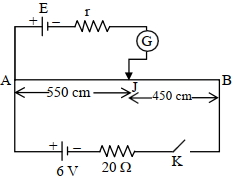
- In the given figure, there is a circuit of potentiometer of length \(A B=10 \,{m}\). The resistance per unit length is \(0.1 \,\Omega\) per \({cm}\). Across \({AB}\), a battery of emf \({E}\) and internal resistance ' \({r}^{\prime}\) is connected. The maximum value of emf measured by this potentiometer is : (In \(V\))
 JEE Mains 2021 Medium
 - The current in an inductor is given by \(\mathrm{I}=(3 \mathrm{t}+8)\) where \(t\) is in second. The magnitude of induced emf produced in the inductor is \(12 \mathrm{mV}\). The selfinductance of the inductor _______ \(\mathrm{mH}\).JEE Mains 2024 Hard
- Given below are two statements. One is labelled as Assertion (A) and the other is labelled as Reason (R).
Assertion (A) : In Young's double slit experiment, the fringes produced by red light are closer as compared to those produced by blue light.
Reason (R): The fringe width is directly proportional to the wavelength of light.
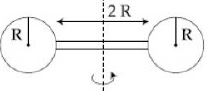
In the light of the above statements, choose the correct answer from the options given below.JEE Mains 2025 Easy - Two identical spherical balls of mass \(M\) and radius \(R\) each are stuck on two ends of a rod of length \(2R\) and mass \(M\) (see figure). The moment of inertia of the system about the axis passing perpendicularly through the centre of the rod is
 JEE Mains 2019 Hard
 - Three infinitely long wires with linear charge density \(\lambda\) are placed along the \(x-a x i s, y\)-axis and \(z-\) axis respectively. Which of the following denotes an equipotential surface?JEE Mains 2025 Hard
More PYQs from JEE Mains
- A solid cylinder having radius \(R\) and length \(L\) is slipping on a rough horizontal plane. At time \(t=0\) the cylinder has a translational velocity \(v_0=49\) m/s, perpendicular to its axis and a rotational velocity \(v_0/4R\) about the centre. The time taken by the cylinder to start rolling is ________ seconds. (coefficient of kinetic friction \(\mu_K=0.25\) and \(g=9.8\) m/s\(^2\))JEE Mains 2026 Hard
- The product of all solutions of the equation \(\mathrm{e}^{5\left(\log _{\mathrm{e}} x\right)^2+3}=x^8, x\gt0\), is :JEE Mains 2025 Medium
- Let the plane \(P : 8 x +\alpha_1 y +\alpha_2 z +12=0\) be parallel to the line \(L : \frac{ x +2}{2}=\frac{ y -3}{3}=\frac{ z +4}{5}\). If the intercept of \(P\) on the \(y\)-axis is 1 , then the distance between \(P\) and \(L\) is :JEE Mains 2023 Hard
- For a triangle \(ABC\), the value of \(\cos 2 A +\cos 2 B +\cos 2 C\) is least. If its inradius is \(3\) and incentre is \(M\), then which of the following is NOT correct?JEE Mains 2023 Hard
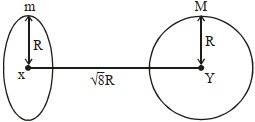
- Find the gravitational force of attraction between the ring and sphere as shown in the diagram, where the plane of the ring is perpendicular to the line joining the centres. If \(\sqrt{8}\, R\) is the distance between the centres of a \(mng\) (of mass ' \(m\) ) and a sphere (mass ' \(M\) ) where both have equal radius \('R'.\)
 JEE Mains 2021 Hard
 - Let the system of linear equations \(-x+2 y-9 z=7\) \(-x+3 y+7 z=9\) \(-2 x+y+5 z=8\) \(-3 x+y+13 z=\lambda\) has a unique solution \(x =\alpha, y =\beta, z =\gamma\). Then the distance of the point \((\alpha, \beta, \gamma)\) from the plane \(2 x-2 y+z=\lambda\) isJEE Mains 2023 Hard