


JEE Mains · Physics · STD 12 - Moving charges and magnetism
- JEE Mains 2026
- Hard
- MCQ
A current carrying circular loop of radius \(2\) cm with unit normal \(\hat{n} = \dfrac{\hat{k}+\hat{i}}{\sqrt{2}}\) is placed in a magnetic field, \(\vec{B} = B_0(3\hat{i}+2\hat{k})\). If \(B_0 = 4\times 10^{-3}\) T and current \(I=100\sqrt{2}\) A, the torque experienced by the loop is ________ Wb·A. (\(\pi=3.14\))
Pick an option to check your answer.
Answer & Solution
Correct Answer
(D) \(5024\times 10^{-7}\,\hat{j}\)
Step-by-step Solution
Detailed explanation
Explanation:
1. Magnetic Dipole Moment (\( \vec{M} \)): The magnetic dipole moment of a current-carrying loop is given by the formula:
\( \vec{M} = I \cdot A \cdot \hat{n} \)
2. Area of the Circular Loop (\( A \)):
Given radius, \( r = 2\text{ cm} = 2 \times 10^{-2}\text{ m} \)
\( A = \pi r^2 = \pi \left(2 \times 10^{-2}\text{ m}\right)^2 = 4\pi \times 10^{-4}\text{ m}^2 \)
3. Calculating \( \vec{M} \):
Substitute \( I = 100\sqrt{2}\text{ A} \) and \( \hat{n} = \frac{\hat{i} + \hat{k}}{\sqrt{2}} \):
\( \vec{M} = \left(100\sqrt{2}\right) \times \left(4\pi \times 10^{-4}\right) \times \left(\frac{\hat{i} + \hat{k}}{\sqrt{2}}\right) \)
\( \vec{M} = 4\pi \times 10^{-2}(\hat{i} + \hat{k})\text{ A}\cdot\text{m}^2 \)
4. Torque (\( \vec{\tau} \)): The torque experienced by a magnetic dipole in a uniform magnetic field is given by:
\( \vec{\tau} = \vec{M} \times \vec{B} \)
Given, \( \vec{B} = 4 \times 10^{-3}(3\hat{i} + 2\hat{k})\text{ T} \)
Substituting the values:
\( \vec{\tau} = \left[4\pi \times 10^{-2}(\hat{i} + \hat{k})\right] \times \left[4 \times 10^{-3}(3\hat{i} + 2\hat{k})\right] \)
\( \vec{\tau} = 16\pi \times 10^{-5} \left[ (\hat{i} + \hat{k}) \times (3\hat{i} + 2\hat{k}) \right] \)
5. Evaluating Cross Product:
Using the cross product rules (\( \hat{i}\times\hat{i}=0 \), \( \hat{i}\times\hat{k}=-\hat{j} \), \( \hat{k}\times\hat{i}=\hat{j} \), \( \hat{k}\times\hat{k}=0 \)):
\( (\hat{i} + \hat{k}) \times (3\hat{i} + 2\hat{k}) = 2(\hat{i} \times \hat{k}) + 3(\hat{k} \times \hat{i}) = -2\hat{j} + 3\hat{j} = \hat{j} \)
Therefore:
\( \vec{\tau} = 16\pi \times 10^{-5}\hat{j} \)
6. Substituting \( \pi = 3.14 \):
\( \vec{\tau} = 16 \times 3.14 \times 10^{-5}\hat{j} = 50.24 \times 10^{-5}\hat{j} = 5024 \times 10^{-7}\hat{j}\text{ Wb}\cdot\text{A} \)
Hence, Option D is the correct choice.
More questions from Physics
- Given below are two statements : one is labelled as Assertion A and the other is labelled as Reason \(\mathrm{R}\) Assertion A : Work done in moving a test charge between two points inside a uniformly charged spherical shell is zero, no matter which path is chosen.
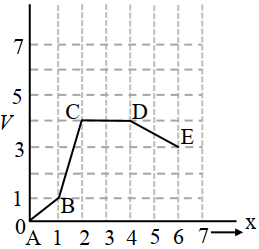
Reason \(\mathrm{R}\) : Electrostatic potential inside a uniformly charged spherical shell is constant and is same as that on the surface of the shell. In the light of the above statements, choose the correct answer from the options given belowJEE Mains 2025 Medium - Potential energy (V) versus distance (x) is given by the graph, Rank various regions as per the magnitudes of the force (F) acting on a particle from high to low.
 JEE Mains 2026 Hard
- A ball of mass \(160\, g\) is thrown up at an angle of \(60^o\) to the horizontal at a speed of \(10\, m\,s^{-1}\) . The angular momentum of the ball at the highest point of the trajectcry with respect to the point from which the ball is thrown is nearly ........ \(kg\, m^2/s\) \((g\, = 10\, m\,s^{-2})\)JEE Mains 2014 Hard
- A printed page is pressed by a glass of water. The refractive index of the glass and water is \(1.5\) and \(1.33\), respectively. If the thickness of the bottom of glass is \(1\, cm\) and depth of water is \(5\, cm\) , how much the page will appear to be shifted if viewed from the top ?JEE Mains 2013 Medium
- The ratio of intensities at two points \(P\) and \(Q\) on the screen in a Young's double slit experiment where phase difference between two wave of same amplitude are \(\pi / 3\) and \(\pi / 2\), respectively areJEE Mains 2023 Medium
- The value of the acceleration due to gravity is \(g _{1}\) at a height \(h =\frac{ R }{2}( R =\) radius of the earth) from the surface of the earth. It is again equal to \(g _{1}\) at a depth \(d\) below the surface of the earth. The ratio \(\left(\frac{ d }{ R }\right)\) equalsJEE Mains 2020 Hard
More PYQs from JEE Mains
- A disc of mass \(1\,kg\) and radius \(R\) is free of rotate about a horizontal axis passing through its centre and perpendicular to the plane of disc. A body of same mass as that of disc is fixed at the highest point of the disc. Now the system is released, when the body comes to the lowest position, its angular speed will be \(4 \sqrt{\frac{x}{3 R}}\) rad s\(^{-1}\) where \(x=\) \(\left( g =10\,ms ^{-2}\right)\)JEE Mains 2022 Hard
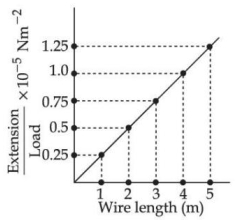
- In an experiment to determine the Young's modulus, steel wires of five different lengths \((1,2,3,4\) and \(5\,m )\) but of same cross section \(\left(2\,mm ^{2}\right)\) were taken and curves between extension and load were obtained. The slope (extension/load) of the curves were plotted with the wire length and the following graph is obtained. If the Young's modulus of given steel wires is \(x \times 10^{11}\,Nm ^{-2}\), then the value of \(x\) is
 JEE Mains 2022 Hard
- Match List \(I\) with List \(II.\)
Choose the correct answer from the options given below:List \(I\) List \(II\) \((a)\) Rectifier \((i)\) Used either for stepping up or stepping down the \(a.c.\) voltage \((b)\) Stabilizer \((ii)\) Used to convert \(a.c.\) voltage into \(d.c.\) voltage \((c)\) Transformer \((iii)\) Used to remove any ripple in the rectified output voltage \((d)\) Filter \((iv)\) Used for constant output voltage even when the input voltage or load current change JEE Mains 2021 Medium - A small bar magnet placed with its axis at \(30^{\circ}\) with an external field of \(0.06\, T\) experiences a torque of \(0.018\, Nm\). The minimum work required to rotate it from its stable to unstable equilibrium position isJEE Mains 2020 Hard
- A wooden block of mass \(5 \mathrm{~kg}\) rests on soft horizontal floor. When an iron cylinder of mass \(25\) \(\mathrm{kg}\) is placed on the top of the block, the floor yields and the block and the cylinder together go down with an acceleration of \(0.1 \mathrm{~ms}^{-2}\). The action force of the system on the floor is equal to _______.JEE Mains 2024 Hard