


- JEE Mains 2021
- Medium
- Numerical
The equilibrium constant \(K_{c}\) at \(298\, \mathrm{~K}\) for the reaction \(\mathrm{A}+\mathrm{B} \rightleftharpoons \mathrm{C}+\mathrm{D}\) is \(100 .\) Starting with an equimolar solution with concentrations of \(\mathrm{A}, \mathrm{B}, \mathrm{C}\) and \(\mathrm{D}\) all equal to \(1\, \mathrm{M}\), the equilibrium concentration of \(D\) is \(.......\times 10^{-2}\) M. (Nearest integer)
Answer & Solution
(B) \(182\)
Step-by-step Solution
Detailed explanation
\(1 \mathrm{M}\quad 1 \mathrm{M} \quad 1 \mathrm{M} \quad1 \mathrm{M}\)
First check direction of reversible reaction.
Since \(\mathrm{Q}_{\mathrm{c}}=\frac{[\mathrm{C}][\mathrm{D}]}{[\mathrm{A}][\mathrm{B}]}=1<\mathrm{K}_{\mathrm{eq} .} \Rightarrow\) reaction will move in forward direction to attain equilibrium state.
\(\Rightarrow \mathrm{A}+\mathrm{B} \rightleftharpoons \mathrm{C}+\mathrm{D}: \mathrm{K}_{\mathrm{eq}}=100\)
\(to \quad 1\quad 1\quad\quad 1\quad 1\)
\(\mathrm{t}_{\text {eq. }} \, 1-\mathrm{x} \, 1-\mathrm{x} \, 1+\mathrm{x} \, 1+\mathrm{x}\)
Now \(: \mathrm{K}_{\mathrm{eq}}=100=\frac{(1+\mathrm{x})(1+\mathrm{x})}{(1-\mathrm{x})(1-\mathrm{x})}\)
\(\Rightarrow 100=\left(\frac{1+x}{1-x}\right)^{2}\)
\((i)\) \(10=\left(\frac{1+\mathrm{x}}{1-\mathrm{x}}\right)\)
\(\Rightarrow 10-10 \mathrm{x}=1+\mathrm{x}\)
\(\Rightarrow 11 \mathrm{x}=9\)
\(\Rightarrow \mathrm{x}=\frac{9}{11}\)
\((ii)\) \(-10=\frac{1+\mathrm{x}}{1-\mathrm{x}}\)
\(\Rightarrow-10+10 \mathrm{x}=1+\mathrm{x}\)
\(\Rightarrow-9 x=-11\)
\(\Rightarrow x=\frac{11}{9}\)
\(\rightarrow\) \('x'\) cannot be more than one, therefore not valid. therefore equation concretion of \((D)=1+x\)
\(=1+\frac{9}{11}=\frac{20}{11}\)
\(=1.8181=181.81 \times 10^{-2}\)
\(\simeq 182 \times 10^{-2}\)
More questions from Chemistry
- The correct decreasing order of energy, for the orbitals having, following set of quantum numbers. \((A)\) \(n=3,1=0, m=0\) \((B)\) \(n=4,1=0, m=0\) \((C)\) \(n =3,1=1, m =0\) \((D)\) \(n=3,1=2, m=1\)JEE Mains 2022 Medium
- The increasing order of the reactivity of the following with \(LiAlH_4\) is
 JEE Mains 2019 Hard
- Reaction \(\mathrm{A}(\mathrm{g}) \rightarrow 2 \mathrm{~B}(\mathrm{~g})+\mathrm{C}(\mathrm{g})\) is a first order reaction. It was started with pure A
t / min Pressure of system
at time t / mm Hg10 160 ∞ 240
Which of the following option is incorrect?JEE Mains 2025 Easy - What is the number of unpaired electron(s) in the highest occupied molecular orbital of the following species : \(N _2: N _2^{+} ; O _2 ; O _2^{+}\)?JEE Mains 2023 Medium
- Given below are the oxides: \(Na _{2} O , As _{2} O _{3}, N _{2} O , NO\) and \(Cl _{2} O _{7}\) Number of amphoteric oxides is ..... .JEE Mains 2022 Easy
- The major product of the following reaction is: \(CH _{3} CH _{2} CH = CH _{2}\) \(\xrightarrow[{Rh\,\,catalyst}]{{{H_2}/CO}}\)JEE Mains 2021 Medium
More PYQs from JEE Mains
- Two projectiles are thrown with same initial velocity making an angle of \(45^{\circ}\) and \(30^{\circ}\) with the horizontal respectively. The ratio of their respective ranges will be.JEE Mains 2022 Easy
- If a reaction follows the Arrhenius equation, the plot \(\ln k\) vs \(1/(RT)\) gives straight line with a gradient \((-y)\) \(unit\). The energy required to activate the reactant isJEE Mains 2019 Medium
- Two long current carrying conductors are placed parallel to each other at a distance of \(8 \,cm\) between them. The magnitude of magnetic field produced at mid-point between the two conductors due to current flowing in them is \(300 \,\mu T\). The equal current flowing in the two conductors is ...............JEE Mains 2022 Medium
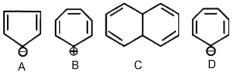
- Which of the following structures are aromatic in nature?
 JEE Mains 2022 Easy
- \(\mathrm{r}=\mathrm{k}[\mathrm{A}]\) for a reaction, \(50 \%\) of \(\mathrm{A}\) is decomposed in\(120\) minutes. The time taken for \(90 \%\) decomposition of \(\mathrm{A}\) is _______ minutes.JEE Mains 2024 Hard
- \(2 \mathrm{SO}_{2}(\mathrm{~g})+\mathrm{O}_{2}(\mathrm{~g}) \rightarrow 2 \mathrm{SO}_{3}(\mathrm{~g})\) The above reaction is carried out in a vessel starting with partial pressure \(\mathrm{P}_{\mathrm{SO}_{2}}=250\, \mathrm{~m}\) \(bar,\) \(\mathrm{P}_{0_{2}}=750 \,\mathrm{~m}\) \(bar\) and \(\mathrm{P}_{\mathrm{SO}_{3}}=0 \,\mathrm{bar}\). When the reaction is complete, the total pressure in the reaction vessel is \(.....\mathrm{m}\) \(bar.\) (Round off to the Nearest Integer).JEE Mains 2021 Medium