


JEE Mains · Chemistry · STD 11 - Thermodynamics and thermochemistry
- JEE Mains 2021
- Medium
- Numerical
The ionization enthalpy of \(Na ^{+}\) formation from \(Na _{( g )}\) is \(495.8\, kJ\, mol ^{-1},\) while the electron gain enthalpy of \(Br\) is \(-325.0\, kJ\, mol ^{-1}\). Given the lattice enthalpy of \(NaBr\) is \(-728.4\, kJ\, mol ^{-1}\). The energy for the formation of NaBr ionic solid is \((-)\) ........... \(\times 10^{-1} kJ \,mol ^{-1}\)
Pick an option to check your answer.
Answer & Solution
Correct Answer
(D) \(5576\)
Step-by-step Solution
Detailed explanation
\(\Delta H _{\text {formation }}= IE _{1}+\Delta Heg _{1}+ LE\)
\(=495.8+(-325)+(-728.4)\)
\(=-557.6\)
\(=-5576 \times 10^{-1} KJ / mol .\)
Note: The above calculation is not for \(\Delta H _{\text {formation }}\) but for \(\Delta H _{ Reaction}\)
But on the basis of given data it is the best ans.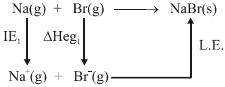
More questions from Chemistry
- Which of the following compounds will give silver mirror with ammoniacal silver nitrate?
(A) Formic acid
(B) Formaldehyde
(C) Benzaldehyde
(D) Acetone
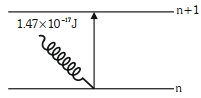
Choose the correct answer from the options given below :JEE Mains 2024 Medium - The electron in the \(n ^{\text {th }}\) orbit of \(Li ^{2+}\) is excited to \((n+1)\) orbit using the radiation of energy \(1.47 \times 10^{-17}\,J\) (as shown in the diagram). The value of \(n\) is \(....\).Given \(R_H=2.18 \times 10^{-18}\,J\)
 JEE Mains 2023 Medium
- The number of radial and angular nodes in \(4 d\) orbital are, respectively ........ .JEE Mains 2022 Easy
- Two \(5\) molal solutions are prepared by dissolving a non-electrolyte, non-volatile solute separately in the solvents \(X\) and \(Y\). The molecular weights of the solvents are \(M_X\) and \(M_Y\), respectively where \(M_X\, = \frac{3}{4} M_Y\). The relative lowering of vapour pressure of the solution in \(X\) is \(''m''\) times that of the solution in \(Y\). Given that the number of moles of solute is very small in comparison to that of solvent, the value of \(''m''\) isJEE Mains 2018 Hard
- Borazine, also known as inorganic benzene, can be prepared by the reaction of \(3-equivalents\) of " \(X\) " with \(6-equivalents\) of "\(Y\)"."\(X\)" and "\(Y\)", respectively are.JEE Mains 2022 Medium
- Among the following, the incorrect statement isJEE Mains 2018 Hard
More PYQs from JEE Mains
- Match the LIST-I with LIST-II
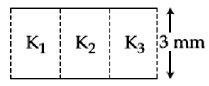
Choose the correct answer from the options given below:LIST-I LIST-II A. Pressure varies inversely with volume of an ideal gas I. Adiabatic process B. Heat absorbed goes partly to increase internal energy and partly to do work II. Isochoric process C. Heat is neither absorbed nor released by a system III. Isothermal process D. No work is done on or by a gas IV. Isobaric process JEE Mains 2025 Easy - A parallel plate capacitor is of area \(6\, cm^2\) and a separation \(3\, mm\). The gap is filled with three dielectric materials of equal thickness (see figure) with dielectric constants \(K_1 = 10, K_2 = 12\) and \(K_3 = 14\). The dielectric constant of a material which when fully inserted in above capacitor, gives same capacitance would be
 JEE Mains 2019 Hard
- The resistivity of a \(0.8\,M\) solution of an electrolyte is \(5 \times 10^{-3}\,\Omega\,cm\). Its molar conductivity is \(.....\times 10^4 \Omega^{-1}\,cm ^2\,mol ^{-1}\). (Nearest integer)JEE Mains 2023 Medium
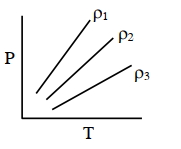
- \(P-T\) diagram of an ideal gas having three different densities \(\rho_1, \rho_2, \rho_3\) (in three different cases) is shown in the figure. Which of the following is correct?
 JEE Mains 2024 Hard
- A uniform chain of \(6\, m\) length is placed on a table such that a part of its length is hanging over the edge of the table. The system is at rest. The co-efficient of static friction between the chain and the surface of the table is \(0.5\), the maximum length of the chain hanging from the table is.......\(m.\)JEE Mains 2022 Medium
- Match the List \(-I\) (Phenomenon associated with electromagnetic radiation) with List \(-II\) (Part of electromagnetic spectrum) and select the correct code from the choices given below this lists
List \(I\) List \(II\) \(I\) Doublet of sodium \((A)\) Visible radiation \(II\) Wavelength corresponding to temperature associated with the isotropic radiation filling all space \((B)\) Microwave \(III\) Wavelength emitted by atomic hydrogen in interstellar space \((C)\) Short radio wave \(IV\) Wavelength of radiation arising from two close energy levels in hydrogen \((D)\) \(X-\) rays JEE Mains 2014 Medium