


JEE Mains · Chemistry · STD 11 - 6.1. Equilibrium - 1 (chemical Equilibrium)
The number of moles of \(\mathrm{NH}_{3}\), that must be added to \(2 \,\mathrm{~L}\) of \(0.80\, \mathrm{M}\, \mathrm{AgNO}_{3}\) in order to reduce the concentration of \(\mathrm{Ag}^{+}\)ions to \(5.0 \times 10^{-8}\, \mathrm{M}\left(\mathrm{K}_{\text {formation }}\right.\) for \(\left.\left[\mathrm{Ag}\left(\mathrm{NH}_{3}\right)_{2}\right]^{+}=1.0 \times 10^{8}\right)\) is ...... . (Nearest integer) [Assume no volume change on adding \(\mathrm{NH}_{3}\) ]
- A \(16\)
- B \(5\)
- C \(4\)
- D \(2\)
Answer & Solution
Correct Answer
(C) \(4\)
Step-by-step Solution
Detailed explanation
Let moles added \(=\mathrm{a}\) \(\mathrm{Ag}_{(\mathrm{ag} .)}^{+}+2 \mathrm{NH}_{3(\mathrm{ag} .)} \rightleftharpoons \mathrm{Ag}\left(\mathrm{NH}_{3}\right)_{2(\mathrm{aq} .)}^{+}\) \(t=0 \quad \quad 0.8 \quad\quad\quad \left(\frac{a}{2}\right)\)…
See the Complete Solution
Get step-by-step explanations for this and 2.5 Lakh+ more JEE, NEET & CET questions.
- Unlock all solutions
- Practice the full chapter
- Track accuracy across PYQs
4.8 rated on Google Play · 14,000+ reviews
More questions from Chemistry
- The difference between bond orders of \(\mathrm{CO}\) and \(\mathrm{NO}\) is \(\mathrm{NO}^{\oplus}\) is \(\frac{\mathrm{x}}{2}\) where \(\mathrm{x}=.....\) (Round off to the Nearest Integer)JEE Mains 2021 Medium
- The correct statement among the following is :JEE Mains 2026 Hard
- How many compounds among the following compounds show inductive, mesomeric as well as hyperconjugation effects?
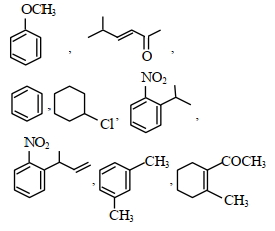 JEE Mains 2024 Medium
 - One mole of an ideal gas at \(350\,K\) is in a \(2.0\,L\) vessel of thermally conducting walls, which are in contact with the surroundings. It undergoes isothermal reversible expansion from \(2.0\,L\) to \(3.0\,L\) against a constant pressure of \(4\,atm\). The change in entropy of the surroundings \((\Delta S )\) is \(......\,J\,K ^{-1}\) (Nearest integer) Given : \(R =8.314\,J\,K ^{-1}\,Mol ^{-1}\).JEE Mains 2023 Medium
- For a chemical reaction \(A + B \rightarrow\) Product, the order is \(1\) with respect to \(A\) and \(B\).
What is the value of \(x\) and \(y ?\)Rate \(mol\,L^{-1}\,s^{-1}\) \([A]\) \(mol\,L^{-1}\) \([B]\) \(mol\,L^{-1}\) \(0.10\) \(20\) \(0.5\) \(0.40\) \(x\) \(0.5\) \(0.80\) \(40\) \(y\) JEE Mains 2023 Medium - Match List \(I\) and with List \(II\)
Choose the correct answer from the option below :List-\(I\) (Molecule) List-\(II\) (Shape) \((A)\) \(\mathrm{NH}_3\) \((I)\) Square pyramid \((B)\) \(\mathrm{BrF}_5\) \((II)\) Tetrahedral \((C)\) \(\mathrm{PCl}_5\) \((III)\) Trigonal pyramidal \((D)\) \(\mathrm{CH}_4\) \((IV)\) Trigonal bipyramidal JEE Mains 2024 Medium
More PYQs from JEE Mains
- Two lines \(\frac{{x - 3}}{1} = \frac{{y + 1}}{3} = \frac{{z - 6}}{{ - 1}}\) and \(\frac{{x + 5}}{7} = \frac{{y - 2}}{{ - 6}} = \frac{{z - 3}}{4}\) intersect at the point \(R\). The reflection of \(R\) in the \(xy -\) plane has coordinatesJEE Mains 2019 Hard
- The equivalent resistance between \(A\) and \(B\) of the network shown in figure
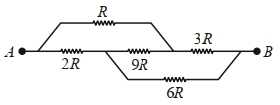 JEE Mains 2023 Medium
 - Let a line \(L_1\) pass through the origin and be perpendicular to the lines
\(L_2: \vec{r} = (3+t)\hat{i} + (2t-1)\hat{j} + (2t+4)\hat{k}\) and
\(L_3: \vec{r} = (3+2s)\hat{i} + (3+2s)\hat{j} + (2+s)\hat{k}\), \(t, s \in \mathbb{R}\).
If \((a, b, c)\), \(a \in \mathbb{Z}\), is the point on \(L_3\) at a distance of \(\sqrt{17}\) from the point of intersection of \(L_1\) and \(L_2\), then \((a+b+c)^2\) is equal to ________.JEE Mains 2026 Hard - \(\lim\limits _{x \rightarrow 0} \frac{\cos (\sin x)-\cos x}{x^{4}}\) is equal to :JEE Mains 2022 Hard
- Consider the elements N, P, O, S, Cl and F. The number of valence electrons present in the elements with most and least metallic character from the above list is respectively.JEE Mains 2026 Easy
- A \(70\, kg\) man leaps vertically into the air from a crouching position. To take the leap the man pushes the ground with a constant force \(F\) to raise himself The center of gravity rises by \(0.5\, m\) before he leaps. After the leap the \(c.g.\) rises by another \(1\, m\). The maximum power delivered by the muscles is : (Take \(g\, = 10\, ms^{-2}\))JEE Mains 2013 Hard