


ऊष्मागतिकी के सभी प्रश्न
नए पहले194 में से 151–194 प्रश्न
-
- (A) \(2.85\)
- (B) \(11.4\)
- (C) \(5.7\)
- (D) \(22.8\)
उत्तर और हल देखें
सही उत्तर: (D)
\(\Delta {C_P} = \frac{{\Delta {H_2} - \Delta {H_1}}}{{{T_2} - {T_1}}}\) -
- (A) \(7.90\)
- (B) \(2.64\)
- (C) \(8.49\)
- (D) \(9.26\)
उत्तर और हल देखें
सही उत्तर: (D)
\(\mathop {\mathop {{H_2}O(s)}\limits_{1\,kg} }\limits_{at\,273\,K} \to \mathop {\mathop {{H_2}O(l)}\limits_{1\,kg} }\limits_{at\,273\,K} \to \mathop {\mathop {{H_2}O(l)}\limits_{1\,kg} }\limits_{at\,373\,K} \to \mathop {\mathop {{H_2}O(g)}\limits_{} }\limits_{at\,373\,K} \to \mathop {\mathop {{H_2}O(g)}\limits_{} }\limits_{at\,383\,K} \)\(\Delta S = \Delta {S_1} + \Delta {S_2} + \Delta {S_3} + \Delta {S_4}\)
\( = \frac{{334}}{{273}} + 4.2\,\ln \,\frac{{373}}{{273}} + \frac{{2491}}{{373}} + 2\ln \,\frac{{383}}{{373}}\)
\( = 9.267\,kJ\,K{g^{ - 1}}\,{Kg^{ - 1}}\)
-
- (A) \(\frac{3}{2}K\)
- (B) \(2\, K\)
- (C) \(\frac{2}{3}K\)
- (D) \(1\, K\)
उत्तर और हल देखें
सही उत्तर: (C)
\(q = P\Delta V\)\(q = 16\)
\({C_P} = 24\)
\({C_P} = \frac{{qP}}{{\Delta T}}\)
\(\Delta T = \frac{{16}}{{24}}\,K = \frac{2}{3}\,K\)
-
- (A) साम्य स्थिरांक बड़ा होना बताता है कि अभिक्रिया पूर्णता को जा रही है और उत्प्रेरक की आवश्यकता नहीं है।
- (B) जब दाब बढ़ता है तो साम्य अग्र दिशा में विस्थापित होती है।
- (C) जब ताप बढ़ता है तो साम्य स्थिरांक घटता है।
- (D) स्थिर आयतन पर, निष्क्रिय गैस के मिलाने पर साम्य स्थिरांक प्रभावित नहीं होगा।
उत्तर और हल देखें
सही उत्तर: (A)
In option \((B)\,-\,\Delta n_g\) is \(-ve\) therefore increase in pressure will bring reaction in forward direction. In option \((C)-\) as the reaction is exothermic therefore increase in temperature will decrease the equilibrium constant. In option \((D)-\) Equilibrium constant changes only with temperature. Hence, option \((B), (C)\) and \((D)\) are correct therefore option \((1)\) is incorrect choice. -
- (A) \(2040.5\)
- (B) \(1890\)
- (C) \(2480.3\)
- (D) \(2380.5\)
उत्तर और हल देखें
सही उत्तर: (C)
In order to be spontaneous \(\Delta G^o\) should be \(-ve\)\(\Delta {G^o} = \Delta {H^o} - T\Delta {S^o}\)
\(0 = 491.1 \times {10^3} - T \times 198\)
\(T = \frac{{491100}}{{198}} = 2480\)
If temp is above \(2480\,K\), the reaction will be spontaneous.
-
- (A) \(x = y + z\)
- (B) \(z = x + y\)
- (C) \(y = 2z -x\)
- (D) \(x = y -z\)
उत्तर और हल देखें
सही उत्तर: (A)
\((ii) + (iii) = (i)\)\(Y + z = x\)
- 157. एक आदर्श गैस को स्थिर बाह्य दाब \(1\) बार के विरुद्ध \(1 \,L\) से \(10 \,L\) तक प्रसारित होने दिया जाता है। किया गया कार्य ( \(kJ\) में) होगा 2019 मध्यम
- (A) \(-8\)
- (B) \(-9\)
- (C) \(-2\)
- (D) \(+10\)
उत्तर और हल देखें
सही उत्तर: (B)
\(W = - {P_{ext}}\,\left( {{V_2} - {V_1}} \right)\) -
- (A) \({C_p}\,\ln \,\left[ {\frac{{{{({T_1} + {T_2})}^2}}}{{4{T_1}{T_2}}}} \right]\)
- (B) \(2{C_p}\,\ln \,\left[ {\frac{{{{({T_1} + {T_2})}^{\frac{1}{2}}}}}{{{T_1}{T_2}}}} \right]\)
- (C) \(2{C_p}\,\ln \,\left[ {\frac{{({T_1} + {T_2})}}{{4{T_1}{T_2}}}} \right]\)
- (D) \(2{C_p}\,\ln \,\left[ {\frac{{({T_1} + {T_2})}}{{2{T_1}{T_2}}}} \right]\)
उत्तर और हल देखें
सही उत्तर: (A)
\(\Delta {S_{Total}}\, = \,{C_p}\ln \frac{{({T_1} + {T_2})}}{{2{T_1}}} + {C_p}\ln \frac{{({T_1} + {T_2})}}{{2{T_2}}}\) -
- (A) \(20\)
- (B) \(12\)
- (C) \(5\)
- (D) \(4\)
उत्तर और हल देखें
सही उत्तर: (C)
\(\Delta S = \frac{{\Delta H}}{T}\) -
- (A) \(\Delta H < 0\) तथा \(\Delta S < 0\)
- (B) \(\Delta H < 0\) तथा \(\Delta S > 0\)
- (C) \(\Delta H > 0\) तथा \(\Delta S > 0\)
- (D) \(\Delta H > 0\) तथा \(\Delta S < 0\)
उत्तर और हल देखें
सही उत्तर: (B)
At constant \(P\) and \(T\) and for the process to be spontaneous we should have \(\Delta G = -ve\) and we know that \(\Delta G = \Delta H - T\Delta S\)If \(\Delta H = -ve\) and \(\Delta S = +ve\) then at all the temperature the process will be spontaneous.
-
- (A) \(8\)
- (B) \(12\)
- (C) \(-12\)
- (D) \(-8\)
उत्तर और हल देखें
सही उत्तर: (A)
Work done on system \(= +10\, kJ\)
Heat escaped \(= -2\,kJ\)
\(\Delta U = q + w\)
\(= 10 -2 = 8\, kJ\) -
- (A) \(-412.8\)
- (B) \(-384.0\)
- (C) \(1920\)
- (D) \(206.4\)
उत्तर और हल देखें
सही उत्तर: (A)
\(\Delta G\, = \, - \,nFE_{cell}\, = \, - \,2\) \( \times \,96500\, \times \,2\,\, = \, - \,386\,\,kJ\)\(\Delta S=nF\left( \frac{dE}{dT} \right)=2\times 96500\,\,\times (-5\times {{10}^{-4}}J{{/}^{o}}C)=-96.5\,kJ\)
at \(298\,K\)
\(T\Delta S=298\times \,(-96.5\,\,J)\,=\,-\,28.8\,kJ\)
at constant \(T\,(=\,248\,K)\) and pressure
\(\Delta G\, = \,\,\Delta H\, - \,\,T\Delta S{\mkern 1mu} \)
\(\Delta H\, = \,\,\Delta G\, + \,\,T\Delta S{\mkern 1mu} \)
\(=-386-28.8=-412.8\,kJ\)
-
- (A) \(-4\,RT\)
- (B) \(-3\,RT\)
- (C) \(3\,RT\)
- (D) \(4\,RT\)
उत्तर और हल देखें
सही उत्तर: (A)
\({C_7}{H_{16}}(l) + 11{O_2}(g) \to 7C{O_2}(g) + 8{H_2}O(l)\)\(\Delta {n_g} = {n_p} - {n_r}\)
\( = 7 - 11 = - 4\)
\(\because \,\Delta H = \Delta U + \Delta {n_g}RT\)
\(\therefore \,\Delta H - \Delta U = - 4\,RT\)
-
- (A) \(\Delta G^o < 0, K > 1\)
- (B) \(\Delta G^o < 0, K < 1\)
- (C) \(\Delta G^o = 0, K = 1\)
- (D) \(\Delta G^o > 0, K < 1\)
उत्तर और हल देखें
सही उत्तर: (B)
\(\Delta G^o = -2.303\, RT\, log\, K_{eq}\) -
- (A) समायतनिक प्रक्रम : \(\Delta U = q\)
- (B) रुद्धोष्म प्रक्रम : \(\Delta U =- W\)
- (C) चक्रीय प्रक्रम : \(q=-w\)
- (D) समतापी प्रक्रम : \(q=-w\)
उत्तर और हल देखें
सही उत्तर: (B)
According to the first law of thermodynamics \(q=\Delta U-w\)For cyclic process : \(\Delta U = 0 \Rightarrow q = - w\)
For isothermal process : \(\Delta U = 0 \Rightarrow q = - w\)
For adiabatic process : \(q = 0 \Rightarrow \Delta U = W\)
For isochoric process : \(w = 0 \Rightarrow \Delta U = q\)
- 166. निम्न में से कौनसे पथ फलन है \((a)\,\,q + w\) \( (b)\,\,q\) \((c)\,\,w\) \( (d)\,\,H -TS\) 2019 कठिन
- (A) \((b)\) तथा \((c)\)
- (B) \((b), (c)\) तथा \((d)\)
- (C) \((a), (b)\) तथा \((c)\)
- (D) \((a)\) तथा \((d)\)
उत्तर और हल देखें
सही उत्तर: (A)
\(\Delta U = q + w\)\(\Delta G = \Delta H - T\Delta S\)
-
- (A) ऊष्माशोषी यदि \(A >0\)
- (B) ऊष्माक्षेपी यदि \(A >0\) तथा \(B <0\)
- (C) ऊष्माशोषी यदि \(A <0\) तथा \(B >0\)
- (D) ऊष्माक्षेपी यदि \(B <0\)
उत्तर और हल देखें
सही उत्तर: (A)
\(\Delta {G^o} = \Delta {H^o} - T\Delta {S^o}\)\(\Delta {G^o} = A - BT\)
In endothermic reaction \(\Delta H = + ve\). Hence, \(A = +ve\)
-
- (A) \(Y\) if \(T = 300\,K\)
- (B) \(Y\) if \(T = 280\,K\)
- (C) \(X\) if \(T = 350\,K\)
- (D) \(X\) if \(T = 315\,K\)
उत्तर और हल देखें
सही उत्तर: (D)
\(\Delta {G^o} = (120 - \frac{3}{8}\,T) = 0\)Then \(T = 320\,K\)
Hence \(T > 320\,K\,Y\) formed
\(T < 320\,K\,X\) formed
-
- (A) \(CaSO _{4}( s )\) का \(CaO ( s )\) तथा \(SO _{3}( g )\) में वियोजन
- (B) शुष्क बर्फ का ऊर्ध्वपातन
- (C) आयोडीन का जल में विलयन
- (D) \(N _{2}\) तथा \(H _{2}\) से अमोनिया का संश्लेषण
उत्तर और हल देखें
सही उत्तर: (D)
\(CaS{O_4}(s) \to CaO(s) + S{O_3}(g)\)\(C{O_2}(s) \to C{O_2}(g)\)
\({I_2} \to {I_2}(aq)\)
\({N_2}(g) + 3{H_2}(g) \to 2N{H_3}(g)\)
\({N_2}(g) + 3{H_2} \leftrightarrow 2N{H_3}(g)\)
\(\Delta S = 2\Delta {S_{N{H_3}}} - [\Delta {S_{{N_2}}} + 3\Delta {S_{{H_2}}}]\)
There is decrease in number of moles of \(NH_3\) entropy is decreasing.
-
- (A) \(13\)
- (B) \(62\)
- (C) \(16\)
- (D) \(21\)
उत्तर और हल देखें
सही उत्तर: (B)
\(\Delta H = n\int\limits_{{T_1}}^{{T_2}} {{C_{p.m}}dT = 3 \times \int\limits_{300}^{1000} {(23 + 0.01\,T)} } dT\)\( = 3[23(1000 - 300)] + \frac{{0.01}}{2}[{(1000)^2} - {(300)^2}]\)
\( = 61950\,J \approx 62\,kJ\)
-
- (A) \( - 5\)
- (B) \( + 5\)
- (C) \( 18\)
- (D) \( -18\)
उत्तर और हल देखें
सही उत्तर: (B)
\(\Delta {U_{AB}} = {q_{AB}} + {W_{AB}} = 2 + ( - 5) = - 3\,kJ/mol\)\(\Delta {U_{BC}} = - 5\,kJ/mol\)
For cyclic procrss, \(\Delta U=0\)
\(\Delta {U_{AB}} + \Delta {U_{BC}} + \Delta {U_{CA}} = 0\)
\(\Delta {U_{CA}} = - \Delta {U_{AB}} - \Delta {U_{BC}}\)
\(\Delta {U_{CA}} = - ( - 3) - ( - 5) = 8\,kJ/mol\)
\(\Delta {U_{CA}} = {q_{CA}} + {W_{CA}}\)
\(8 = {q_{CA}} + 3\)
\({q_{CA}} = + 5\,kJ/mol\)
Heat absorbed has positive sign.
-
- (A) \({N_2}(g) + 3{H_2}(g) \to 2N{H_3}(g)\)
- (B) \(2HI(g) \to H_2(g) + I_2(g)\)
- (C) \(2SO_2 (g) + O_2 (g) \to 2SO_3 (g)\)
- (D) \(2NO_2 (g) \to N_2O_4 (g)\)
उत्तर और हल देखें
सही उत्तर: (B)
\(\Delta H = \Delta U + \Delta {n_g}RT\)\(2HI(g) \to {H_2}(g) + {I_2}(g);\Delta {n_g} = (1 + 1) - 2 = 0\)
\(\therefore \,\Delta H = \Delta U + 0\)
-
- (A) \(C\) (हीरा) \(\to\) \(C\) (ग्रेफाइट)
- (B) \(N_2(g,\,1\,atm) \to N_2(g,\,5\,atm)\)
- (C) \(N_2(g,\,273\,K) \to N_2(g,\,300\,K)\)
- (D) \(H_2(g) \to 2H(g)\)
उत्तर और हल देखें
सही उत्तर: (B)
\((a)\) When diamond is converted into graphite when it is heated to \(1500\,^oC\) and entropy is increased so \(\Delta S > 0\)
\((b)\) When pressure increases then molecules of gas will come closer and intermolecular distance decreases so entropy will also decrease and \(\Delta S < 0\)
\((c)\) When we increase the temperature of a gas then random ness is increased due to kinetic energy gained by molecules. So, \(\Delta S > 0\)
\((d)\) \(H_2\) molecule is converted into atoms, the no. of particles increases . Thus entropy will increase. So, \(\Delta S > 0\) -
- (A) \(5.44\)
- (B) \(5.81\)
- (C) \(6.56\)
- (D) \(6\)
उत्तर और हल देखें
सही उत्तर: (C)
In order to calculate the enthalpy change for \(H_2O\) at \(5\,^oC\) to ice at \(-\,5\,^oC\) , we need to calculated the enthalpy change of all the transformation involved in the process.\((a)\) Energy change of \(1\,mol\), \(H_2O\,(l)\), at \(5\,^oC\)
\(\to \,1\,mol\), \(H_2O\,(l)\) , \(0\,^oC\)
\((b)\) Energy change of \(1\,mol\), \(H_2O\,(l)\), at \(0\,^oC\)
\(\to \,1\,mol\), \(H_2O\,(s)\) (ice) , \(0\,^oC\)
\((c)\) Energy change of \(1\,mol\), Ice \((s)\), at \(0\,^oC\)
\(\to \,1\,mol\), Ice \((s)\) , \(-5\,^oC\)
Total \(\Delta H\)
\( = \,{C_P}\,[{H_2}O\,(l)]\,\,\Delta T\,\, + \,\Delta H\) freezing \( + \,\,{C_P}\,[{H_2}O\,(s)]\,\,\Delta T\)
\( = \,(75.3\,\,J\,\,mo{l^{ - 1}}\,{K^{ - 1}})\,( - 5)\,K\, + ( - \,6\, \times \,{10^3}\,\,J\,mo{l^{ - 1}}\,{K^{ - 1}})\) \(+ \,(36.8\,\,J\,mo{l^{ - 1}}\,{K^{ - 1}})\,( - 5)\,K\)
\(\Delta H\,\, = \,\, - \,6.56\,\,kJ\,mo{l^{ - 1}}\) (exothermic process)
So, \(\Delta H\,\, = \,\,6.56\,\,kJ\,mo{l^{ - 1}}\)
-
- (A) \(+ 74.8\)
- (B) \(+ 144.0\)
- (C) \(- 74.8\)
- (D) \(- 144.0\)
उत्तर और हल देखें
सही उत्तर: (C)
\(C(graphite) +\mathrm{O}_{2}(\mathrm{g}) \rightarrow \mathrm{CO}_{2}(\mathrm{g})\) \(\Delta_{r} H^{\circ}=-393.55\,\mathrm{kJ}\, \mathrm{mol}^{-1}\)\(\mathrm{H}_{2}(\mathrm{g})+\frac{1}{2} \mathrm{O}_{2}(\mathrm{g}) \rightarrow \mathrm{H}_{2} \mathrm{O}(\mathrm{l}) ; \)\(\quad \Delta_{r} H^{\circ}=-285.8\, \mathrm{kJ}\, \mathrm{mol}^{-1}\)
\(\mathrm{CO}_{2}(\mathrm{g})+2 \mathrm{H}_{2} \mathrm{O}(\mathrm{l}) \rightarrow \mathrm{CH}_{4}(\mathrm{g})+2 \mathrm{O}_{2}(\mathrm{g}) ;\)\( \Delta_{r} H^{\circ}=+890.3\,\mathrm{kJ}\,\mathrm{mol}^{-1}\)
\(C(graphite) +2 \mathrm{H}_{2}(\mathrm{g}) \rightarrow \mathrm{CH}_{4}(\mathrm{g}) ; \)\(\quad \Delta_{r} H^{\circ}=?\)
Now, Eq. \((4)= \) Eq. \((1)+2 \times\) Eq. \((2)+\) Eq. \(( 3)\)
\(\Delta_{r} H^{\circ}=-393.55+2(-285.8)+890.3\)
\(=-74.8\,\mathrm{kJ} \,\mathrm{mol}^{-1}\)
-
- (A) एन्थैल्पी बढ़ती है परन्तु एन्ट्रॉपी घटती है।
- (B) एन्थैल्पी स्थिर रहती है परन्तु एन्ट्रॉपी बढ़ती है।
- (C) एन्थैल्पी घटती है परन्तु एन्ट्रॉपी बढ़ती है।
- (D) एन्थैल्पी तथा एन्ट्रॉपी दोनों ही स्थिर रहती हैं।
उत्तर और हल देखें
सही उत्तर: (B)
\(\Delta H = n{c_p}\Delta T = 0\) means \(\Delta H\) constant.\(\Delta S = nR\,\ln {\kern 1pt} \left( {\frac{{{v_f}}}{{{v_i}}}} \right) \geqslant 0\) \(\Delta S\) increases.
- 177. एक अभिक्रिया \(A ( g ) \rightarrow A (l)\) के लिए \(\Delta H =-3 \;RT\). इस अभिक्रिया के लिये सही कथन है। 2017 कठिन
- (A) \(\Delta H = \Delta U \ne O\)
- (B) \(\Delta H = \Delta U = O\)
- (C) \(\left| {\Delta H} \right| < \left| {\Delta U} \right|\)
- (D) \(\left| {\Delta H} \right| > \left| {\Delta U} \right|\)
उत्तर और हल देखें
सही उत्तर: (D)
\(A(g) \to A(1)\)\(\Delta H = \Delta U + \Delta {n_g}RT\)
Given, \(\Delta H = - 3RT\)
Here
\(\Delta {n_g} = {n_p} - {n_r} = 0 - 1 = - 1\)
\(\Delta H = \Delta U - RT\)
\( \Rightarrow - 3RT = \Delta U - RT\)
\( \Rightarrow - 3RT + RT = \Delta U\)
\( \Rightarrow - 2RT = \Delta U\)
\(|\Delta H|\, > \,|\Delta U|\)
-
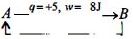
- (A) गैस द्वारा \(10\; J\) कार्य किया जायेगा।
- (B) गैस द्वारा \(6 \;J\) कार्य किया जायेगा।
- (C) गैस पर परिवेश द्वारा किया गया कार्य \(10\; J\) होगा।
- (D) गैस पर परिवेश द्वारा किया गया कार्य \(6\; J\) होगा।
उत्तर और हल देखें
सही उत्तर: (D)
\(\Delta {U_{AB}} = q + w = + 5 + ( - 8) = - 3\)\(q = - 3,\,\Delta {U_{BA}} = + 3\)
\(\Delta {U_{BA}} = q + w\)
\( \Rightarrow 3 = - 3 + w \Rightarrow w = + 6\)
(work done on the system)
-
- (A) रूद्धोष्म कार्य
- (B) समदाबी कार्य
- (C) सम-आयतनिक कार्य
- (D) समतापी कार्य
उत्तर और हल देखें
सही उत्तर: (C)
\(\Delta U = Q +\Delta W\)In adiabatic process no exchange of heat occurs between system and surrounding so \(Q =0\).
Thus, \(\Delta U\) is equal to adiabatic work.
-
- (A) \(\Delta H\) ॠणात्मक तथा \(\Delta S\) धनात्मक है।
- (B) \(\Delta H\) तथा \(\Delta S\), दोनों ऋणात्मक हैं।
- (C) \(\Delta H\) धनात्मक तथा \(\Delta S\) ॠणात्मक है।
- (D) \(\Delta H\) तथा \(\Delta S\), दोनों धनात्मक हैं।
उत्तर और हल देखें
सही उत्तर: (D)
\(\Delta G\, = \,\Delta H - T\Delta S\)For a spontaneous reaction \(\Delta G = -ve\) which is possible when both \(\Delta H\) and \(\Delta S\) are positive at high temperature and hence the reaction becomes spontaneous.
-
- (A) \(-676.5\)
- (B) \(-110\)
- (C) \(110.5\)
- (D) \(676.5\)
उत्तर और हल देखें
सही उत्तर: (B)
Many enthalpy changes are difficult to measure directly under standard conditions. Hess law states that the total enthalpy change of a reaction is independent of the route taken. To find\(H _{ f }, C _{( s )}+\frac{1}{2} O _{2}( g ) \rightarrow CO ( g )\)
Given:- combustion of carbon
\(C + O _{2} \rightarrow CO _{2}: \Delta H _{1}=-393.5 KJmol\)
combination of carbon monoxide
\(CO +\frac{1}{2} O _{2} \rightarrow CO _{2}: \Delta H _{2}=-283.5 kJ mol ^{-1}\)
Formation of carbon monoxide:
\(\triangle H =\triangle H _{1}-\Delta H _{2}=-393.5-(-283.5)\)
\(=39.3 .5+283.5=-110 kJ / mol\)
-
- (A) \(1.0 \times 10^{-10}\)
- (B) \(10\)
- (C) \(1\)
- (D) \(1.0 \times 10^{10}\)
उत्तर और हल देखें
सही उत्तर: (C)
Given \(\Delta {H^o} = - 29.8\,kJ\,mo{l^{ - 1}}\)\(\Delta {S^o} = - 1.00\,kJ\,{K^{ - 1}}\)
From the equation
\(\Delta G = \Delta {H^o} - T\Delta {S^o} = - 29.8 - (298 \times - 0.100)\)
\( = - 29.8 + 29.8 = 0\)
Now, \(\Delta {G^o} = - 2.303\,RT\,\log \,{K_{eq}}\)
\(0 = - 2.303\,RT\,\log \,{K_{eq}}\)
\(\therefore {K_{eq}} = 1\)
-
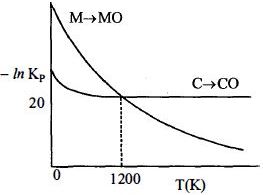
- (A) \(T <1200 K\) पर कार्बन का उपचयन प्रतिकूल है।
- (B) कार्बन का उपचयन सभी ताप पर अनुकूल है।
- (C) \(T <1200 K\), पर अभिक्रिया, \(MO ( s )+ C ( s )\) \(\rightarrow M ( s )+ CO ( g )\) स्वतः प्रवर्तित है ।
- (D) \(T >1200 K\), पर कार्बन \(MO ( s )\) को अपचयित करके \(M ( s )\) देगा।
उत्तर और हल देखें
सही उत्तर: (C)
At \(< 1200\,K\), carbon will reduce \(MO(s)\) to \(M(s)\) hence, chemical reaction\(MO(s) + C(s) \to M(s) + CO(g)\) is spontaneous
-
- (A) \(124.50\)
- (B) \(249\)
- (C) \(498\)
- (D) \(62.25\)
उत्तर और हल देखें
सही उत्तर: (A)
\(2{H_2}{O_2}(l) \leftrightarrow 2{H_2}O(l) + {O_2}(g)\)\(W = - {P_{ext}}(\Delta V) = - ({n_{{O_2}}})RT\)
\(\because \,100\) mole \({H_2}{O_2}\) on decomposition give \(50\) mol \({O_2}\)
\(\therefore \,W = - (50)(8.3)(300) = - 124500\,J\)
\( = - 124.5\,kJ\)
-
- (A) \(2.48 \times 10^4\,\,nm\)
- (B) \(1.49 \times 10^3\,\,nm\)
- (C) \(2.48 \times 10^3\,\,nm\)
- (D) \(1.49 \times 10^4\,\,nm\)
उत्तर और हल देखें
सही उत्तर: (B)
In \(C{H_4},\,4 \times B{E_{(C - H)}} = 360\,kJ/mol\)\(\therefore \,B{E_{(C - H)}} = 90{\kern 1pt} kJ/mol\)
In \({C_2}{H_6},\,B{E_{(C - C)}} + 6 \times B{E_{(C - H)}} = 620\,kJ/mol\)
\(\therefore \,B{E_{(C - C)}} = 80{\kern 1pt} kJ/mol\)
\(\therefore \,B{E_{(C - C)}} = \frac{{80 \times {{10}^3}}}{{6.023 \times {{10}^{23}}}}\,J/molecule\)
Now, \(E = \frac{{hc}}{\lambda }\)
\(\therefore \,\lambda = \frac{{6.626 \times {{10}^{ - 34}} \times 3 \times {{10}^8} \times 6.023 \times {{10}^{23}}}}{{80 \times {{10}^3}}}\)
\(\therefore \,\lambda = 1.419 \times {10^3}\,nm\)
-
- (A) अधिशोषण की एन्थैल्पी ॠणात्मक है।
- (B) अधिशोषण पर, पृष्ठ ऊर्जा का ह्रास ऊष्मा के रूप में प्रकट होता है।
- (C) अधिशोषण पर, पृष्ठ पर अवशिष्ट बल बढ़ते हैं।
- (D) अधिशोषण की एन्ट्रॉपी ऋणात्मक है।
उत्तर और हल देखें
सही उत्तर: (C)
Adsorption is a phenomena of attracting and retaining the molecules of a substance on the surface of a liquid or a solid resulting into a higher concentration of the molecules on the surface.After adsorption there is a decrease in the residual forces due to bond formation \(\Delta G\), \(\Delta H\) and \(\Delta S\) all are negative in the case of adsorption.
-
- (A) \(86600 - \frac{\ln (1.6 \times 10^{12})}{ R (298) }\)
- (B) \(0.5[2 \times 86,600-R(298)\ln (1.6 \times 10^{12} )]\)
- (C) \(R(298) \ln (1.6 \times 10^{12} )-86600\)
- (D) \(86600+R( 298) \ln (1.6 \times 10^{12})\)
उत्तर और हल देखें
सही उत्तर: (B)
\( {\Delta G_{N O}^{\circ}} _{(g)}=86.6 \,k J / m o l=86600 \,J / m o l\)\(G_{N O_{2}(g)}^{\circ}=x \,J / m o l\)
\(T=298, K_{p}=1.6 \times 10^{12}\)
\(\Delta G^{\circ}=-R T \ln K_{p}\)
Given equation,
\(2 \mathrm{NO}(g)+\mathrm{O}_{2}(g) \rightleftharpoons 2 \mathrm{NO}_{2}(g)\)
\(2 \Delta G_{N O_{2}}^{\circ}-2 \Delta G_{N O}^{\circ}=-R(298) \ln \left(1.6 \times 10^{12}\right)\)
\(2 \Delta G_{N O_{2}}^{\circ}-2 \times 86600=-R(298) \ln \left(1.6 \times 10^{12}\right)\)
\(2 \Delta G_{N O_{2}}^{\circ}=2 \times 86600-R(298) \ln \left(1.6 \times 10^{12}\right)\)
\(\Delta G^{\circ}_{N O_{2}}=\frac{1}{2}\left[2 \times 86600-R(298) \ln \left(1.6 \times 10^{12}\right)\right]\)
\(=0.5\left[2 \times 86600-R(298) \ln \left(1.6 \times 10^{12}\right)\right]\)
-
- (A) \(23.03\)
- (B) \(-23.03\)
- (C) \(2.303\)
- (D) \(-2.303\)
उत्तर और हल देखें
सही उत्तर: (B)
Given, \(C_p = 10\) cals at \(1000\,K\)\(T_t = 1000 K.\) \(T_2 = 100\,K\)
\(m = 32\,g\)
\(\Delta S = ?\)
at constant pressure
\(\Delta S = {C_p}\,\ln \,\frac{{{T_2}}}{{{T_1}}}\)
\( = 2.303 \times {C_p}\,\log \,\frac{{{T_2}}}{{{T_1}}}\)
\( = 2.303 \times 10\,\log \,\frac{{100}}{{1000}}\)
\( = - 23.03\,cal\,{\deg ^{ - 1}}\)
-
- (A) \(\Delta H _{\text {mixing}} < 0\) (zero)
- (B) \(\Delta H _{\text {mixing}} > 0\) (zero)
- (C) \(A - A\) और \(B - B\) की परस्पर प्रभाव से \(A - B\) का परस्पर प्रभाव अधिक प्रबल होगा।
- (D) \(A - A , B - B\) और \(A - B\) सभी परस्पर प्रभाव एक समान हैं।
उत्तर और हल देखें
सही उत्तर: (D)
Solutions in which solute - solute and solvent-solvent interactions are almost similar to solute solvent interactions are known as ideal solution -
- (A) \(- 1366. 95\)
- (B) \(- 1361.95\)
- (C) \(- 1460.95\)
- (D) \(- 1350. 50\)
उत्तर और हल देखें
सही उत्तर: (A)
\(C _{2} H _{5} OH ( l )+3 O _{2}( g ) \rightarrow 2 CO _{2}( g )+3 H _{2} O ( l )\)\(\Delta E =-1364.47 kJ mol ^{-1}\)
\(\Delta H =?\)
\(T =298 K\)
\(\Delta n _{ g }=-1 \because\) complete combution
\(R =8.314 J mol ^{-1}=\frac{8.314}{1000} kJ mol ^{-1}\)
\(\because \Delta H =\Delta E + P \Delta V\)
but, \(P \Delta V =\Delta n _{ g } RT\)
\(\because \Delta H =\Delta E +\Delta n _{ g } RT\)
\(\Delta H =-1364.47+\left((-1) \times \frac{8.314}{1000} \times 298\right)\)
\(\Delta H =-1366.95 kJ mol ^{-1}\)
-
- (A) \(H _{2}\) अणु की वियोजन ऊर्जा।
- (B) कार्बन की पहली चार आयनन ऊर्जाएँ।
- (C) \(H _{2}\) की वियोजन ऊर्जा और कार्बन (ग्रेफ़ाइट) की ऊर्ध्वपातन ऊर्जा।
- (D) कार्बन की प्रथम चार आयनन ऊर्जाएँ और हाइड्रोजन की इलैक्ट्रॉन बन्धुता।
उत्तर और हल देखें
सही उत्तर: (A)
To calculate average enthalpy of \(C-H\) bond in methane following informations are needed\((i)\) dissociation energy of \(H_2\) i.e.
\(\frac{1}{2}{H_2}(g) \to H(g);\Delta H = x\) (suppose)
\((ii)\) Sublimation enegry of \(C\) (graphite) to \(C(g)\)
\(C(graphite) \to C(g);\Delta H = y\) (Suppose)
Given
\(C(graphite) + 2{H_2}(g) \to C{H_4}(g);\Delta H = 75\,kJ\,mo{l^{ - 1}}\)
-
- (A) \(- 1102\)
- (B) \(- 964\)
- (C) \(+352\)
- (D) \(+1056\)
उत्तर और हल देखें
सही उत्तर: (B)
Given \(\frac{1}{2}{N_2} + \frac{3}{2}{H_2} \leftrightarrow N{H_3};\)\(\Delta {H_f} = - 46.0\,kJ/mol\)
\(H + H \leftrightarrow {H_2};\,\Delta {H_f} = - 436\,kJ/mol\)
\(N + N \leftrightarrow {N_2};\,\Delta {H_f} = - 712\,kJ/mol\)
\(\Delta {H_f}(N{H_3}) = \frac{1}{2}\Delta {H_{N - N}} + \frac{3}{2}\Delta {H_{H - H}} - \Delta {H_{N - H}}\)
\( - 46 = \frac{1}{2}( - 712) + \frac{3}{2}( - 436) - \Delta {H_{N - H}}\)
On calculation
\(\Delta {H_{N - H}} = - 964\,kJ/mol\)
-
- (A) \(-312.5\)
- (B) \(-242.8\)
- (C) \(-108.1\)
- (D) \(-37.6\)
उत्तर और हल देखें
सही उत्तर: (B)
\(\Delta {S^o} = S_{_{C{O_2}}}^o + 2 \times S_{_{{H_2}O}}^o - (S_{_{C{H_4}}}^o + 2 \times S_{{O_2}}^o)\)\( = (213.6 + 2 \times 69.9) - (186.2 + 2 \times 205.2)\)
\( = - 242.8\,J\,{K^{ - 1}}\,mo{l^{ - 1}}\,\)
-
- (A) \(q = +208\,J, \,w =-208\,J\)
- (B) \(q =-208\,J, w =-208\,J\)
- (C) \(q =-208\,J, w = +208\,J\)
- (D) \(q = +208\,J, w = +208\,J\)
उत्तर और हल देखें
सही उत्तर: (A)
Solution:-As the heat is absorbed.
\(\therefore q =+208 J\)
Now for reversible isothermal process,
\(q =- W\)
\(\therefore W =- q =-208 J\)
Hence the values of \(q\) and \(W\) for the process will be \(+208 J\) and \(-208 J\) respectively.
इस पेज पर इन फ़िल्टर से कोई प्रश्न नहीं मिला।