


JEE Mains · Physics · STD 11 - Thermodynamics
- JEE Mains 2026
- Medium
- MCQ
Given below are two statements: one is labelled as Assertion A and the other is labelled as Reason R
Statement I: Change in internal energy of a system containing \(n\) mole of ideal gas can be written as \(\Delta U = n C_v (T_f - T_i) = \dfrac{nR}{\gamma - 1}(T_f - T_i)\), where \(\gamma = \dfrac{C_p}{C_v}\), \(T_i =\) initial temperature, \(T_f =\) final temperature.
Statement II: Relation between degree of freedom \(f\) and \(\gamma (= C_p/C_v)\) is \(\left(\gamma = 1 + \dfrac{2}{f}\right)\)
Choose the correct answer from the options given below
Pick an option to check your answer.
Answer & Solution
Correct Answer
(B) Both A and R are true but R is NOT the correct explanation of A
Step-by-step Solution
Detailed explanation
Statement I is true because for an ideal gas, the change in internal energy is given by \(\Delta U = n C_v \Delta T\). Using Mayer's relation \(C_p - C_v = R\) and the ratio of specific heats \(\gamma = \dfrac{C_p}{C_v}\), we can write \(C_v = \dfrac{R}{\gamma - 1}\). Substituting this, we get \(\Delta U = \dfrac{nR}{\gamma - 1}(T_f - T_i)\).
Statement II is true because according to the law of equipartition of energy, the molar heat capacity at constant volume is \(C_v = \dfrac{f}{2}R\) and at constant pressure is \(C_p = \left(\dfrac{f}{2} + 1\right)R\). Therefore, \(\gamma = \dfrac{C_p}{C_v} = 1 + \dfrac{2}{f}\).
Statement II does not explain Statement I, as Statement I is derived purely from macroscopic thermodynamic relations (Mayer's relation) and is independent of the microscopic concept of degrees of freedom.
Hence, both statements are true but Statement II is NOT the correct explanation of Statement I.
Answer: Both A and R are true but R is NOT the correct explanation of A
More questions from Physics
- A \(2 \mathrm{~kg}\) brick begins to slide over a surface which is inclined at an angle of \(45^{\circ}\) with respect to horizontal axis. The co-efficient of static friction between their surfaces is _______.JEE Mains 2024 Hard
- The frequency of oscillation of a mass \(m\) suspended by a spring is \(v_1\). If the length of the spring is cut to half, the same mass oscillates with frequency \(v_2\). The value of \(v_2/v_1\) is ________.JEE Mains 2026 Medium
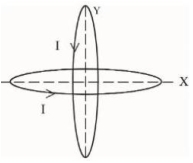
- Two identical circular wires of radius \(20\,cm\) and carrying current \(\sqrt{2}\,A\) are placed in perpendicular planes as shown in figure. The net magnetic field at the centre of the circular wire is \(.............\times 10^{-8}\,T\). (Take \(\pi=3.14\) )
 JEE Mains 2023 Medium
- In a Young's double slit experiment set up, the two slits are kept 0.4 mm apart and screen is placed at 1 m from slits. If a thin transparent sheet of thickness \(20 \mu m\) is introduced in front of one of the slits then centre bring fringe shifts by 20 mm on the screen. The refractive index of transparent sheet is given by \(\frac{\alpha}{10}\), where \(\alpha\) is _________ .JEE Mains 2026 Hard
- In Bohr's atomic model, the electron is assumed to revolve in a circular orbit of radius \(0.5 \times 10^{-10}\,m\). If the speed of electron is \(2.2 \times 10^{6} \;{m} / {s}\), then the current associated with the electron will be \(....\,\times 10^{-2} \;{mA}\). [Take \(\pi\) as \(\left.\frac{22}{7}\right]\)JEE Mains 2021 Hard
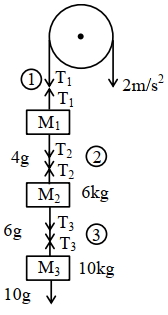
- Three blocks \(\mathrm{M}_1, \mathrm{M}_2, \mathrm{M}_3\) having masses \(4 \mathrm{~kg}, 6 \mathrm{~kg}\) and \(10 \mathrm{~kg}\) respectively are hanging from a smooth pully using rope 1,2 and 3 as shown in figure. The tension in the rope \(1, \mathrm{~T}_1\) when they are moving upward with acceleration of \(2 \mathrm{~ms}^{-2}\) is _______ \(\mathrm{N}\) (if \(\mathrm{g}=10 \mathrm{~m} / \mathrm{s}^2\) )
 JEE Mains 2024 Hard
More PYQs from JEE Mains
- Two point charges \(Q\) each are placed at a distance \(d\) apart. A third point charge \(q\) is placed at a distance \(x\) from mid-point on the perpendicular bisector. The value of \(x\) at which charge \(q\) will experience the maximum \(Coulomb's force\) is ...............JEE Mains 2022 Hard
- A particle is moving in a straight line such that its velocity is increasing at \(5\,ms ^{-1}\) per meter. The acceleration of the particle is \(ms ^{-2}\) at a point where its velocity is \(20\,ms ^{-1}\).JEE Mains 2022 Medium
- An object is placed at a distance of \(12\,cm\) in front of a plane mirror. The virtual and erect image is formed by the mirror. Now the mirror is moved by \(4\,cm\) towards the stationary object. The distance by which the position of image would be shifted, will be:JEE Mains 2023 Medium