


JEE Mains · Physics · STD 11 - Surface tension
- JEE Mains 2026
- Medium
- MCQ
A liquid drop of diameter \(2\) mm breaks into \(512\) droplets. The change in surface energy is \(\alpha \times 10^{-6}\) J. The value of \(\alpha\) is _______. (Take surface tension of liquid \(= 0.08\) N/m)
Pick an option to check your answer.
Answer & Solution
Correct Answer
(B) \(7\)
Step-by-step Solution
Detailed explanation
Let the radius of the initial drop be \(R\) and the radius of each small droplet be \(r\).
Given diameter \(D = 2\) mm, so \(R = 1\) mm \(= 10^{-3}\) m.
By conservation of volume:
\(\dfrac{4}{3}\pi R^3 = 512 \times \dfrac{4}{3}\pi r^3\)
\(R^3 = 512 r^3 \Rightarrow R = 8r \Rightarrow r = \dfrac{R}{8}\)
Initial surface area, \(A_i = 4\pi R^2\)
Final surface area, \(A_f = 512 \times 4\pi r^2 = 512 \times 4\pi \left(\dfrac{R}{8}\right)^2 = 32\pi R^2\)
Change in surface area, \(\Delta A = A_f - A_i = 32\pi R^2 - 4\pi R^2 = 28\pi R^2\)
Change in surface energy, \(\Delta U = T \Delta A\)
\(\Delta U = 0.08 \times 28\pi R^2\)
Substituting \(R = 10^{-3}\) m and \(\pi \approx \dfrac{22}{7}\):
\(\Delta U = 0.08 \times 28 \times \dfrac{22}{7} \times (10^{-3})^2\)
\(\Delta U = 0.08 \times 4 \times 22 \times 10^{-6}\)
\(\Delta U = 7.04 \times 10^{-6}\) J
Comparing with \(\alpha \times 10^{-6}\) J, we get \(\alpha \approx 7\).
Answer: \(7\)
More questions from Physics
- A particle starts simple harmonic motion from the mean position. Its amplitude is \(a\) and total energy \(E\). At one instant its kinetic energy is \(3E/4.\) Its displacement at that instant isJEE Mains 2021 Medium
- A simple pendulum oscillating in air has period \(T.\) The bob of the pendulum is completely immersed in a non-viscous liquid. The density of the liquid is \(\frac {1}{16}\) of the material of the bob. If the bob is inside liquid all the time, its period of oscillation in this liquid isJEE Mains 2019 Hard
- Four particles \(A, B, C, D\) of mass \(\frac{\mathrm{m}}{2}, \mathrm{~m}, 2 \mathrm{~m}, 4 \mathrm{~m}\), have same momentum, respectively. The particle with maximum kinetic energy is _______.JEE Mains 2024 Hard
- Sodium light of wavelengths \(650\, nm\) and \(655\, nm\) is used to study diffraction at a single slit of aperture \(0.5\, mm\). The distance between the slit and the screen is \(2.0 \,m\). The separation between the positions of the first maxima of diffraction pattern obtained in the two cases is \(\times 10^{-5} \,m\)JEE Mains 2022 Medium
- The diameter of a sphere is measured using a vernier caliper whose \(9\) divisions of main scale are equal to \(10\) divisions of vernier scale. The shortest division on the main scale is equal to \(1 \mathrm{~mm}\). The main scale reading is \(2 \mathrm{~cm}\) and second division of vernier scale coincides with a division on main scale. If mass of the sphere is \(8.635 \mathrm{~g}\), thedensity of the sphere \(1 \mathrm{~s}\) _______.JEE Mains 2024 Hard
- A current of \(200\ \mu \mathrm{A}\) deflects the coil of a moving coil galvanometer through \(60^{\circ}\). The current to cause deflection through \(\frac{\pi}{10}\) radian is:JEE Mains 2024 Hard
More PYQs from JEE Mains
- Two uniform circular discs are rotating independently in the same direction around their common axis passing through their centres. The moment of inertia and angular velocity of the first disc are \(0.1 \;kg - m ^{2}\) and \(10\; rad \,s^{-1}\) respectively while those for the second one are \(0.2 \;kg - m ^{2}\) and \(5\; rad \,s ^{-1}\) respectively. At some instant they get stuck together and start rotating as a single system about their common axis with some angular speed. The Kinetic energy of the combined system is ...........\(J\)JEE Mains 2020 Hard
- A moving coil galvanometer has resistance \(50\,\Omega \) and it indicates full deflection at \(4\,mA\) current. A voltmeter is made using this galvanometer and a \(5\,k\Omega \) resistance. The maximum voltage, that can be measured using this voltamenter, will be close to ......\(V\)JEE Mains 2019 Medium
- An electric dipole of dipole moment is \(6.0 \times 10^{-6}\,Cm\) placed in a uniform electric field of \(1.5 \times 10^3\,NC ^{-1}\) in such a way that dipole moment is along electric field. The work done in rotating dipole by \(180^{\circ}\) in this field will be \(.........\,mJ\)JEE Mains 2023 Medium
- Region \(I\) and \(II\) are separated by a spherical surface of radius \(25\, {cm}\). An object is kept in region \(I\) at a distance of \(40\, {cm}\) from the surface. The distance of the image from the surface is \(.....\,cm\)
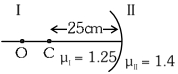 JEE Mains 2021 Medium