


JEE Mains · Physics · STD 12 - 2. Electric potential and capacitance
Three infinitely long wires with linear charge density \(\lambda\) are placed along the \(x-a x i s, y\)-axis and \(z-\) axis respectively. Which of the following denotes an equipotential surface?
- A \(x y z=\) constant
- B \(x y+y z+z x=\) constant
- C \(\left(x^2+y^2\right)\left(y^2+z^2\right)\left(z^2+x^2\right)=\) constant
- D \((x+y)(y+z)(z+x)=\) constant
Answer & Solution
Correct Answer
(C) \(\left(x^2+y^2\right)\left(y^2+z^2\right)\left(z^2+x^2\right)=\) constant
Step-by-step Solution
Detailed explanation
Potential due to an infinite wire is \(V=2 k \lambda \ln r\), where \(r\) is the distance from the wire. Taking the point in space \(P(x, y, z)\) Distance from wire along \(x\)-axis is \(r_x=\sqrt{y^2+z^2}\) Distance from wire along \(y\)-axis is \(r_y=\sqrt{x^2+z^2}\) Distance…
See the Complete Solution
Get step-by-step explanations for this and 2.5 Lakh+ more JEE, NEET & CET questions.
- Unlock all solutions
- Practice the full chapter
- Track accuracy across PYQs
4.8 rated on Google Play · 14,000+ reviews
More questions from Physics
- Statement \(I :\)Two forces \((\overrightarrow{{P}}+\overrightarrow{{Q}})\) and \((\overrightarrow{{P}}-\overrightarrow{{Q}})\) where \(\overrightarrow{{P}} \perp \overrightarrow{{Q}}\), when act at an angle \(\theta_{1}\) to each other, the magnitude of their resultant is \(\sqrt{3\left({P}^{2}+{Q}^{2}\right)}\), when they act at an angle \(\theta_{2}\), the magnitude of their resultant becomes \(\sqrt{2\left({P}^{2}+{Q}^{2}\right)}\). This is possible only when \(\theta_{1}<\theta_{2}\). Statement \(II :\) In the situation given above. \(\theta_{1}=60^{\circ} \text { and } \theta_{2}=90^{\circ}\) In the light of the above statements, choose the most appropriate answer from the options given belowJEE Mains 2021 Hard
- In an experiment for estimating the value of focal length of converging mirror, image of an object placed at \(40\,cm\) from the pole of the mirror is formed at distance \(120\,cm\) from the pole of the mirror. These distances are measured with a modified scale in which there are \(20\) small divisions in \(1\,cm\). The value of error in measurement of focal length of the mirror is \(1 / K\) \(cm\). The value of \(K\) is \(..........\)JEE Mains 2023 Hard
- In order to determine the Young's Modulus of a wire of radius \(0.2\, cm\) (measured using a scale of least count \(=0.001\, cm )\) and length \(1 \,m\) (measured using a scale of least count \(=1\, mm\) ), a weight of mass \(1\, kg\) (measured using a scale of least count \(=1 \,g\) ) was hanged to get the elongation of \(0.5\, cm\) (measured using a scale of least count \(0.001\, cm\) ). What will be the fractional error in the value of Young's Modulus determined by this experiment? (in \(\%\))JEE Mains 2021 Hard
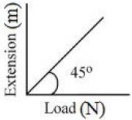
- As shown in the figure, in an experiment to determine Young's modulus of a wire, the extension-load curve is plotted. The curve is a straight line passing through the origin and makes an angle of \(45^{\circ}\) with the load axis. The length of wire is \(62.8\,cm\) and its diameter is \(4\,mm\). The Young's modulus is found to be \(x \times\) \(10^4\,Nm ^{-2}\). The value of \(x\) is
 JEE Mains 2023 Easy
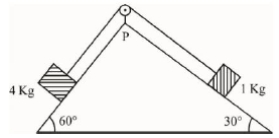
 - As per given figure, a weightless pulley \(P\) is attached on a double inclined frictionless surface. The tension in the string (massless) will be (if \(g=\) \(10\,m / s ^2\) )
 JEE Mains 2023 Medium
 - The position vectors of two 1 kg particles, (A) and (B), are given by
\(\overrightarrow{\mathrm{r}}_{\mathrm{A}}=\left(\alpha_1 \mathrm{t}^2 \hat{i}+\alpha_2 \mathrm{t} \hat{j}+\alpha_3 \mathrm{t} \hat{k}\right) \mathrm{m}\) and \(\overrightarrow{\mathrm{r}}_{\mathrm{B}}=(\beta_1 \mathrm{t} \hat{i}+\beta_2 \mathrm{t}^2 \hat{j}\) \(+\beta_3 \mathrm{t} \hat{k}) \mathrm{m}\), respectively; \((\alpha_1=1 \mathrm{~m} / \mathrm{s}^2, \alpha_2=3 \mathrm{n} \mathrm{m} / \mathrm{s},\) \(\alpha_3=2 \mathrm{~m} / \mathrm{s},\) \(\beta_1=2 \mathrm{~m} / \mathrm{s}, \beta_2=-1 \mathrm{~m} / \mathrm{s}^2, \beta_3=4 \mathrm{pm} / \mathrm{s})\), where t is time, n and p are constants. At \(t=1 \mathrm{~s},\left|\overrightarrow{V_A}\right|=\left|\vec{V}_B\right|\) and velocities \(\vec{V}_A\) and \(\vec{V}_B\) of the particles are orthogonal to each other. At \(t=1 \mathrm{~s}\), the magnitude of angular momentum of particle (A) with respect to the position of particle (B) is \(\sqrt{\mathrm{L}} \mathrm{kgm}^2 \mathrm{~s}^{-1}\). The value of L is _______ .JEE Mains 2025 Hard
More PYQs from JEE Mains
- Let \(\mathrm{f}: N \rightarrow N\) be a function such that \(\mathrm{f}(\mathrm{m}+\mathrm{n})=\mathrm{f}(\mathrm{m})+\mathrm{f}(\mathrm{n})\) for every \(\mathrm{m}, \mathrm{n} \in N\). If \(\mathrm{f}(6)=18\) then \(\mathrm{f}(2) \cdot \mathrm{f}(3)\) is equal to :JEE Mains 2021 Hard
- Let a line \(L_1\) pass through the origin and be perpendicular to the lines
\(L_2: \vec{r} = (3+t)\hat{i} + (2t-1)\hat{j} + (2t+4)\hat{k}\) and
\(L_3: \vec{r} = (3+2s)\hat{i} + (3+2s)\hat{j} + (2+s)\hat{k}\), \(t, s \in \mathbb{R}\).
If \((a, b, c)\), \(a \in \mathbb{Z}\), is the point on \(L_3\) at a distance of \(\sqrt{17}\) from the point of intersection of \(L_1\) and \(L_2\), then \((a+b+c)^2\) is equal to ________.JEE Mains 2026 Hard - Let \(f:[0, \infty) \rightarrow \mathbb{R}\) be differentiable function such that \(f(\mathrm{x})=1-2 \mathrm{x}+\int_0^x e^{x-t} f(t) \mathrm{dt}\) for all \(\mathrm{x} \in[0, \infty)\).
Then the area of the region bounded by \(\mathrm{y}=f(\mathrm{x})\) and the coordinate axes isJEE Mains 2025 Medium - There are 12 points in a plane, no three of which are in the same straight line, except 5 points which are collinear. Then the total number of triangles that can be formed with the vertices at any three of these 12 points isJEE Mains 2025 Easy
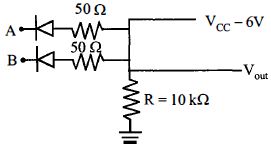
- Given \(A\) and \(B\) are input terminals. Logic \(1\, = \,> 5\, V\) Logic \(0\, =\, < 1\, V\) Which logic gate operation, the above circuit does?
 JEE Mains 2014 Hard
 - Lets \(S=\{z \in C:|z-1|=1\) and \((\sqrt{2}-1)(z+\bar{z})-i(z-\bar{z})=2 \sqrt{2}\}\). Let \(\mathrm{z}_1, \mathrm{z}_2\) \(\in S\) be such that \(\left|z_1\right|=\max _{z \in S}|z|\) and \(\left|z_2\right|=\min _{z \in S}|z|\). Then \(\left|\sqrt{2} z_1-z_2\right|^2\) equals :JEE Mains 2024 Hard