


JEE Mains · Physics · STD 12 - Electric charges and fields
- JEE Mains 2025
- Hard
- MCQ
A metallic ring is uniformly charged as shown in figure. AC and BD are two mutually perpendicular diameters. Electric field due to \(\operatorname{arc} \mathrm{AB}\) to ' O ' is ' E ' is magnitude. What would be the magnitude of electric field at ' O ' due to arc ABC ?

Pick an option to check your answer.
Answer & Solution
Correct Answer
(B) \(\sqrt{2} \mathrm{E}\)
Step-by-step Solution
Detailed explanation
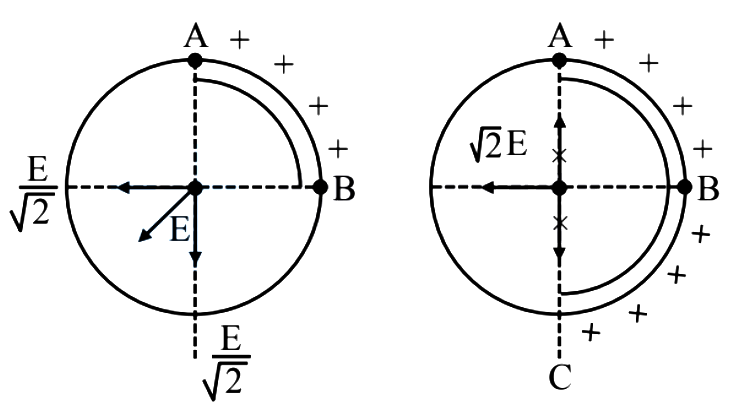
Let the metallic ring be divided into four identical quadrants: arc AB, arc BC, arc CD, and arc DA.
Since the charge distribution is uniform, the magnitude of the electric field at the center 'O' due to each individual quadrant is equal. We are given that the electric field due to arc AB has a magnitude of \( E \).
The electric field vector for any uniformly charged arc points along its angle bisector, away from the positive charge. - Let the electric field due to arc AB be \( \vec{E}_{AB} \) (magnitude = \( E \)). - Let the electric field due to arc BC be \( \vec{E}_{BC} \) (magnitude = \( E \)).
Because AC and BD are mutually perpendicular diameters, the quadrants AB and BC sit 90° apart. Consequently, their respective electric field vectors, \( \vec{E}_{AB} \) and \( \vec{E}_{BC} \), are also perpendicular to each other.
The total electric field at 'O' due to the combined arc ABC is the vector sum of the fields from arc AB and arc BC. Since the two vectors are perpendicular, we calculate the resultant magnitude using the Pythagorean theorem:
\( E_{ABC} = \sqrt{|\vec{E}_{AB}|^2 + |\vec{E}_{BC}|^2} \)
\( E_{ABC} = \sqrt{E^2 + E^2} \)
\( E_{ABC} = \sqrt{2E^2} = \sqrt{2}E \)
More questions from Physics
- A rod of length \(L\) has non-uniform linear mass density given by \(\rho(\mathrm{x})=\mathrm{a}+\mathrm{b}\left(\frac{\mathrm{x}}{\mathrm{L}}\right)^{2},\) where \(a\) and \(\mathrm{b}\) are constants and \(0 \leq \mathrm{x} \leq \mathrm{L}\). The value of \(\mathrm{x}\) for the centre of mass of the rod is atJEE Mains 2020 Hard
- The magnetic field of a plane electromagnetic wave is given by \(\vec B\, = {B_0}\hat i\,[\cos \,(kz - \omega t)]\, + \,{B_1}\hat j\,\cos \,(kz - \omega t)\) where \({B_0} = 3 \times {10^{-5}}\,T\) and \({B_1} = 2 \times {10^{-6}}\,T\). The rms value of the force experienced by a stationary charge \(Q = 10^{-4} \,C\) at \(z = 0\) is closet toJEE Mains 2019 Hard
- Two cells of same emf but different internal resistances \(I_{1}\) and \(I_{2}\) are connected in series with a resistance \(R\). The value of resistance \(R\), for which the potential difference across second cell is zero, isJEE Mains 2022 Medium
- Let \(\eta_{1}\) is the efficiency of an engine at \(T _{1}=447^{\circ}\,C\) and \(T _{2}=147^{\circ}\,C\) while \(\eta_{2}\) is the efficiency at \(T _{1}=947^{\circ}\,C\) and \(T _{2}=47^{\circ}\,C\). The ratio \(\frac{\eta_{1}}{\eta_{2}}\) will be.JEE Mains 2022 Medium
- Energy released when two deuterons \(\left({ }_1 \mathrm{H}^2\right)\) fuse to form a helium nucleus \(\left({ }_2 \mathrm{He}^4\right)\) is :
(Given : Binding energy per nucleon of \({ }_1 \mathrm{H}^2=1.1 \mathrm{MeV}\) and binding energy per nucleon of \({ }_2 \mathrm{He}^4=7.0 \mathrm{MeV}\))JEE Mains 2025 Easy - For the circuit shown below, calculate the value of \({I}_{{z}}\) : (In \({mA}\))
 JEE Mains 2021 Medium
More PYQs from JEE Mains
- Under an adiabatic process, the volume of an ideal gas gets doubled. Consequently the mean collision time between the gas molecule changes from \(\tau_{1}\) to \(\tau_{2} .\) If \(\frac{C_{p}}{C_{v}}=\gamma\) for this gas then a good estimate for \(\frac{\tau_{2}}{\tau_{1}}\) is given by :JEE Mains 2020 Hard
- A block '\(A\)' takes \(2\,s\) to slide down a frictionless incline of \(30^{\circ}\) and length ' \(l\) ', kept inside a lift going up with uniform velocity ' \(v\) '. If the incline is changed to \(45^{\circ}\), the time taken by the block, to slide down the incline, will be approximately \(........\,s\)JEE Mains 2022 Medium
- A monochromatic neon lamp with wavelength of \(670.5\, {nm}\) illuminates a photo-sensitive material which has a stopping voltage of \(0.48\, {V}\). What will be the stopping voltage if the source light is changed with another source of wavelength of \(474.6 \,{nm} ?\) (In \({V}\))JEE Mains 2021 Hard
- The force required to stretch a wire of crosssection \(1 cm ^{2}\) to double its length will be ........ \( \times 10^{7}\,N\) (Given Yong's modulus of the wire \(=2 \times 10^{11}\,N / m ^{2}\) )JEE Mains 2022 Hard
- An expression of energy density is given by \(u=\frac{\alpha}{\beta} \sin \left(\frac{\alpha x}{k t}\right)\), where \(\alpha, \beta\) are constants, \(x\) is displacement, \(k\) is Boltzmann constant and \(t\) is the temperature. The dimensions of \(\beta\) will be.JEE Mains 2022 Hard
- The pulley shown in figure is made using a thin rim and two rods of length equal to diameter of the rim. The rim and each rod have a mass of M . Two blocks of mass of M and m are attached to two ends of a light string passing over the pulley, which is hinged to rotate freely in vertical plane about its centre. The magnitudes of the acceleration experienced by the blocks is _________ (assume no slipping of string on pulley.)
 JEE Mains 2026 Easy