


JEE Mains · Physics · STD 12 - 12. atoms
A small particle of mass \(m\) moves in such a way that its potential energy \(U=\frac{1}{2} m \omega^2 r ^2\) where \(\omega\) is constant and \(r\) is the distance of the particle from origin. Assuming Bohr's quantization of momentum and circular orbit, the radius of \(n^{\text {th }}\) orbit will be proportional to.
- A \(\sqrt{n}\)
- B \(n\)
- C \(n^2\)
- D \(\frac{1}{n}\)
Answer & Solution
Correct Answer
(A) \(\sqrt{n}\)
Step-by-step Solution
Detailed explanation
\(U=\frac{1}{2} m \omega^2 r^2\) \(F=-\frac{d v}{d r}=-m \omega^2 r\) Now \(m \omega^2 r=\frac{m v^2}{r} \Rightarrow v=\omega v^{\prime}\) \(m vr=\frac{n h}{2 \pi} \ldots (ii)\) From \((i)\) and \((ii)\) \(m \omega r^2=\frac{n h}{2 \pi}\) \(\Rightarrow r \propto \sqrt{n}\)
See the Complete Solution
Get step-by-step explanations for this and 2.5 Lakh+ more JEE, NEET & CET questions.
- Unlock all solutions
- Practice the full chapter
- Track accuracy across PYQs
4.8 rated on Google Play · 14,000+ reviews
More questions from Physics
- The kinetic energy of an electron, \(\alpha\)-particle and a proton are given as \(4K,2K\) and \(K\) respectively. The de-Broglie wavelength associated with electron ( \(\lambda e), \alpha\)-particle \((\lambda \alpha)\) and the proton \((\lambda p)\) are as follows:JEE Mains 2023 Medium
- Match the \(\frac{C _{ P }}{ C _{ v }}\) ratio for ideal gases with different type of molecules
Moleculae type \(\frac{C _{ P }}{ C _{ v }}\) \((A)\) Monoatomic \((I)\) \(\frac{7}{ 5}\) \((B)\) Diatomic rigid molecules \((II)\) \(\frac{9}{7}\) \((C)\) Diatomic non-rigid molecules \((III)\) \(\frac{4}{3}\) \((D)\) Triatomic rigid molecules \((IV)\) \(\frac{5}{3}\) JEE Mains 2020 Medium - The momentum of a body is increased by \(50 \%\). The percentage increase in the kinetic energy of the body is \(...........\,\%\)JEE Mains 2023 Medium
- As shown in figure, when a spherical cavity (centred at \(\mathrm{O})\) of radius \(1\) is cut out of a uniform sphere of radius \(\mathrm{R} \text { (centred at } \mathrm{C}),\) the centre of mass of remaining (shaded) part of sphere is at \(G\), i.e, on the surface of the cavity. \(\mathrm{R}\) can be detemined by the equation
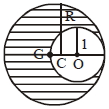 JEE Mains 2020 Hard
 - The de Broglie wavelength of a proton and \(\alpha\) -particle are equal. The ratio of their velocities is ...... .JEE Mains 2021 Medium
- A diode has Zener voltage of \(10\) V and maximum power dissipation of \(0.5\) W, then the minimum resistance to be used in series with this diode for safety when it is connected to a \(25\) V power supply is ______ \(\Omega\).JEE Mains 2026 Easy
More PYQs from JEE Mains
- Let \(f: R-\{0\} \rightarrow R\) be a function such that \(f(x)-6 f\left(\frac{1}{x}\right)=\frac{35}{3 x}-\frac{5}{2}\).
If the \(\lim _{x \rightarrow 0}\left(\frac{1}{\alpha x}+f(x)\right)=\beta ; \alpha, \beta \in R\), then \(\alpha+2 \beta\) is equal toJEE Mains 2025 Easy - Let \(y=x+2,4 y=3 x+6\) and \(3 y=4 x+1\) be three tangent lines to the circle \((x-h)^2+(y-k)^2=r^2\). Then \(h+k\) is equal to :JEE Mains 2023 Hard
- Let \([x]\) denote the greatest integer less than or equal to \(x\) Then \(\mathop {\lim }\limits_{x \to 0} \,\frac{{\tan \,(\pi \,{{\sin }^2}\,x) + \,{{(\left| x \right|\, - \,\sin \,(x\,[x]))}^2}}}{{{x^2}}}\)JEE Mains 2019 Hard
- If the coefficents of \({x^3}\) and \({x^4}\) in the expansion of \(\left( {1 + ax + b{x^2}} \right){\left( {1 - 2x} \right)^{18}}\) in powers of \(x\) are both zero, then \( (a,b) \) is equal toJEE Mains 2014 Hard
- Let the tangent drawn to the parabola \(y ^{2}=24 x\) at the point \((\alpha, \beta)\) is perpendicular to the line \(2 x\) \(+2 y=5\). Then the normal to the hyperbola \(\frac{x^{2}}{\alpha^{2}}-\frac{y^{2}}{\beta^{2}}=1\) at the point \((\alpha+4, \beta+4)\) does \(NOT\) pass through the point.JEE Mains 2022 Medium
- A ball of mass \(0.5 \mathrm{~kg}\) is attached to a string of length \(50 \mathrm{~cm}\). The ball is rotated on a horizontal circular path about its vertical axis. The maximum tension that the string can bear is \(400 \mathrm{~N}\). The maximum possible value of angular velocity of the ball in rad/s is _______.JEE Mains 2024 Hard