


JEE Mains · Physics · STD 12 - 13. Nuclei
Substance \(A\) has atomic mass number \(16\) and half life of \(1\) day. Another substance \(B\) has atomic mass number \(32\) and half life of \(\frac{1}{2}\) day. If both \(A\) and \(B\) simultaneously start undergo radio activity at the same time with initial mass \(320\,g\) each, how many total atoms of \(A\) and \(B\) combined would be left after \(2\) days \(.........\times 10^{24}\)
- A \(3.38\)
- B \(6.76\)
- C \(67.6\)
- D \(1.69\)
Answer & Solution
Correct Answer
(A) \(3.38\)
Step-by-step Solution
Detailed explanation
\(\left( N _0\right) A =\frac{320}{16}=20 \text { moles }\) \(\left( N _0\right) B =\frac{320}{32}=10 \text { moles }\) \(N _{ A }=\frac{\left( N _0\right)_{ A }}{(2)^{2 / 1}}=\frac{20}{4}=5\) \(N _{ B }=\frac{\left( N _0\right)_{ B }}{(2)^{2 / 5}}=\frac{10}{2^4}=0.625\) Total…
See the Complete Solution
Get step-by-step explanations for this and 2.5 Lakh+ more JEE, NEET & CET questions.
- Unlock all solutions
- Practice the full chapter
- Track accuracy across PYQs
4.8 rated on Google Play · 14,000+ reviews
More questions from Physics
- A tuning fork of frequency \(340\,Hz\) resonates in the fundamental mode with an air column of length \(125\,cm\) in a cylindrical tube closed at one end. When water is slowly poured in it, the minimum height of water required for observing resonance once again is________ \(cm\) (Velocity of sound in air is \(340\,ms ^{-1}\) )JEE Mains 2022 Hard
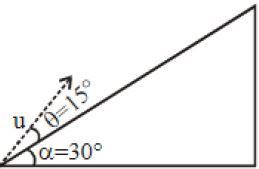
- A plane is inclined at an angle \(\alpha = 30^o\) with respect to the horizontal. A particle is projected with a speed \(u = 2\,ms^{-1},\) from the base of the plant, making an angle \(\theta = 15^o\) with respect to the plane as shown in the figure. The distance from the base at which the particle hits the plane is close to ........ \(cm\) (Take \(g = 10\,ms^2\) )
 JEE Mains 2019 Hard
 - In a long glass tube, mixture of two liquids A and B with refractive indices 1.3 and 1.4 respectively, forms a convex refractive meniscus towards \(A\). If an object placed at 13 cm from the vertex of the meniscus in A forms an image with a magnification of ' \(-2^{\prime}\) then the radius of curvature of meniscus is :JEE Mains 2025 Hard
- A wire of resistance R is bent into an equilateral triangle and an identical wire is bent into \(a\) square. The ratio of resistance between the two end points of an edge of the triangle to that of the square is:JEE Mains 2025 Medium
- A telescope with objective diameter \(R\) is used to observe a distant star emitting light of wavelength \(500\) nm, at a resolution of \(5 \times 10^{-7}\) radian. The value of \(R\) is _____ cm.JEE Mains 2026 Medium
- Two spherical balls having equal masses with radius of \(5\, {cm}\) each are thrown upwards along the same vertical direction at an interval of \(3\, {s}\) with the same initial velocity of \(35 \,{m} / {s}\), then these balls collide at a height of \(\ldots \ldots \ldots . {m}\). (Take \({g}=10 \,{m} / {s}^{2}\) )JEE Mains 2021 Hard
More PYQs from JEE Mains
- The equation of line passing through \((-4, 1, 3)\), parallel to the plane \(x + 2y - z - 5 = 0\) and intersecting the line \(\frac{{x + 1}}{{ - 3}} = \frac{{y - 3}}{2} = \frac{{z - 2}}{{ - 1}}\) isJEE Mains 2019 Hard
- One plano-convex and one plano-concave lens of same radius of curvature \(‘R’\) but of different materials are joined side by side as shown in the figure. If the refractive index of the material of \(1\) is \(\mu_1\) and that of \(2\) is \(\mu _2\), then the focal length of the combination is
 JEE Mains 2019 Hard
 - Let \(\frac{x^{2}}{a^{2}}+\frac{y^{2}}{b^{2}}=1(a>b)\) be a given ellipse length of whose latus rectum is \(10 .\) If its eccentricity is the maximum value of the function, \(\phi( t )=\frac{5}{12}+ t - t ^{2},\) then \(a ^{2}+ b ^{2}\) is equal toJEE Mains 2020 Hard
- The dimensions of angular momentum , latent heat and capacitance are, respectively.JEE Mains 2013 Hard
- If the foot of the perpendicular from the point \(A (-1,4,3)\) on the plane \(P : 2 x + my + nz =4\), is \(\left(-2, \frac{7}{2}, \frac{3}{2}\right)\), then the distance of the point \(A\) from the plane \(P\), measured parallel to a line with direction ratios \(3,-1,-4\), is equal to.JEE Mains 2022 Hard
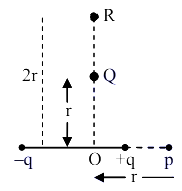
- The electric field at point p due to an electric dipole is E . The electric field at point R on equitorial line will be \(\frac{E}{x}\). The value of \(x\) is _______.
 JEE Mains 2024 Medium