


JEE Mains · Physics · STD 12 -6. Electromagnetic induction
The arm \(P Q\) of a rectangular conductor is moving from \(x=0\) to \(x=2 b\) outwards and then inwards from \(x=2 b\) to \(x=0\) as shown in the figure. A uniform magnetic field perpendicular to the plane is acting from \(x=0\) to \(x=b\). Identify the graph showing the variation of different quantities with distance.
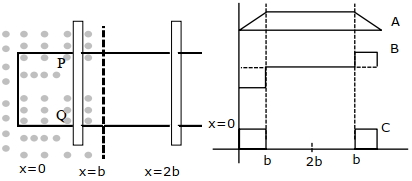
- A \(A-\)Flux, \(B-EMF, C-\)Power dissipated
- B \(A-\)Power dissipated, \(B-\)Flux, \(C-EMF\)
- C \(A-Flux, B-\)Power, dissipated, \(C-EMF\)
- D \(A-EMF, B-\)Power dissipeated, \(C-\)Flux
Answer & Solution
Correct Answer
(A) \(A-\)Flux, \(B-EMF, C-\)Power dissipated
Step-by-step Solution
Detailed explanation
As rod moves in field area increases upto \(x=b\) then field is absent and again flux is generated on return journey from \(x=b\) to \(x=0\). Thus plot \(A\) for flux. \(\Rightarrow e=-\frac{d \phi}{d t} \Rightarrow\) curve \(B\) for \(e m f\) \(\Rightarrow\) Power dissipated…
See the Complete Solution
Get step-by-step explanations for this and 2.5 Lakh+ more JEE, NEET & CET questions.
- Unlock all solutions
- Practice the full chapter
- Track accuracy across PYQs
4.8 rated on Google Play · 14,000+ reviews
More questions from Physics
- The resistances of the platinum wire of a platinum resistance thermometer at the ice point and steam point are \(8 \Omega\) and \(10 \Omega\) respectively. After inserting in a hot bath of temperature \(400^{\circ} \mathrm{C}\), the resistance of platinum wire is _______.JEE Mains 2024 Hard
- A convex lens of focal length 30 cm is placed in contact with a concave lens of focal length 20 cm. An object is placed at 20 cm to the left of this lens system. The distance of the image from the lens in cm is ________JEE Mains 2025 Easy
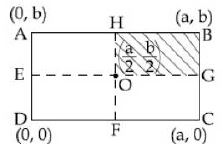
- A uniform rectangular thin sheet \(ABCD\) of mass \(M\) has length \(a\) and breadth \(b\), as shown in the figure. If the shaded portion \(HBGO\) is cut off, the coordinates of the centre of mass of the remaining portion will be
 JEE Mains 2019 Hard
 - Consider a finite insulated, uncharged conductor placed near a finite positively charged conductor. The uncharged body must have a potentialJEE Mains 2013 Hard
- Two identical conducting spheres with negligible volume have \(2.1\, nC\) and \(-0.1\, nC\) charges, respectively. They are brought into contact and then separated by a distance of \(0.5 \,m\). The electrostatic force acting between the spheres is \(.......... \, \times 10^{-9} \,N\) [Given : \(4 \pi \varepsilon_{0}=\frac{1}{9 \times 10^{9}} SI\) unit]JEE Mains 2021 Medium
- In a hydrogen spectrum, \(\lambda\) be the wavelength of first transition line of Lyman series. The wavelength difference will be "a \(\lambda^{\prime}\) between the wavelength of \(3^{\text {rd }}\) transition line of Paschen series and that of \(2^{\text {nd }}\) transition line of Balmer Series where \(a=........\)JEE Mains 2022 Hard
More PYQs from JEE Mains
- A small bob of mass 100 mg and charge \(+10 \mu \mathrm{C}\) is connected to an insulating string of length 1 m. It is brought near to an infinitely long nonconducting sheet of charge density ' \(\sigma\) ' as shown in figure. If string subtends an angle of \(45^{\circ}\) with the sheet at equilibrium the charge density of sheet will be :
(Given, \(\varepsilon_0=8.85 \times 10^{-12} \frac{\mathrm{~F}}{\mathrm{~m}}\) and acceleration due to gravity, \(g=10 \mathrm{~m} / \mathrm{s}^2\))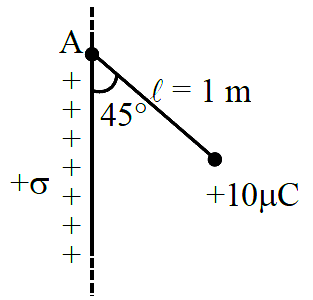 JEE Mains 2025 Medium
 - Let \(z\) be a complex number such that \(|z|=1\). If \(\frac{2+\mathrm{k}^2 \mathrm{z}}{\mathrm{k}+\overline{\mathrm{z}}}=\mathrm{kz}, \mathrm{k} \in \mathbf{R}\), then the maximum distance of \(\mathrm{k}+\mathrm{ik}^2\) from the circle \(|\mathrm{z}-(1+2 \mathrm{i})|=1\) is:JEE Mains 2025 Hard
- In a photoelectric effect experiment, the graph of stopping potential \(V\) versus reciprocal of wavelength obtained is shown in the figure. As the intensity of incident radiation is increased
 JEE Mains 2020 Medium
 - Given below are two statements: Statement \(I :\) An electric dipole is placed at the centre of a hollow sphere. The flux of electric field through the sphere is zero but the electric field is not zero anywhere in the sphere. Statement \(II :\) If \(R\) is the radius of a solid metallic sphere and \(Q\) be the total charge on it. The electric field at any point on the spherical surface of radius \(r ( < R )\) is zero but the electric flux passing through this closed spherical surface of radius \(r\) is not zero. In the light of the above statements, choose the correct answer from the options given below:JEE Mains 2021 Hard
- Let \(A=\left[\begin{array}{lll}0 & 1 & 2 \\ a & 0 & 3 \\ 1 & c & 0\end{array}\right]\), where \(a, c \in R\). If \(A^3=A\) and the positive value of a belongs to the interval ( \(n -1, n\) ], where \(n \in N\), then \(n\) is equal to \(..........\).JEE Mains 2023 Hard
- The locus of the mid points of the chords of the hyperbola \(\mathrm{x}^{2}-\mathrm{y}^{2}=4\), which touch the parabola \(\mathrm{y}^{2}=8 \mathrm{x}\), is :JEE Mains 2021 Hard