


JEE Mains · Physics · STD 11 - 3.1 vectors
Three particles \({P}, {Q}\) and \({R}\) are moving along the vectors \({A}=\hat{{i}}+\hat{{j}}, {B}=\hat{{j}}+\hat{{k}}\) and \({C}=-\hat{{i}}+\hat{{j}}\) respectively. They strike on a point and start to move in different directions. Now particle \(P\) is moving normal to the plane which contains vector \(\vec{A}\) and \(\vec{B} .\) Similarly particle \(Q\) is moving normal to the plane which contains vector \(\vec{A}\) and \(\vec{C} .\) The angle between the direction of motion of \(P\) and \(Q\) is \(\cos ^{-1}\left(\frac{1}{\sqrt{x}}\right)\). Then the value of \(x\) is ...... .
- A \(11\)
- B \(47\)
- C \(5\)
- D \(3\)
Answer & Solution
Correct Answer
(D) \(3\)
Step-by-step Solution
Detailed explanation
Direction of \(P=\hat{v}_{1}=\pm \frac{\vec{A} \times \vec{B}}{|\vec{A} \times \vec{B}|}=\pm \frac{\hat{i}-\hat{j}+\hat{k}}{\sqrt{3}}\) Direction of \(Q=\hat{v}_{2}=\pm \frac{\vec{A} \times \vec{C}}{|\vec{A} \times \vec{C}|}=\pm \frac{2 \hat{k}}{2}=\pm \hat{k}\) Angle between…
See the Complete Solution
Get step-by-step explanations for this and 2.5 Lakh+ more JEE, NEET & CET questions.
- Unlock all solutions
- Practice the full chapter
- Track accuracy across PYQs
4.8 rated on Google Play · 14,000+ reviews
More questions from Physics
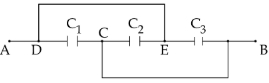
- A combination of parallel plate capacitors is maintained at a certain potential difference When a \(3\, mm\) thick slab is introduced between all the plates, in order to maintain the same potential difference, the distance between the plates is increased by \(2.4\, mm\). Find the dielectric constant of the slab.
 JEE Mains 2017 Hard
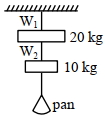
 - Wires \({W}_{1}\) and \({W}_{2}\) are made of same material having the breaking stress of \(1.25 \times 10^{9} \,{N} / {m}^{2}\) \({W}_{1}\) and \({W}_{2}\) have cross-sectional area of \(8 \times 10^{-7}\, {m}^{2}\) and \(4 \times 10^{-7}\, {m}^{2}\), respectively. Masses of \(20 \,{kg}\) and \(10\, {kg}\) hang from them as shown in the figure. The maximum mass that can be placed in the pan without breaking the wires is \(.....{kg}\) (Use \(\left.{g}=10\, {m} / {s}^{2}\right)\)
 JEE Mains 2021 Hard
 - The frequency of oscillation of a mass \(m\) suspended by a spring is \(v_1\). If the length of the spring is cut to half, the same mass oscillates with frequency \(v_2\). The value of \(v_2/v_1\) is ________.JEE Mains 2026 Medium
- For which of the following particles will it be most difficult to experimentally verify the deBroglie relationship?JEE Mains 2014 Easy
- Match List \(I\) with List \(II\) :
Choose the correct answer from the options given below :List \(I\) List \(II\) \(A\) Isothermal Process \(I\) Work done by the gas decreases internal energy \(B\) Adiabatic Process \(II\) No change in internal energy \(C\) Isochoric Process \(III\) The heat absorbed goes partly to increase internal energy and partly to do work \(D\) Isobaric Process \(IV\) No work is done on or by the gas JEE Mains 2023 Medium - A 4 kg mass moves under the influence of a force \(\vec{F}=\left(4 t^3 \hat{i}-3 t \hat{j}\right) N\) where \(t\) is the time in second. If mass starts from origin at \(t=0\), the velocity and position after \(t=2 s\) will be :JEE Mains 2026 Medium
More PYQs from JEE Mains
- Consider a rectangle \(ABCD\) having \(5,7,6,9\) points in the interior of the line segments \(AB,CD , BC , DA\) respectively. Let \(\alpha\) be the number of triangles having these points from different sides as vertices and \(\beta\) be the number of quadrilaterals having these points from different sides as vertices. Then \((\beta-\alpha)\) is equal to :JEE Mains 2021 Medium
- Effective capacitance of parallel combination of two capacitors \(\mathrm{C}_{1}\) and \(\mathrm{C}_{2}\) is \(10\; \mu \mathrm{F}\). When these capacitors are individually connected to a voltage source of \(1\; \mathrm{V},\) the energy stored in the capacitor \(\mathrm{C}_{2}\) is \(4\) times that of \(\mathrm{C}_{1}\). If these capacitors are connected in series, their effective capacitance will beJEE Mains 2020 Medium
- The coefficients \(a, b, c\) in the quadratic equation \(a x^2+b x+c=0\) are from the set \(\{1,2,3,4,5,6\}\). If the probability of this equation having one real root bigger than the other is \(p\), then \(216\) p equals:JEE Mains 2024 Hard
- The absolute difference of the coefficients of \(x^{10}\) and \(x^7\) in the expansion of \(\left(2 x^2+\frac{1}{2 x}\right)^{11}\) is equal toJEE Mains 2023 Hard
- For \(a , b \in Z\) and \(| a - b | \leq 10\), let the angle between the plane \(P : ax + y - z = b\) and the line \(l: x -1= a\) \(-y=z+1\) be \(\cos ^{-1}\left(\frac{1}{3}\right)\). If the distance of the point \((6,-6,4)\) from the plane \(P\) is \(3 \sqrt{6}\), then \(a^4+b^2\) is equal toJEE Mains 2023 Hard
- Angle of minimum deviation is equal to the half of the angle of prism in an equilateral prism. The refractive index of the prism is __________.JEE Mains 2026 Medium