


JEE Mains · Physics · STD 12 - 4. Moving charges and magnetism
A positive charge \('q'\) of mass \('m'\) is moving along the \(+ x\) axis. We wish to apply a uniform magnetic field \(B\) for time \(\Delta t\) so that the charge reverses its direction crossing the \(y\) axis at a distance \(d.\) Then
- A \(B\, = \,\frac{{mv}}{{qd}}\) and \(\Delta t\, = \,\frac{{\pi d}}{v}\)
- B \(B\, = \,\frac{{mv}}{{2qd}}\) and \(\Delta t\, = \,\frac{{\pi d}}{2v}\)
- C \(B\, = \,\frac{{2mv}}{{qd}}\) and \(\Delta t\, = \,\frac{{\pi d}}{2v}\)
- D \(B\, = \,\frac{{2mv}}{{qd}}\) and \(\Delta t\, = \,\frac{{\pi d}}{v}\)
Answer & Solution
Correct Answer
(C) \(B\, = \,\frac{{2mv}}{{qd}}\) and \(\Delta t\, = \,\frac{{\pi d}}{2v}\)
Step-by-step Solution
Detailed explanation
The applied magnetic field provides the required centripetal force to the charge particle, so it can move in circular path of radius \(\frac{d}{2}\) \(\therefore \mathrm{Bqv}=\frac{\mathrm{mv}^{2}}{\mathrm{d} / 2}\) or, \(B = \frac{{2{\text{mv}}}}{{{\text{qd}}}}\) Time interval…
See the Complete Solution
Get step-by-step explanations for this and 2.5 Lakh+ more JEE, NEET & CET questions.
- Unlock all solutions
- Practice the full chapter
- Track accuracy across PYQs
4.8 rated on Google Play · 14,000+ reviews
More questions from Physics
- An object is placed in a medium of refractive index \(3\). An electromagnetic wave of intensity \(6 \times 10^8 \mathrm{~W} / \mathrm{m}^2\) falls normally on the object and it is absorbed completely. The radiation pressure on the object would be (speed of light in free space \(=3 \times 10^8 \mathrm{~m} / \mathrm{s}\) ):JEE Mains 2024 Hard
- Two identical bodies \(A\) and \(B\) of equal masses have initial velocities \(\vec{v_1} = 4\hat{i}\) m/s and \(\vec{v_2} = 4\hat{j}\) m/s respectively. The body \(A\) has acceleration \(\vec{a_1} = 6\hat{i} + 6\hat{j}\) m/s\(^2\) while the acceleration of the other body \(B\) is zero. The centre of mass of the two bodies moves in __________ path.JEE Mains 2026 Hard
- Match the LIST-I with LIST-II
LIST-I LIST-II (A) Boltzmann constant I. \(\mathrm{ML}^2 \mathrm{~T}^{-1}\) (B) Coefficient of viscosity II. \(\mathrm{MLT}^{-3} \mathrm{~K}^{-1}\) (C) Planck's constant III. \(\mathrm{ML}^2 \mathrm{~T}^{-2} \mathrm{~K}^{-1}\) (D) Thermal conductivity IV. \(\mathrm{ML}^{-1} \mathrm{~T}^{-1}\)
Choose the correct answer from the options given below :JEE Mains 2025 Medium - Find the peak current and resonant frequency of the following circuit (as shown in figure).
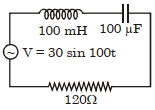 JEE Mains 2021 Hard
 - The half-life of \({ }^{198} {Au}\) is \(3 \,days.\) If atomic weight of \({ }^{198} {Au}\) is \(198\, {g} / {mol}\) then the activity of \(2 \,{mg}\) of \({ }^{198} {Au}\) is ..... \(\times 10^{12}\,disintegration/second\)JEE Mains 2021 Hard
- A capacitor of capacitance \(C\) is charged to a potential \(V\). The flux of the electric field through a closed surface enclosing the positive plate of the capacitor is \(......\)JEE Mains 2023 Medium
More PYQs from JEE Mains
- If \(y = y ( x )\) is the solution of the differential equation \(\frac{ dy }{ dx }+(\tan x ) y =\sin x , 0 \leq x \leq \frac{\pi}{3},\) with \(y (0)=0,\) then \(y \left(\frac{\pi}{4}\right)\) equal to :JEE Mains 2021 Hard
- A string is wound around a hollow cylinder of mass \(5\, kg\) and radius \(0.5\,m\). If the string is now pulled with a horizontal force of \(40\, N\), and the cylinder is rolling without slipping on a horizontal surface (see figure), then the angular acceleration of the cylinder will be ......... \(rad/s^2\) .(Neglect the mass and thickness of the string)
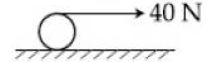 JEE Mains 2019 Medium
 - Two uniform circular discs are rotating independently in the same direction around their common axis passing through their centres. The moment of inertia and angular velocity of the first disc are \(0.1 \;kg - m ^{2}\) and \(10\; rad \,s^{-1}\) respectively while those for the second one are \(0.2 \;kg - m ^{2}\) and \(5\; rad \,s ^{-1}\) respectively. At some instant they get stuck together and start rotating as a single system about their common axis with some angular speed. The Kinetic energy of the combined system is ...........\(J\)JEE Mains 2020 Hard
- The angle of elevation of the top \(P\) of a tower from the feet of one person standing due South of the tower is \(45^{\circ}\) and from the feet of another person standing due west of the tower is \(30^{\circ}\). If the height of the tower is \(5\) meters, then the distance (in meters) between the two persons is equal to \(..........\).JEE Mains 2023 Medium
- Let f, g: \(R \rightarrow R\) be functions defined by \(f ( x )=\left\{\begin{array}{ll}{[ x ]} & , \quad x < 0 \\ |1- x | & , \quad x \geq 0\end{array}\right.\) and \(g(x)=\left\{\begin{array}{ll}e^{x}-x & , x < 0 \\ (x-1)^{2}-1 & , \quad x \geq 0\end{array}\right.\) where \([ x ]\) denote the greatest integer less than or equal to \(x\). Then, the function fog is discontinuous at exactlyJEE Mains 2022 Hard
- Let the image of the point \(P (1,2,3)\) in the line \(L : \frac{ x -6}{3}=\frac{ y -1}{2}=\frac{ z -2}{3}\) be \(Q .\) let \(R (\alpha, \beta, \gamma)\) be a point that divides internally the line segment \(PQ\) in the ratio \(1: 3\). Then the value of \(22(\alpha+\beta+\gamma)\) is equal toJEE Mains 2022 Hard