


Questions
26 questionsShowing 1–26 of 26 questions
-
- (A) \(3200\)
- (B) \(1800\)
- (C) \(1600\)
- (D) \(2400\)
Show answer and solution
Correct Answer: (D)
\(\eta=\frac{ T _{2}}{ T _{1}}=\frac{ Q _{2}}{ Q _{1}}=\frac{ Q _{1}- W }{ Q _{1}} \quad\left(\because W = Q _{1}- Q _{2}\right)\)\(\frac{400}{800}=1-\frac{ W }{ Q _{1}}\)
\(\frac{ W }{ Q _{1}}=1-\frac{1}{2}=\frac{1}{2}\)
\(Q _{1}=2 W =2400 J\)
-
- (A) \(5: 7: 3\)
- (B) \(5: 7: 2\)
- (C) \(3: 7: 2\)
- (D) \(3: 5: 2\)
Show answer and solution
Correct Answer: (B)
\(d U = n C _{ v } dT\)\(dQ = nC _{ p } dT\)
\(dW = PdV = nRdT\) (isobaric process)
\(d U : dQ : dW : C _{ v }: C _{ p }: R\)
\(=\frac{5 R }{2}: \frac{7 R }{2} \cdot R =5: 7: 2\)
-
- (A) \(400\)
- (B) \(500\)
- (C) \(300\)
- (D) \(100\)
Show answer and solution
Correct Answer: (B)
\({Q}_{\text {in }}=300\, {J} ; Q_{\text { out }}=240\, {J}\)Work done \(=Q_{\text {in }}-Q_{\text {out }}=300-240=60 {J}\)
Efficiency \(=\frac{W}{{Q}_{\text {in }}}=\frac{60}{300}=\frac{1}{5}\)
efficiency \(=1-\frac{{T}_{2}}{{T}_{1}}\)
\(\frac{1}{5}=1-\frac{400}{{T}_{1}} \Rightarrow \frac{400}{{T}_{1}}=\frac{4}{5}\)
\({T}_{1}=500\, {k}\)
-
- (A) \(263\)
- (B) \(298\)
- (C) \(350\)
- (D) \(35\)
Show answer and solution
Correct Answer: (A)
\(\frac{{T}_{{L}}}{{T}_{{H}}-{T}_{{L}}}={C} . {O} \cdot {P} .=\frac{\frac{{dH}}{{dt}}}{\frac{{dW}}{{dt}}}\)\(\frac{263}{35} \times 35=\frac{{dH}}{{dt}}\)
\(\frac{{dH}}{{dt}}=263\) \(watts\)
-
- (A) \(174\)
- (B) \(280\)
- (C) \(180.4\)
- (D) \(382\)
Show answer and solution
Correct Answer: (A)
\({T}_{2}=\) sink temperature\(\eta=1-\frac{{T}_{2}}{{T}_{1}}\)
\(\frac{1}{4}=1-\frac{{T}_{2}}{{T}_{1}}\)
\(\frac{{T}_{2}}{{T}_{1}}=\frac{3}{4} \ldots\) \((i)\)
\(\frac{1}{2}=1-\frac{{T}_{2}-58}{{T}_{1}}\)
\(\frac{{T}_{2}}{{T}_{1}}-\frac{58}{{T}_{1}}=\frac{1}{2}\)
\(\frac{3}{4}=\frac{58}{{T}_{1}}+\frac{1}{2}\)
\(\frac{1}{4}=\frac{58}{{T}_{1}} \Rightarrow {T}_{1}=232\)
\({T}_{2}=\frac{3}{4} \times 232\)
\({T}_{2}=174\, {K}\)
-
- (A) \(256\)
- (B) \(208\)
- (C) \(104\)
- (D) \(52\)
Show answer and solution
Correct Answer: (B)
\(\eta=\frac{1}{4}=1-\frac{ T _{2}}{ T _{1}}\)\(\frac{ T _{2}}{ T _{1}}=\frac{3}{4}\)
\(\frac{ T _{2}-52}{ T _{1}}=\frac{1}{2}\)
-
- (A) \(0.5\)
- (B) \(240\)
- (C) \(48\)
- (D) \(480\)
Show answer and solution
Correct Answer: (D)
\(\gamma=1.5\)\(p_{1} v_{1}^{\gamma}=p_{2} v_{2}^{\gamma}\)
\((200)(1200)^{1.5}=P^{2}(300)^{1.5}\)
\(P_{2}=200[4]^{3 / 2}=1600 {kPa}\)
\(\mid\) W.D. \(\mid=\frac{{p}_{2} {v}_{2}-{p}_{1} {v}_{1}}{v-1}=\left(\frac{480-240}{0.5}\right)=480 {J}\)
-
- (A) \(250\)
- (B) \(410\)
- (C) \(300\)
- (D) \(150\)
Show answer and solution
Correct Answer: (A)
\(\Delta \mathrm{Q}=\Delta \mathrm{U}+\Delta \mathrm{W}\)\(\frac{\Delta \mathrm{Q}}{\Delta \mathrm{t}}=\frac{\Delta \mathrm{U}}{\Delta \mathrm{t}}+\frac{\Delta \mathrm{W}}{\Delta \mathrm{t}}\)
\(\frac{6000}{60} \frac{\mathrm{J}}{\mathrm{sec}}=\frac{2.5 \times 10^{3}}{\Delta \mathrm{t}}+90\)
\(\Delta \mathrm{t}=250 \,\mathrm{sec}\)
-
- (A) \(-\gamma \frac{ dV }{ V }\)
- (B) \(-\gamma \frac{ V }{ dV }\)
- (C) \(-\frac{1}{\gamma} \frac{ dV }{ V }\)
- (D) \(\frac{ d V }{ V }\)
Show answer and solution
Correct Answer: (A)
\(PV ^{\gamma}=\) constantDifferentiating
\(\frac{ dP }{ dV }=-\frac{\gamma P }{ V }\)
\(\frac{ dP }{ P }=-\frac{\gamma dV }{ V }\)
-
- (A) \(-\,113\)
- (B) \(121\)
- (C) \(107\)
- (D) \(128\)
Show answer and solution
Correct Answer: (A)
\(n =0.60=1=\frac{ T _{ L }}{ T _{ H }}\)\(\frac{ T _{ L }}{ T _{ H }}=0.4 \Rightarrow T _{ L }=0.4 \times 400\)
\(=160\, K\)
\(=-113\,^{\circ} C\)
-
- (A) \(RT \left(\ln 2-\frac{1}{2(\gamma-1)}\right)\)
- (B) \(-\frac{ RT }{2(\gamma-1)}\)
- (C) \(0\)
- (D) \(RT \ln 2\)
Show answer and solution
Correct Answer: (A)
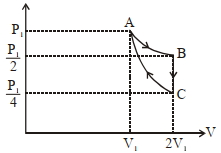
\(A-B=\) isothermal process\(W _{ AB }= P _{1} V _{1} \ln \left[\frac{2 V _{1}}{ V _{1}}\right]= P _{1} V _{1} \ln (2)\)
\(B - C \rightarrow\) Isochoric process
\(W _{ BC }=0\)
\(C - A \rightarrow\) Adiabatic process
\(W _{ CA }=\frac{ P _{1} V _{1}-\frac{ P _{1}}{4} \times 2 V _{1}}{1-\gamma}=\frac{ P _{1} V _{1}\left[1-\frac{1}{2}\right]}{1-\gamma}=\frac{ P _{1} V _{1}}{2(1-\gamma)}\)
\(W _{ net }= W _{ AB }+ W _{ BC }+ W _{ CA } \quad\left\{ P _{1} V _{1}= RT \right\}\)
\(= P _{1} V _{1} \ln (2)+0+\frac{ P _{1} V _{1}}{2(1-\gamma)}\)
\(W _{\text {net }}= RT \left[\ln (2)-\frac{1}{2(\gamma-1)}\right]\)
-
- (A) \(25\)
- (B) \(40\)
- (C) \(50\)
- (D) \(60\)
Show answer and solution
Correct Answer: (C)
\(P=k V^{3}\)\(T_{i}=100^{\circ} C \)
\(T _{ f }=300^{\circ} C\)
\(\Delta T =300-100\)
\(\Delta T =200^{\circ} C\)
\(P = kV ^{3}\)
now \(PV = nRT\)
\(\therefore kV ^{4}= nRT\)
now \(4 kV ^{3} dV = nRdT\)
\(\therefore PdV = nRdT / 4\)
\(\therefore\) Work \(=\int PdV =\int \frac{ nRdT }{4}=\frac{ nR }{4} \Delta T\)
\(=\frac{200}{4} \times nR =50 nR\)
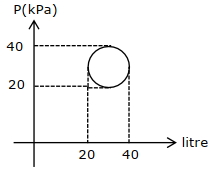
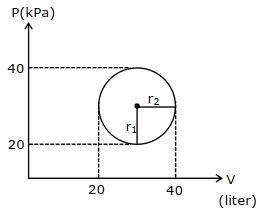
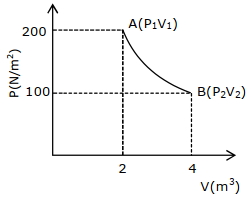
- 13. In the reported figure, heat energy absorbed by a system in going through a cyclic process is \(......\,\pi J\)
 2021 Medium
- (A) \(50\)
- (B) \(150\)
- (C) \(100\)
- (D) \(200\)
Show answer and solution
Correct Answer: (C)
For complete cyclic process\(\Delta U=0\)
\(\therefore \text { from } \Delta Q=\Delta U+W\)
\(=0+W\)
\(\Delta Q=W\)
\(=\text { Area }\)
\(=\pi r_{1} \cdot r_{2}\)
\(=\pi \times\left(10 \times 10^{3}\right)\left(10 \times 10^{-3}\right)\)
\(\Delta Q=100 \pi\)
\(\therefore \text { Ans. }=100\)
-
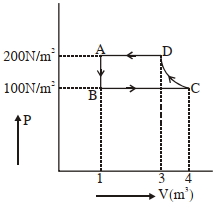
- (A) \({W}_{{AB}}\,<\,{W}_{{CD}}\)
- (B) \({W}_{{AD}}={W}_{{BC}}\)
- (C) \({W}_{{BC}}+{W}_{{DA}}\,>\,0\)
- (D) \({W}_{{AB}}={W}_{{DC}}\)
Show answer and solution
Correct Answer: (B)
Work done in adiabatic process \(=\frac{-n R}{\gamma-1}\left(T_{f}-T_{i}\right)\)\(\therefore W _{ AD }=\frac{- nR }{\gamma-1}\left( T _{2}- T _{1}\right)\)
\(\text { and } W _{ BC }=\frac{- nR }{\gamma-1}\left( T _{2}- T _{1}\right)\)
\(\therefore W _{ AD }= W _{ BC }\)
-
- (A) Path functions
- (B) Intensive thermodynamic state variables
- (C) Extensive thermodynamic state variables
- (D) Point functions
Show answer and solution
Correct Answer: (A)
Heat and work are treated as path functions in thermodynamics.\(\Delta Q =\Delta U +\Delta W\)
Since work done by gas depends on type of
process i.e. path and \(\Delta U\) depends just on initial
and final states, so \(\Delta Q\) i.e. heat, also has to
depend on process is path.
-
- (A) \(( a ) \rightarrow( i ),( b ) \rightarrow( iii ),( c ) \rightarrow( ii ),( d ) \rightarrow( iv )\)
- (B) \(( a ) \rightarrow( ii ),( b ) \rightarrow( iii ),( c ) \rightarrow( iv ),( d ) \rightarrow( i )\)
- (C) \((a) \rightarrow (ii), (b) \rightarrow( iv ),( c ) \rightarrow( iii ),( d ) \rightarrow( i )\)
- (D) \((a) \rightarrow( iii ),( b ) \rightarrow( ii ),( c ) \rightarrow( i ),( d ) \rightarrow( iv )\)
Show answer and solution
Correct Answer: (B)
\((a)\) Isothermal \(\Rightarrow\) Temperature constant\((a)\) \(\rightarrow\) \((ii)\)
\((b)\) Isochoric \(\Rightarrow\) Volume constant
\((a)\) \(\rightarrow\) \((iii)\)
\((c)\) Adiabatic \(\Rightarrow \Delta Q=0\)
\(\Rightarrow\) Heat content is constant
\((c)\) \(\rightarrow\) \((iv)\)
\((d)\) Isobaric \(\Rightarrow\) Pressure constant
\((d)\) \(\rightarrow\) \((i)\)
-
- (A) \(0\)
- (B) \(nRT \left(\ln 2+\frac{1}{2}\right)\)
- (C) \(nRTIn2\)
- (D) \(nRT \left(\ln 2-\frac{1}{2}\right)\)
Show answer and solution
Correct Answer: (D)
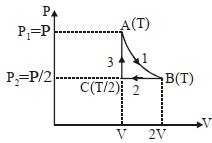
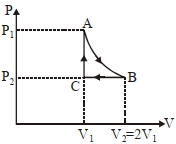
\(W _{\text {Isothermal }}= nRT \ln \left(\frac{ v _{2}}{ v _{1}}\right)\)\(W _{\text {Isobaric }}= P \Delta V = nR \Delta T\)
\(W _{\text {Isochoric }}=0\)
\(W _{1}= nRT \ln \left(\frac{2 V }{ V }\right)= nRT \ln 2\)
\(W _{2}= nR \left(\frac{ T }{2}- T \right)=- nR \frac{ T }{2}\)
\(W _{3}=0\)
\(\Rightarrow W _{ net }= W _{1}+ W _{2}+ W _{3}\)
\(W _{ net }= nRT \left(\ln 2-\frac{1}{2}\right)\)
-
- (A) \(30012\)
- (B) \(2147\)
- (C) \(834\)
- (D) \(17258\)
Show answer and solution
Correct Answer: (D)
Process of isothermal\(W=n R T \ln \left(\frac{V_{2}}{V_{1}}\right)\)
\(1 \times 8.3 \times 300 \times \ln 2\)
\(=17258 \times 10^{-1} {J}\)
-
- (A) Work done on the gas is close to \(582\, J\)
- (B) Work done by the gas is close to \(332\, J\)
- (C) Work done by the gas is close to \(582 \,{J}\)
- (D) Work done on the gas is close to \(332 \,J\)
Show answer and solution
Correct Answer: (A)
For an ideal gas, each vibrational mode, corresponds to two degrees of freedom, hence, \({f}=3\) (trans.) \(+3(\) rot. \()+8(\) vib. \()=14\)\(\gamma=1+\frac{2}{f}\)
\(\gamma =1+\frac{2}{14}=\frac{8}{7}\)
\(W =\frac{n R \Delta T}{\gamma-1}=-582\)
As \({W}\,<\,0\). Work is done on the gas.
-
- (A) \(750\)
- (B) \(175\)
- (C) \(500\)
- (D) \(250\)
Show answer and solution
Correct Answer: (C)
\(\Delta Q=\Delta U+\Delta W\)Here \(\Delta W=0\)
\(\Delta Q=\Delta {U}={nC}_{v} \Delta {T}\)
\(\Delta Q=4 \times \frac{5 R}{2}(50)=500 \,{R}\)
-
- (A) \(-500\)
- (B) \(-400\)
- (C) \(400\)
- (D) \(200\)
Show answer and solution
Correct Answer: (A)
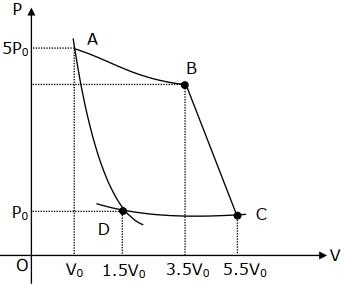
Adiabatic process is from \(C\) to \(D\)\(WD =\frac{ P _{2} V _{2}- P _{1} V _{1}}{1-\gamma}\)
\(=\frac{P_{D} V_{D}-P_{C} V_{C}}{1-\gamma}\)
\(=\frac{200(3)-(100)(4)}{1-1.4}\)
\(=-500\, J\)
-
- (A) \(25\)
- (B) \(2.5\)
- (C) \(125\)
- (D) \(250\)
Show answer and solution
Correct Answer: (A)
Pressure is not changing \(\Rightarrow\) isobaric process\(\Rightarrow \Delta {U}={n} {C}_{{v}} \Delta {T}=\frac{5 {nR} \Delta {T}}{2}\)
and \({W}={n} {R} \Delta {T}\)
\(\frac{\Delta {U}}{{W}}=\frac{5}{2}=\frac{{x}}{10} \Rightarrow {x}=25.00\)
-
- (A) \(50\)
- (B) \(60\)
- (C) \(48\)
- (D) \(72\)
Show answer and solution
Correct Answer: (B)
We know that work done is\(W =\int PdV\quad \ldots (1)\)
\(\Rightarrow P=\frac{ nRT }{ V }\quad \ldots (2)\)
\(\Rightarrow W =\int \frac{ nRT }{ V } dv\quad \ldots (3)\)
and \(V = KT ^{2 . / 3}\quad \ldots (4)\)
\(\Rightarrow W =\int \frac{ nRT }{ KT ^{2 / 3}} \cdot dv \quad \ldots (5)\)
\(\Rightarrow\) from (4)\(: dv =\frac{2}{3} KT ^{-1 / 3} dT\)
\(\Rightarrow W =\int_{ T _{1}}^{ T _{2}} \frac{ nRT }{ KT ^{2 / 3}} \frac{2}{3} K \frac{1}{ T ^{1 / 3}} dT\)
\(\Rightarrow W =\frac{2}{3} n R \times\left( T _{2}- T _{1}\right) \ldots(6)\)
\(\Rightarrow T _{2}- T _{1}=90 K \ldots(7)\)
\(\Rightarrow W=\frac{2}{3} n R \times 90\)
\(\Rightarrow W =60 nR\)
Assuming \(1\) mole of gas
\(n =1\)
So \(W =60 \,R\)
-
- (A) \(\frac{1}{2}\)
- (B) \(2\)
- (C) \(\sqrt{2}\)
- (D) \(\frac{1}{\sqrt{2}}\)
Show answer and solution
Correct Answer: (C)
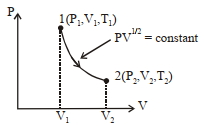
\(PV ^{1 / 2}= c\)\(\frac{ nRT }{ V } V ^{1 / 2}= c\)
\(T = c ^{1} V ^{1 / 2}\)
\(\frac{ T _{2}}{ T _{1}}=\left(\frac{ V _{2}}{ V _{1}}\right)^{1 / 2}=\left(\frac{2 V _{1}}{ V _{1}}\right)^{1 / 2}\)
\(\frac{ T _{2}}{ T _{1}}=\sqrt{2}\)
-
- (A) \(\frac{2}{3} {T}_{1}+\frac{1}{3} T_{3}\)
- (B) \(\frac{3}{2} {T}_{1}+\frac{1}{3} {T}_{3}\)
- (C) \(\frac{1}{3} {T}_{1}+\frac{2}{3} {T}_{3}\)
- (D) \(\frac{2}{3} {T}_{1}+\frac{3}{2} {T}_{3}\)
Show answer and solution
Correct Answer: (A)
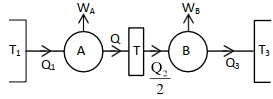
carnot engine is as shown\({W}_{{A}}=1-\frac{{Q}_{2}}{{Q}_{1}}=1-\frac{{T}}{{T}_{1}} \Rightarrow \frac{{Q}_{2}}{{Q}_{1}}=\frac{{T}}{{T}_{1}}\)
\({W}_{{B}}=1-\frac{{Q}_{3}}{\left({Q}_{2} / 2\right)}=1-\frac{{T}_{3}}{{T}} \Rightarrow \frac{2 {Q}_{3}}{{Q}_{2}}=\frac{{T}_{3}}{{T}}\)
Now, \({W}_{{A}}={W}_{{B}}\)
\({Q}_{1}-{Q}_{2}=\frac{{Q}_{2}}{2}-{Q}_{3}\)
\(\Rightarrow \frac{2 {Q}_{1}}{{Q}_{2}}+\frac{2 {Q}_{3}}{{Q}_{2}}=3\)
\(\Rightarrow \frac{2 {T}_{1}}{{T}}+\frac{{T}_{3}}{{T}}=3\)
\(\frac{2 {T}_{1}}{3}+\frac{{T}_{3}}{3}={T}\)
-
- (A) \((c)\) and \((a)\)
- (B) \((c)\) and \((d)\)
- (C) \((a)\) only
- (D) \((b)\) and \((c)\)
Show answer and solution
Correct Answer: (B)
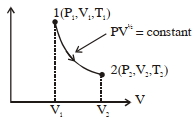
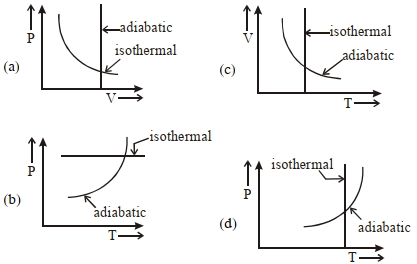
Option \((a)\) is wrong ; since in adiabatic process \(V \neq\) constantOption \((b)\) is wrong, since in isothermal process
\(T = constant\)
Option \((c)\) and \((d)\) matches isothermes and adiabatic formula :
\(TV ^{\gamma-1}=\) constant and \(\frac{ T ^{\gamma}}{ p ^{\gamma-1}}= constant\)
No questions on this page match these filters.