


JEE Mains · Chemistry · STD 11 - 5. Thermodynamics and thermochemistry
\(4.0\, L\) of an ideal gas is allowed to expand isothermally into vacuum until the total volume is \(20\, L.\) The amount of heat absorbed in this expansion is \(.....\,L\,atm\)
- A \(10\)
- B \(20\)
- C \(0\)
- D \(1\)
Answer & Solution
Correct Answer
(C) \(0\)
Step-by-step Solution
Detailed explanation
For free expansion: \(P _{\text {ext }}=0, w =0\) \(q =0, \Delta U =0\)
See the Complete Solution
Get step-by-step explanations for this and 2.5 Lakh+ more JEE, NEET & CET questions.
- Unlock all solutions
- Practice the full chapter
- Track accuracy across PYQs
4.8 rated on Google Play · 14,000+ reviews
More questions from Chemistry
- The correct set of four quantum numbers for the valence electron of rubidium atom \((Z=37)\) is _______.JEE Mains 2024 Hard
- Consider the following reactions. From these reactions which reaction will give carboxylic acid
as a major product ?
(A) \(\mathrm{R}-\mathrm{C} \equiv \mathrm{N} \xrightarrow[\text { mild condition }]{\text { (i) } \mathrm{H}^{+} / \mathrm{H}_2 \mathrm{O}}\)
(B) \(\mathrm{R}-\mathrm{MgX} \xrightarrow[\text { (ii) } \mathrm{H}_3 \mathrm{O}^{+}]{\text {(i) } \mathrm{CO}_2}\)
(C) \(\mathrm{R}-\mathrm{C} \equiv \mathrm{N} \xrightarrow[\text { (ii) } \mathrm{H}_3 \mathrm{O}^{+}]{\text {(i) } \mathrm{SnCl}_2 / \mathrm{HCl}}\)
(D) \(\mathrm{R} \cdot \mathrm{CH}_2 \cdot \mathrm{OH} \xrightarrow{\mathrm{PCC}}\)
(E)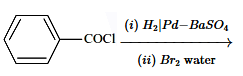
Choose the correct answer from the options given below:JEE Mains 2025 Easy - The maximum number of possible oxidation states of actinoids are shown byJEE Mains 2019 Medium
- Number of moles of \(AgCl\) formed in the following reaction is \(........\).
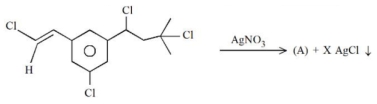 JEE Mains 2023 Hard
 - \(2 \mathrm{SO}_{2}(\mathrm{~g})+\mathrm{O}_{2}(\mathrm{~g}) \rightarrow 2 \mathrm{SO}_{3}(\mathrm{~g})\) The above reaction is carried out in a vessel starting with partial pressure \(\mathrm{P}_{\mathrm{SO}_{2}}=250\, \mathrm{~m}\) \(bar,\) \(\mathrm{P}_{0_{2}}=750 \,\mathrm{~m}\) \(bar\) and \(\mathrm{P}_{\mathrm{SO}_{3}}=0 \,\mathrm{bar}\). When the reaction is complete, the total pressure in the reaction vessel is \(.....\mathrm{m}\) \(bar.\) (Round off to the Nearest Integer).JEE Mains 2021 Medium
- For the given reactions \(Sn ^{2+}+2 e ^{-} \rightarrow Sn\) \(Sn ^{4+}+4 e ^{-} \rightarrow Sn\) The electrode potentials are; \(E _{ Sn ^{2+} / Sn }^{\circ}=-0.140\, V\) and \(E _{ Sn ^{4+} / Sn }^{\circ}=0.010\, V\). The magnitude of standard electrode potential for \(Sn ^{4+} / Sn ^{2+}\) i.e. \(E _{ Sn ^{4+} / Sn ^{2+}}^{\circ}\) is \(.....\times 10^{-2}\, V\). (Nearest integer)JEE Mains 2022 Medium
More PYQs from JEE Mains
- In the sulphur estimation, 0.20 g of a pure organic compound gave 0.40 g of barium sulphate. The percentage of sulphur in the compound is ______ \(\times 10^{-1} \%\).
(Molar mass : \(\mathrm{O}=16, \mathrm{~S}=32, \mathrm{Ba}=137\) in \(\mathrm{g} \mathrm{mol}^{-1}\) )JEE Mains 2025 Medium - A small ball of mass \(m\) is thrown upward with velocity \(u\) from the ground. The ball experiences a resistive force \(mkv ^{2}\) where \(v\) is its speed. The maximum height attained by the ball isJEE Mains 2020 Hard
- If \(y = y ( x )\) is the solution of the differential equation \(2 x^{2} \frac{d y}{d x}-2 x y+3 y^{2}=0 \quad\) such that \(y(e)=\frac{e}{3}\), then \(y(1)\) is equal toJEE Mains 2022 Hard
- Number of atoms in the following samples of substances is largest inJEE Mains 2013 Hard
- Two blocks of masses \(m\) and \(M\) are connected by means of a metal wire of cross-sectional area \(A\) passing over a frictionless fixed pulley as shown in the figure. The system is then released. If \(M = 2\, m\), then the stress produced in the wire is
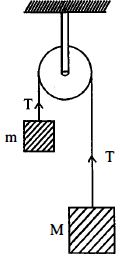 JEE Mains 2013 Hard
 - A radio-active material is reduced to \(1 / 8\) of its original amount in \(3\) days. If \(8 \times 10^{-3}\,kg\) of the material is left after \(5\) days. The initial amount of the material is \(.......\,g\)JEE Mains 2023 Medium