


Questions
Newest firstShowing 51–59 of 59 questions
-
- (A) \({N_2}(g) + 3{H_2}(g) \to 2N{H_3}(g)\)
- (B) \(2HI(g) \to H_2(g) + I_2(g)\)
- (C) \(2SO_2 (g) + O_2 (g) \to 2SO_3 (g)\)
- (D) \(2NO_2 (g) \to N_2O_4 (g)\)
Show answer and solution
Correct Answer: (B)
\(\Delta H = \Delta U + \Delta {n_g}RT\)\(2HI(g) \to {H_2}(g) + {I_2}(g);\Delta {n_g} = (1 + 1) - 2 = 0\)
\(\therefore \,\Delta H = \Delta U + 0\)
-
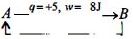
- (A) \(10\, J\) of the work will be done by the gas
- (B) \(6\, J\) of the work will be done by the gas
- (C) \(10\, J\) of the work will be done by the surrounding on gas
- (D) \(6\, J\) of the work will be done by the surrounding on gas.
Show answer and solution
Correct Answer: (D)
\(\Delta {U_{AB}} = q + w = + 5 + ( - 8) = - 3\)\(q = - 3,\,\Delta {U_{BA}} = + 3\)
\(\Delta {U_{BA}} = q + w\)
\( \Rightarrow 3 = - 3 + w \Rightarrow w = + 6\)
(work done on the system)
- 53. For a reaction, \(A(g) \to A(l)\); \(\Delta H = - 3RT\). The correct statement for the reaction is 2017 Hard
- (A) \(\Delta H = \Delta U \ne O\)
- (B) \(\Delta H = \Delta U = O\)
- (C) \(\left| {\Delta H} \right| < \left| {\Delta U} \right|\)
- (D) \(\left| {\Delta H} \right| > \left| {\Delta U} \right|\)
Show answer and solution
Correct Answer: (D)
\(A(g) \to A(1)\)\(\Delta H = \Delta U + \Delta {n_g}RT\)
Given, \(\Delta H = - 3RT\)
Here
\(\Delta {n_g} = {n_p} - {n_r} = 0 - 1 = - 1\)
\(\Delta H = \Delta U - RT\)
\( \Rightarrow - 3RT = \Delta U - RT\)
\( \Rightarrow - 3RT + RT = \Delta U\)
\( \Rightarrow - 2RT = \Delta U\)
\(|\Delta H|\, > \,|\Delta U|\)
-
- (A) \(+ 74.8\)
- (B) \(+ 144.0\)
- (C) \(- 74.8\)
- (D) \(- 144.0\)
Show answer and solution
Correct Answer: (C)
\(C(graphite) +\mathrm{O}_{2}(\mathrm{g}) \rightarrow \mathrm{CO}_{2}(\mathrm{g})\) \(\Delta_{r} H^{\circ}=-393.55\,\mathrm{kJ}\, \mathrm{mol}^{-1}\)\(\mathrm{H}_{2}(\mathrm{g})+\frac{1}{2} \mathrm{O}_{2}(\mathrm{g}) \rightarrow \mathrm{H}_{2} \mathrm{O}(\mathrm{l}) ; \)\(\quad \Delta_{r} H^{\circ}=-285.8\, \mathrm{kJ}\, \mathrm{mol}^{-1}\)
\(\mathrm{CO}_{2}(\mathrm{g})+2 \mathrm{H}_{2} \mathrm{O}(\mathrm{l}) \rightarrow \mathrm{CH}_{4}(\mathrm{g})+2 \mathrm{O}_{2}(\mathrm{g}) ;\)\( \Delta_{r} H^{\circ}=+890.3\,\mathrm{kJ}\,\mathrm{mol}^{-1}\)
\(C(graphite) +2 \mathrm{H}_{2}(\mathrm{g}) \rightarrow \mathrm{CH}_{4}(\mathrm{g}) ; \)\(\quad \Delta_{r} H^{\circ}=?\)
Now, Eq. \((4)= \) Eq. \((1)+2 \times\) Eq. \((2)+\) Eq. \(( 3)\)
\(\Delta_{r} H^{\circ}=-393.55+2(-285.8)+890.3\)
\(=-74.8\,\mathrm{kJ} \,\mathrm{mol}^{-1}\)
-
- (A) lsochoric work
- (B) Isobaric work
- (C) Adiabatic work
- (D) Isothermal work
Show answer and solution
Correct Answer: (C)
\(\Delta U = Q +\Delta W\)In adiabatic process no exchange of heat occurs between system and surrounding so \(Q =0\).
Thus, \(\Delta U\) is equal to adiabatic work.
-
- (A) \(124.50\)
- (B) \(249\)
- (C) \(498\)
- (D) \(62.25\)
Show answer and solution
Correct Answer: (A)
\(2{H_2}{O_2}(l) \leftrightarrow 2{H_2}O(l) + {O_2}(g)\)\(W = - {P_{ext}}(\Delta V) = - ({n_{{O_2}}})RT\)
\(\because \,100\) mole \({H_2}{O_2}\) on decomposition give \(50\) mol \({O_2}\)
\(\therefore \,W = - (50)(8.3)(300) = - 124500\,J\)
\( = - 124.5\,kJ\)
-
- (A) \(- 1366. 95\)
- (B) \(- 1361.95\)
- (C) \(- 1460.95\)
- (D) \(- 1350. 50\)
Show answer and solution
Correct Answer: (A)
\(C _{2} H _{5} OH ( l )+3 O _{2}( g ) \rightarrow 2 CO _{2}( g )+3 H _{2} O ( l )\)\(\Delta E =-1364.47 kJ mol ^{-1}\)
\(\Delta H =?\)
\(T =298 K\)
\(\Delta n _{ g }=-1 \because\) complete combution
\(R =8.314 J mol ^{-1}=\frac{8.314}{1000} kJ mol ^{-1}\)
\(\because \Delta H =\Delta E + P \Delta V\)
but, \(P \Delta V =\Delta n _{ g } RT\)
\(\because \Delta H =\Delta E +\Delta n _{ g } RT\)
\(\Delta H =-1364.47+\left((-1) \times \frac{8.314}{1000} \times 298\right)\)
\(\Delta H =-1366.95 kJ mol ^{-1}\)
-
- (A) \(q = +208\,J, \,w =-208\,J\)
- (B) \(q =-208\,J, w =-208\,J\)
- (C) \(q =-208\,J, w = +208\,J\)
- (D) \(q = +208\,J, w = +208\,J\)
Show answer and solution
Correct Answer: (A)
Solution:-As the heat is absorbed.
\(\therefore q =+208 J\)
Now for reversible isothermal process,
\(q =- W\)
\(\therefore W =- q =-208 J\)
Hence the values of \(q\) and \(W\) for the process will be \(+208 J\) and \(-208 J\) respectively.
- 59. Which of the following statements/ relationships is not correct in thermodynamic changes ? 2013 Hard
- (A) \(\Delta U\, = 0\) (isothermal reversible expansion of a gas)
- (B) \(w = - nRT\,\ln \frac{{{V_2}}}{{{V_1}}}\) ( isothermal reversible expansion of an ideal gas)
- (C) \(w = nRT\,\ln \frac{{{V_2}}}{{{V_1}}}\) (isothermal reversible expansion of an ideal gas)
- (D) For a system of constant volume heat involved directly changes to internal energy.
Show answer and solution
Correct Answer: (C)
For isothermal reversible expansion \(w = - nRT\,\ln \frac{{{V_2}}}{{{V_1}}}\)
No questions on this page match these filters.