


JEE Mains · Physics · STD 12 -7. Alternating current
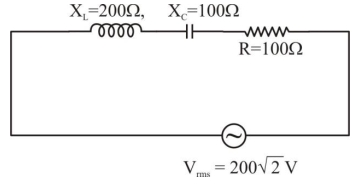
In the given circuit, rms value of current \(\left( I _{ rms }\right)\) through the resistor \(R\) is :\(..........\,A\)
- A \(2\)
- B \(\frac{1}{2}\)
- C \(20\)
- D \(2 \sqrt{2}\)
Answer & Solution
Correct Answer
(A) \(2\)
Step-by-step Solution
Detailed explanation
\(z =\sqrt{100^2+(200-100)^2}\) \(=100 \sqrt{2}\,\Omega\) \(i _{ rms }=\frac{ V _{ rms }}{ z }=\frac{200 \sqrt{2}}{100 \sqrt{2}}\) \(=2\,A\)
See the Complete Solution
Get step-by-step explanations for this and 2.5 Lakh+ more JEE, NEET & CET questions.
- Unlock all solutions
- Practice the full chapter
- Track accuracy across PYQs
4.8 rated on Google Play · 14,000+ reviews
More questions from Physics
- Two harmonic waves moving in the same direction superimpose to form a wave \(\mathrm{x}=\mathrm{a} \cos (1.5 \mathrm{t}) \cos (50.5 \mathrm{t})\) where \(t\) is in seconds. Find the period with which they beat (close to nearest integer)JEE Mains 2025 Medium
- A particle starts moving from time \(t=0\) and its coordinate is given as \(x(t)=4t^{3}-3t.\)
A. The particle returns to its original position (origin) 0.866 units later
B. The particle is 1 unit away from origin at its turning point.
C. Acceleration of the particle is non-negative.
D. The particle is 0.5 units away from origin at its turning point.
E. Particle never turns back as acceleration is non-negative.
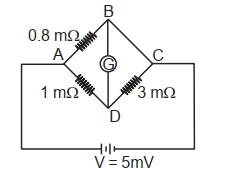
Choose the correct answer from the options given below :JEE Mains 2026 Hard - To measure the temperature coefficient of resistivity \(\alpha\) of a semiconductor, an electrical arrangement shown in the figure is prepared. The arm BC is made up of the semiconductor. The experiment is being conducted at \(25^{\circ} \mathrm{C}\) and resistance of the semiconductor arm is \(3 \mathrm{~m} \Omega\). Arm BC is cooled at a constant rate of \(2^{\circ} \mathrm{C} / \mathrm{s}\). If the galvanometer \(\mathrm{G}\) shows no deflection after \(10 \mathrm{~s}\), then \(\alpha\) is _______.
 JEE Mains 2024 Hard
 - In a meter bridge experiment, the circuit diagram and the corresponding observation table are shown in figure
Which of the readings is inconsistent ?\(Sl\). \(No\). \(R\, (\Omega )\) \(l\, (cm)\) \(1\). \(1000\) \(60\) \(2\). \(100\) \(13\) \(3\). \(10\) \(1.5\) \(4\). \(1\) \(1.0\) 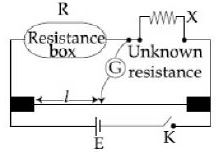 JEE Mains 2019 Medium
 - The position of a particle as a function of time \(t\), is given by \(x\left( t \right) = at+ b{t^2} - c{t^3}\) where \(a, b\) and \(c\) are constants. When the particle attains zero acceleration, then its velocity will beJEE Mains 2019 Hard
- The minimum energy required by a hydrogen atom in ground state to emit radiation in Balmer series is nearly _______.JEE Mains 2024 Hard
More PYQs from JEE Mains
- Three blocks \(A\), \(B\) and \(C\) are pulled on a horizontal smooth surface by a force of \(80 \mathrm{~N}\) as shown in figure. The tensions \(T_1\) and \(T_2\) in the string are respectively _______ and _______.
 JEE Mains 2024 Hard
 - Let \(S=\{1,2,3,4,5,6,7,8,9,10\}\). Define \(f: S \rightarrow S\) as \(f(n)=\left\{\begin{array}{cc}2 n, & \text { if } n=1,2,3,4,5 \\ 2 n-11 & \text { if } n=6,7,8,9,10\end{array}\right.\). Let \(g : S \rightarrow S\) be a function such that \(f o g(n)=\left\{\begin{array}{ll}n+1 & \text {, if } n \text { is odd } \\ n-1 & \text {, if } n \text { is even }\end{array}\right.\), then \(g (10)(( g (1)+ g (2)+ g (3)+ g (4)+ g (5))\) is equal toJEE Mains 2022 Hard
- A bag of sand of mass \(9.8\,kg\) is suspended by a rope. A bullet of \(200 \,g\) travelling with speed \(10\, ms ^{-1}\) gets embedded in it, then loss of kinetic energy will be \(...J\)JEE Mains 2022 Medium
- In a triangle \(ABC\), coordianates of \(A\) are \((1, 2)\) and the equations of the medians through \(B\) and \(C\) are \(x + y = 5\) and \(x = 4\) respectively. Then area of \(\Delta ABC\) (in sq. units) isJEE Mains 2018 Hard
- A radioactive substance decays to \(\left(\frac{1}{16}\right)^{t h}\) of its initial activity in \(80\, days.\) The half life of the radioactive substance expressed in days is ... .JEE Mains 2021 Medium
- An unpolarised light beam of intensity \(2 I _{0}\) is passed through a polaroid \(P\) and then through another polaroid \(Q\) which is oriented in such a way that its passing axis makes an angle of \(30^{\circ}\) relative to that of \(P\). The intensity of the emergent light is.JEE Mains 2022 Medium