


Questions
32 questionsShowing 1–32 of 32 questions
-
- (A) \(60\)
- (B) \(30\)
- (C) \(45\)
- (D) \(90\)
Show answer and solution
Correct Answer: (B)
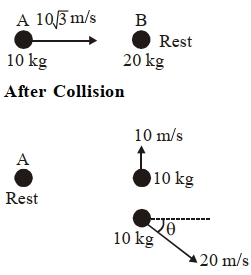
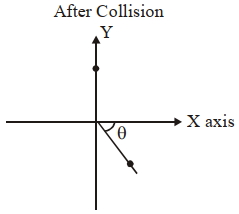
From conservation of momentum along \(x\) axis\(\overrightarrow{ P }_{ i }=\overrightarrow{ P }_{ f }\)
\(10 \times 10 \sqrt{3}=200 \cos \theta\)
\(\cos \theta=\frac{\sqrt{3}}{2}\)
\(\theta=30^{\circ}\)
-
- (A) \(15\)
- (B) \(24\)
- (C) \(20\)
- (D) \(30\)
Show answer and solution
Correct Answer: (C)
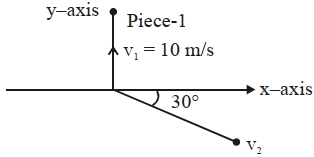
Let velocity of \(2^{\text {nd }}\) fragment is \(\vec{v}\) then by conservation of linear momentum\(10(10 \sqrt{3}) \hat{ i }=(10)(10 \hat{ j })+10 \overrightarrow{ v }\)
\(\Rightarrow \overrightarrow{ v }=10 \sqrt{3} \hat{ i }-10 \hat{ j }\)
\(|\overrightarrow{ v }|=\sqrt{300+100}=\sqrt{400}=20 m / s\)
-
- (A) \(4\)
- (B) \(9\)
- (C) \(6\)
- (D) \(12\)
Show answer and solution
Correct Answer: (C)
Let's say the compression in the spring by: \(y\).So, by work energy theorem we have
\(\Rightarrow \frac{1}{2} mv ^{2}=\frac{1}{2} ky ^{2}\)
\(\Rightarrow y =\sqrt{\frac{ m }{ k }} \cdot v\)
\(\Rightarrow y=\sqrt{\frac{4}{100}} \times 10\)
\(\Rightarrow y =2\, m\)
\(\Rightarrow\) final length of spring \(=8-2=6\, m\)
-
- (A) \(4\)
- (B) \(10\)
- (C) \(1\)
- (D) \(50\)
Show answer and solution
Correct Answer: (C)
\({P}_{{i}}={P}_{{f}}\)\({m} \times 40=\frac{{m}}{2} \times {v}+\frac{{m}}{2} \times 60\)
\(40=\frac{{v}}{2}+3\)
\(\Rightarrow {v}=20\)
\(({K} . {E} .)_{{I}}=\frac{1}{2} {m} \times(40)^{2}=800\, {m}\)
\(({K} . {E} .)_{{f}}=\frac{1}{2} \frac{{m}}{2} \cdot(20)^{2}+\frac{1}{2} \cdot \frac{{m}}{2}(60)^{2}=1000\, {m}\)
\(|\Delta {K} . {E} .|=|1000\, {m}-800 \,{m}|=200\, {m}\)
\(\frac{\Delta {K} . {E}}{({K} . {E} .)_{{i}}}=\frac{200 \,{m}}{800\, {m}}=\frac{1}{4}=\frac{{x}}{4}\)
\({x}=1\)

-
- (A) \(\frac{1}{3}\)
- (B) \(\frac{2}{3}\)
- (C) \(\frac{1}{8}\)
- (D) \(\frac{1}{4}\)
Show answer and solution
Correct Answer: (C)
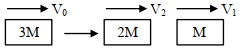
\(3 {MV}_{0}=2 {MV}_{2}+{MV}_{1}\)\(3 {V}_{0}=2 {V}_{2}+{V}_{1}\)
\(120=2 {V}_{2}+60 \Rightarrow {V}_{2}=30\, {m} / {s}\)
\(\frac{\Delta {K} {E}}{{K} . {E} .}=\frac{\frac{1}{2} {MV}_{1}^{2}+\frac{1}{2} 2 {M} V_{2}^{2}-\frac{1}{2} 3 {M} V_{0}^{2}}{\frac{1}{2} 3 {M} V_{0}^{2}}\)
\(=\frac{{V}_{1}^{2}+2 {V}_{2}^{2}-3 {V}_{0}^{2}}{3 {V}_{0}^{2}}\)
\(=\frac{3600+1800-4800}{4800}\)
\(=\frac{1}{8}\)
-
- (A) \(5\)
- (B) \(75\)
- (C) \(25\)
- (D) \(50\)
Show answer and solution
Correct Answer: (C)
\(p_{i}=p_{f}\)\(2 \times 4=2 \times 1+m_{2} \times v_{2}\)
\(m_{2} v_{2}=6\)
by coefficient of restitution
\(1=\frac{v_{2}-1}{4} \Rightarrow v_{2}=5 m / s\)
\(m _{2} \times 5=6\)
\(m _{2}=1.2 kg\)
\(v _{ cm }=\frac{ m _{1} v _{1}+ m _{2} v _{2}}{ m _{1}+ m _{2}}\)
\(v _{ cm }=\frac{2 \times 1+1.2 \times 5}{2+1.2}=\frac{8}{3.2}=\frac{25}{10}\)
\(x =25\)
-
- (A) \(0.68\)
- (B) \(1\)
- (C) \(1.64\)
- (D) \(0.64\)
Show answer and solution
Correct Answer: (A)
Work done \(=\) Change in kinetic energy\({W}_{{mg}}+{W}_{{air}-\text { fiction }}=\frac{1}{2} {m}(.8 \sqrt{{gh}})^{2}-\frac{1}{2} {m}(0)^{2}\)
\({W}_{\text {air - fiction }}=\frac{.64}{2} {mgh}-{mgh}=0.68 {mgh}\)
-
- (A) \(4\)
- (B) \(1\)
- (C) \(3\)
- (D) \(2\)
Show answer and solution
Correct Answer: (C)
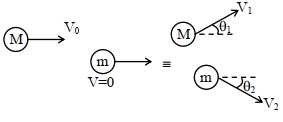
given \(\theta_{1}=\theta_{2}=\theta\)from momentum conservation
in \(x\)-direction \(M V_{0}=M V_{1} \cos \theta+m V_{2} \cos \theta\)
in \({y}\)-direction \(0={MV}_{1} \sin \theta-{m} {V}_{2} \sin \theta\)
Solving above equations
\({V}_{2}=\frac{{MV}_{1}}{{m}}, {V}_{0}=2 {V}_{1} \cos \theta\)
From energy conservation
\(\frac{1}{2} {MV}_{0}^{2}=\frac{1}{2} {MV}_{1}^{2}+\frac{1}{2} {MV}_{2}^{2}\)
Substituting value of \({V}_{2} \& {V}_{0}\), we will get
\(\frac{{M}}{{m}}+1=4 \cos ^{2} \theta \leq 4\)
\(\frac{{M}}{{m}} \leq 3\)
-
- (A) \(19.0\)
- (B) \(4.47\)
- (C) \(14.41\)
- (D) \(1.00\)
Show answer and solution
Correct Answer: (B)
Given, \(m =0.5 kg\) and \(u =20 m / s\)Initial kinetic energy \(\left( k _{ i }\right)=\frac{1}{2} mu ^{2}\)
\(=\frac{1}{2} \times 0.5 \times 20 \times 20=100 J\)
After deflection it moves with \(5 \%\) of \(k _{ i }\)
\(\therefore k _{ f }=\frac{5}{100} \times k _{ i } \Rightarrow \frac{5}{100} \times 100\)
\(\Rightarrow k_{ f }=5 J\)
Now, let the final speed be 'v' \(m / s\), then :
\(k_{ f }=5=\frac{1}{2} mv ^{2}\)
\(\Rightarrow v ^{2}=20\)
\(\Rightarrow v =\sqrt{20}=4.47 m / s\)
-
- (A) \(1000\)
- (B) \(400\)
- (C) \(100\)
- (D) \(10\)
Show answer and solution
Correct Answer: (B)
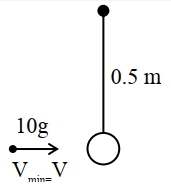
\({V}^{\prime}=\sqrt{5 {gR}}=\sqrt{5 \times 10 \times 0.5}\)\({V}^{\prime}=5\, {m} / {s}\)
\({m}_{1} {V}={m}_{2} \times 5-{m}_{1} \times 100\)
\(\frac{10}{1000} \times {V}=5-\frac{10}{1000} \times 100\)
\({V}=400\, {m} / {s}\)
-
- (A) \(t^{2 / 3}\)
- (B) \(t ^{3 / 2}\)
- (C) \(t\)
- (D) \(t ^{1 / 2}\)
Show answer and solution
Correct Answer: (B)
\(P=C\)\(F V=C\)
\(M \frac{d V}{d t} V=C\)
\(\frac{V^{2}}{2} \propto t\)
\(V \propto t^{1 / 2}\)
\(\frac{d x}{d t} \propto t^{1 / 2}\)
\(x \propto t^{3 / 2}\)
-
- (A) \(300\)
- (B) \(75\)
- (C) \(150\)
- (D) \(450\)
Show answer and solution
Correct Answer: (D)
\(F=(5 y+20) \hat{j}\)\(W=\int F d y=\int_{0}^{10}(5 y+20) d y\)
\(=\left(\frac{5 y^{2}}{2}+20 y\right)_{0}^{10}\)
\(=\frac{5}{2} \times 100+20 \times 10\)
\(W=250+200=450 J\)
-
- (A) \(846.5\)
- (B) \(821.5\)
- (C) \(831.5\)
- (D) \(886.4\)
Show answer and solution
Correct Answer: (C)
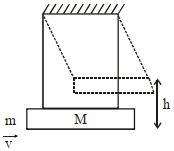
From energy conservation,\([\) after bullet gets embedded till the system comes momentarily at rest \(]\)
\(( M + m ) g h =\frac{1}{2}( M + m ) v _{1}^{2}\)
\(\left[ v _{1}\right.\) is velocity after collision]
\(\therefore v _{1}=\sqrt{2 gh }\)
Applying momentum conservation, (just before and just after collision)
\(mv =( M + m ) v _{1}\)
\(v =\left(\frac{ M + m }{ m }\right) v _{1}=\frac{6}{10 \times 10^{-3}} \times \sqrt{2 \times 9.8 \times 9.8 \times 10^{-2}}\)
\(\approx 831.55\, m / s\)
-
- (A) \(+627.2 {J}\)
- (B) \(-62720.0 {J}\)
- (C) \(784.0 {J}\)
- (D) \(-627.2 {J}\)
Show answer and solution
Correct Answer: (D)
\(W_{\text {Porter }}+W_{m g}=\Delta K . E_{.}=0\)\(W_{\text {Porter }}=-W_{{mg}}=-m g h\)
\(=-80 \times 9.8 \times 0.8=-627.2\, {J}\)
-
- (A) \(3.0\)
- (B) \(3.50\)
- (C) \(2.0\)
- (D) \(2.50\)
Show answer and solution
Correct Answer: (D)
\(v _{0}=\sqrt{2 gh }\)\(v = e \sqrt{2 gh }=\sqrt{2 gh }\)
\(\Rightarrow e =0.9\)
\(S = h +2 e ^{2} h +2 e ^{4} h +\ldots \ldots \ldots\)
\(t =\sqrt{\frac{2 h }{ g }}+2 e \sqrt{\frac{2 h }{ g }}+2 e ^{2} \sqrt{\frac{2 h }{ g }}+\ldots \ldots \ldots\)
\(v _{ av }=\frac{ s }{ t }=2.5\, m / s\)
-
- (A) \(1\)
- (B) \(2\)
- (C) \(3\)
- (D) \(4\)
Show answer and solution
Correct Answer: (B)
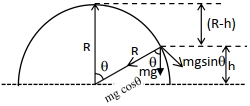
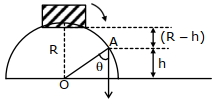
on balancing\(m g \cos \theta=\frac{m v^{2}}{R}....(1)\)
\(\cos \theta=\frac{h}{R}\)
Energy conservation
\(m g\{R-h\}=\frac{1}{2} m v^{2}....(2)\)
From \((1)\) and \((2) \Rightarrow m g\left\{\frac{h}{R}\right\}=\frac{2 m g\{R-h\}}{R}\)
\(h=\frac{2 R}{3}=2\, m\)
-
- (A) \(0\)
- (B) \(10\)
- (C) \(5\)
- (D) \(8\)
Show answer and solution
Correct Answer: (C)
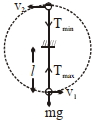
Let the speed of bob at lowest position be \(v _{1}\) and at the highest position be \(v _{2}\).Maximum tension is at lowest position and minimum tension is at the highest position. Now, using, conservation of mechanical energy,
\(\frac{1}{2} mv _{1}^{2}=\frac{1}{2} mv _{2}^{2}+ mg 2 l\)
\(\Rightarrow v _{1}^{2}= v _{2}^{2}+4 g l\) \(......(1)\)
Now \(T _{\max }- mg =\frac{ mv _{1}^{2}}{l}\)
\(\Rightarrow T _{\max }= mg +\frac{ mv _{1}^{2}}{l}\)
and \(T _{\min }+ mg =\frac{ mv _{2}^{2}}{l}\)
\(\Rightarrow T _{\min }=\frac{ mv _{2}^{2}}{l}- mg\)
\(\frac{ T _{\max }}{ T _{\min }}=\frac{5}{1}\)
\(\Rightarrow \frac{ mg +\frac{ mv _{1}^{2}}{l}}{\frac{ mv _{2}^{2}}{l}- mg }=\frac{5}{1}\)
\(\Rightarrow mg +\frac{ mv _{1}^{2}}{l}=\left[\frac{ mv _{2}^{2}}{l}- mg \right] 5\)
\(\Rightarrow mg +\frac{ m }{l}\left[ v _{2}^{2}+4 g l\right]=\frac{5 mv _{2}^{2}}{l}-5 mg\)
\(\Rightarrow mg +\frac{ mv _{2}^{2}}{l}+4 mg =\frac{5 mv _{2}^{2}}{l}-5 mg\)
\(\Rightarrow 10 mg =\frac{4 mv _{2}^{2}}{l}\)
\(v _{2}{ }^{2}=\frac{10 \times 10 \times 1}{4}\)
\(\Rightarrow v _{2}^{2}=25 \Rightarrow v _{2}=5 m / s\)
Thus, velocity of bob at highest position is \(5 m / s\)
-
- (A) \(40\)
- (B) \(60\)
- (C) \(400\)
- (D) \(10\)
Show answer and solution
Correct Answer: (A)
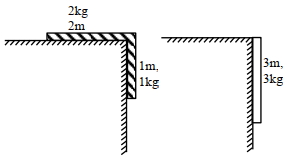
From energy conservation\({K}_{{i}}+{U}_{{i}}={k}_{{f}}+{U}_{{f}}\)
\(0+\left(-1 \times 10 \times \frac{1}{2}\right)={k}_{{f}}+\left(-3 \times 10 \times \frac{3}{2}\right)\)
\(-5={k}_{{f}}-45\)
\({k}_{{f}}=40 \,{J}\)
-
- (A) \(\left(\frac{8 {P}}{9 {m}}\right)^{\frac{1}{2}} {t}^{\frac{3}{2}}\)
- (B) \(\left(\frac{8 {P}}{9 {m}}\right)^{\frac{1}{2}} {t}^{\frac{2}{3}}\)
- (C) \(\left(\frac{9 {m}}{8 {P}}\right)^{\frac{1}{2}} {t}^{\frac{3}{2}}\)
- (D) \(\left(\frac{9 {P}}{8 {m}}\right)^{\frac{1}{2}} {t}^{\frac{3}{2}}\)
Show answer and solution
Correct Answer: (A)
If 10.Power is constant\(P=\text { const. }\)
\(P=F v=\frac{m v^{2} d v}{d x}\)
\(\int_{0}^{x} \frac{P}{m} d x=\int_{0}^{v} v^{2} d v\)
\(\frac{P x}{m}=\frac{v^{3}}{3}\)
\(\left(\frac{3 P x}{m}\right)^{1 / 3}=v=\frac{d x}{d t}\)
\(\left(\frac{3 P}{m}\right)^{1 / 3} \int_{0}^{t} d t=\int_{0}^{x} x^{-1 / 3} d x\)
\(\Rightarrow x=\left(\frac{8 P}{9 m}\right)^{1 / 2} t^{3 / 2}\)
-
- (A) \(16\)
- (B) \(400\)
- (C) \(1.6\)
- (D) \(160\)
Show answer and solution
Correct Answer: (A)
\(\text { Work }=\Delta K . E\)\(W_{\text {friction }}+W_{\text {spring }}=0-\frac{1}{2} m v^{2}\)
\(-\frac{90}{100}\left(\frac{1}{2} m v^{2}\right)+W_{\text {Spring }}=-\frac{1}{2} m v^{2}\)
\({W}_{\text {spring }}=-\frac{10}{100} \times \frac{1}{2} {mv}^{2}\)
\(-\frac{1}{2} {kx}^{2}=-\frac{1}{20} {mv}^{2}\)
\(\Rightarrow {k}=\frac{40000 \times(20)^{2}}{10 \times(1)^{2}}=16 \times 10^{5}\)
-
- (A) \(3:1\)
- (B) \(2:1\)
- (C) \(1:2\)
- (D) \(1:1\)
Show answer and solution
Correct Answer: (A)
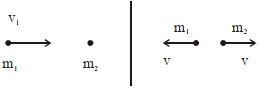
\(m _{1} v _{1}=- m _{1} v + m _{2} v\)\(v _{1}=- v +\frac{ m _{2}}{ m _{1}} v\)
\(\frac{\left( v _{1}+ v \right)}{ v }=\frac{ m _{2}}{ m _{1}}\)
\(e =\frac{2 v }{ v _{1}}=1\)
\(v =\frac{ v _{1}}{2}\)
\(\frac{ v _{1}+ v _{1} / 2}{ v _{1} / 2}=\frac{ m _{2}}{ m _{1}}\)
\(3=\frac{ m _{2}}{ m _{1}}\)
-
- (A) \(5\)
- (B) \(8\)
- (C) \(12\)
- (D) \(10\)
Show answer and solution
Correct Answer: (D)
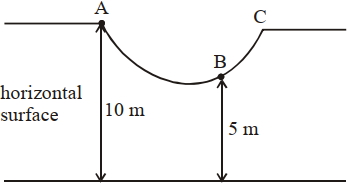
Using work energy theorem,\(W _{ g }=\Delta K . E\)
\((10)(g)(5)=\frac{1}{2}(10) v^{2}-0\)
\(v =10 m / s\)
-
- (A) \(A\) is not correct but \(R\) is correct.
- (B) Both \(A\) and \(R\) are correct but \(R\) is \(NOT\) the correct explanation of \(A\).
- (C) Both \(A\) and \(R\) are correct and \(R\) is the correct explanation of \(A\).
- (D) \(A\) is correct but \(R\) is not correct.
Show answer and solution
Correct Answer: (C)
For \(e =1\) and second body at rest\(V_{2}=\frac{2 m_{1} u_{1}}{m_{1}+m_{2}}=\frac{2 u(M)}{M+m} \simeq 2 u\)
Since \(M > >m\)
-
- (A) at \(x=x_{3}\), \(K.E.=4\;J\)
- (B) at \(x=x_{2}\), \(K.E.\) is greatest and the particle is moving at the fastest speed.
- (C) at \(x\,<\,x_{1}\), \(K.E.\) is smallest and the particle is moving at the slowed speed.
- (D) at \(x\,>\,x_{4}\), \(K.E.\) is constant throughout the region.
Show answer and solution
Correct Answer: (C)
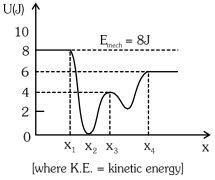
Given\(\left.E_{\text {mech. }}=8\right]\)
\((A)\) at \(x\,>\,x_{4}, \quad U=\) constant \(\left.=6\right]\)
\({K}={E}_{{mech} .}-{U}=2\, {J}=\) constant
\((B)\) at \(x\,<\,x_{1}, \quad U=\) constant \(\left.=8\right]\)
\({K}={E}_{\text {mech. }}-{U}=8-8=0 \,{J}\)
Particle is at rest.
\((C)\) At \(x=x_{2}, U=0 \Rightarrow E_{\text {mech. }}=K=8\) ]
\({KE}\) is greatest, and particle is moving at fastest speed.
\((C)\) \((D)\) At \(\left.x=x_{3}, \quad U=4\right]\)
\({U}+{K} =8\, {J}\)
\({K} =4\, {J}\)
-
- (A) \(100\)
- (B) \(300\)
- (C) \(400\)
- (D) \(200\)
Show answer and solution
Correct Answer: (A)
\({K}_{2}=4 {K}_{1}\)\(\frac{1}{2} m v_{2}^{2}=4 \frac{1}{2} m v_{1}^{2}\)
\(v_{2}=2 v_{1}\)
\(P=m v\)
\(P_{2}=m v_{2}=2 m v_{1}\)
\(P_{1}=m v_{1}\)
\(\% \,\text { change }=\frac{\Delta P}{P_{1}} \times 100=\frac{2 m v_{1}-m v_{1}}{m v_{1}} \times 100=100\, \%\)
-
- (A) \(51\)
- (B) \(212\)
- (C) \(1\)
- (D) \(9\)
Show answer and solution
Correct Answer: (C)
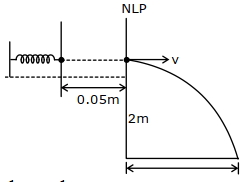
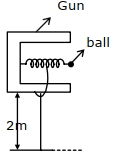
\(\frac{1}{2} k x^{2}=\frac{1}{2} m v^{2}\)\(k x^{2}=m v^{2}\)
\(V=x \sqrt{\frac{k}{m}}=0.05 \sqrt{\frac{100}{1}}=0.05 \times 10 \sqrt{10}\)
\(v=0.5 \sqrt{10}\)
From \(h=\frac{1}{2} g t^{2}\)
\(t=\sqrt{\frac{2 h}{g}}=\sqrt{\frac{2 \times 2}{10}}=\frac{2}{\sqrt{10}}\)
\(\therefore d=v t=0.5 \sqrt{10} \times \frac{2}{\sqrt{10}}=1\, {m}\)
-
- (A) \(2\)
- (B) \(1\)
- (C) \(3\)
- (D) \(0\)
Show answer and solution
Correct Answer: (B)
For equilibrium\(\frac{ dU }{ dr }=0\)
\(\frac{-10 \alpha}{r^{11}}+\frac{5 \beta}{r^{6}}=0\)
\(\frac{5 \beta}{r^{6}}=\frac{10 \alpha}{r^{11}}\)
\(r ^{3}=\frac{2 \alpha}{\beta}\)
\(r=\left(\frac{2 \alpha}{\beta}\right)^{\frac{1}{3}}\)
\(a=1\)
-
- (A) \(4\)
- (B) \(6\)
- (C) \(9\)
- (D) \(3\)
Show answer and solution
Correct Answer: (A)
After \(1^{st}\) collision\(m v_{A}=m v_{A}^{\prime}+2 m v_{B}^{\prime}\)
\(-1=\frac{v_{B}^{\prime}-v_{A}^{\prime}}{0-v_{A}} \Rightarrow v_{B}^{\prime}=6 m / s\)
After the \(2^{nd}\) collision
\(2 mv _{ B }^{\prime}=(2 m + m )_{ V _{ C }}\)
\(\Rightarrow v _{ C }=\frac{2}{3} v _{ B }^{\prime} \Rightarrow v _{ C }=4 m / s\)
-
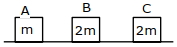
- (A) \(v\sqrt{\frac{ M }{2 K }}\)
- (B) \(\sqrt{\frac{ mv }{2 K }}\)
- (C) \(\sqrt{\frac{ mv }{ K }}\)
- (D) \({\sqrt{\frac{ m }{2 K }}}\)
Show answer and solution
Correct Answer: (A)
\(C\) comes to rest\(V_{c m}\) of \(A \& B=\frac{v}{2}\)
\(\Rightarrow \frac{1}{2}\) is \(v _{ ret }^{2}=\frac{1}{2} kx ^{2}\)
\(x=\sqrt{\frac{\mu \times v^{2}}{k}}=\sqrt{\frac{m}{2 k}} v\)
-
- (A) \(1\)
- (B) \(2\)
- (C) \(3\)
- (D) \(4\)
Show answer and solution
Correct Answer: (A)
\(\frac{ p _{1}^{2}}{2 \times 4}=\frac{ p _{2}^{2}}{2 \times 16}\)\(\frac{ p _{1}}{ p _{2}}=\frac{1}{2}\)
-
- (A) \(2\)
- (B) \(3\)
- (C) \(1\)
- (D) \(4\)
Show answer and solution
Correct Answer: (A)
\(\text { Given } {W}_{{A}}={W}_{{B}}\)\({F}_{{A}} {d} \cos 45^{\circ}={F}_{{B}} {d} \cos 60^{\circ}\)
\({F}_{A} \times \frac{1}{\sqrt{2}}={F}_{{B}} \times \frac{1}{2}\)
\(\frac{{F}_{{A}}}{{F}_{{B}}}=\frac{\sqrt{2}}{2}=\frac{1}{\sqrt{2}}\)
\({x}=2\)
-
- (A) \(1\)
- (B) \(2\)
- (C) \(3\)
- (D) \(4\)
Show answer and solution
Correct Answer: (B)
Kinetic energy \(K =\frac{ P ^{2}}{2 m },\left( P _{ A }= P _{ B }\right)\)\(K \propto \frac{1}{ m }\)
\(\frac{ K _{ A }}{ K _{ B }}=\frac{ m _{ B }}{ m _{ A }}\)
\(=\frac{2}{1}\)


No questions on this page match these filters.