


JEE Mains · Chemistry · STD 11 - 2. structure of atom
Consider the following pairs of electrons \((A)\) \((a)\) \(n=3,1=1, m_{l}=1, m_{s}=+\frac{1}{2}\) \(\quad (b)\) \(n =3,1=2, m _{l}=1, m _{s}=+\frac{1}{2}\) \((B)\) \((a)\) \(n =3,1=2, m _{l}=-2, m _{s}=-\frac{1}{2}\) \(\quad (b)\) \(n =3,1=2, m _{l}=-1, m _{s}=-\frac{1}{2}\) \((C)\) \((a)\) \(n=4,1=2, m_{l}=2, m_{s}=+\frac{1}{2}\) \(\quad (b)\) \(n =3,1=2, m _{l}=2, m _{s}=+\frac{1}{2}\) The pairs of electron present in degenerate orbitals is/are...... .
- A Only \(A\)
- B Only \(B\)
- C Only \(C\)
- D \((B)\) and \((C)\)
Answer & Solution
Correct Answer
(B) Only \(B\)
Step-by-step Solution
Detailed explanation
Based on \(" n+1 "\) rule only \((B)\) has pair of electron in degenerate orbitals
See the Complete Solution
Get step-by-step explanations for this and 2.5 Lakh+ more JEE, NEET & CET questions.
- Unlock all solutions
- Practice the full chapter
- Track accuracy across PYQs
4.8 rated on Google Play · 14,000+ reviews
More questions from Chemistry
- Which of the following mixing of 1 M base and 1 M acid leads to the largest increase in temperature?JEE Mains 2025 Hard
- \(2-\) hexene \(\xrightarrow[(ii)H_2O]{(i) O_3}\) Products The two products formed in above reaction are -JEE Mains 2023 Medium
- The third ionization enthalpy is minimum forJEE Mains 2020 Medium
- On heating a mixture of common salt and \(K_{2}Cr_{2}O_{7}\) with concentrated \(H_{2}SO_{4}\), a gas is evolved. Formula of the gas evolved and oxidation state of the central metal atom in the gas respectively are:JEE Mains 2026 Easy
- One mole of an alkane (x) requires \(8\) mole oxygen for complete combustion. Sum of number of carbon and hydrogen atoms in the alkane (x) is _______.JEE Mains 2026 Medium
- The compound that is white in color is _______.JEE Mains 2024 Medium
More PYQs from JEE Mains
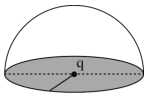
- If a charge \(q\) is placed at the centre of a closed hemispherical non-conducting surface, the total flux passing through the flat surface would be
 JEE Mains 2022 Medium
 - The correct order of the rate of the reaction for the following reaction with respect to nucleophiles is: \(CH_{3}Br + Nu^{\ominus} \longrightarrow CH_{3}Nu + Br^{\ominus}\)JEE Mains 2026 Medium
- The final product \(\mathrm{A}\), formed in the following reaction sequence is: \(\mathrm{Ph}-\mathrm{CH}=\mathrm{CH}_2 \xrightarrow[\text { (iii) } \mathrm{HBr}{(iv) \mathrm{Mg}, ether, then \mathrm{HCHO} / \mathrm{H}_3 \mathrm{O}^{+}}]{{(i)BH_3}{\text { (ii) } \mathrm{H}_2 \mathrm{O}_2,{ }^{\text {(-) }} \mathrm{OH}}} \mathrm{A}\)JEE Mains 2024 Hard
- Given below are two statements: Statement \(I :\) Rutherford's gold foil experiment cannot explain the line spectrum of hydrogen atom. Statement \(II :\) Bohr'smodel of hydrogen atom contradicts Heisenberg's uncertainty principle. In the light of the above statements, choose the most appropriate answer from the options given below :JEE Mains 2021 Medium
- The mass per unit length of a uniform wire is \(0.135\, g / cm\). A transverse wave of the form \(y =-0.21 \sin ( x +30 t )\) is produced in it, where \(x\) is in meter and \(t\) is in second. Then, the expected value of tension in the wire is \(x \times 10^{-2} N\). Value of \(x\) is . (Round-off to the nearest integer)JEE Mains 2021 Easy
- Given below are two statements:
Statement I : Hyperconjugation is not a permanent effect.
Statement II : In general, greater the number of alkyl groups attached to a positively charged C -atom, greater is the hyperconjugation interaction and stabilization of the cation.
In the light of the above statements, choose the correct answer from the options given belowJEE Mains 2025 Medium