


All Solution and colligative properties questions
Newest firstShowing 51–100 of 188 questions
-
- (A) \(702\)
- (B) \(704\)
- (C) \(705\)
- (D) \(707\)
Show answer and solution
Correct Answer: (D)
\( 2=0.52 \times \mathrm{m}\)\(\mathrm{m}=\frac{2}{0.52}\)
According to question, solution is much diluted
\(\text { so } \frac{\Delta \mathrm{P}}{\mathrm{P}^{\circ}}=\frac{\mathrm{n}_{\text {solate }}}{\mathrm{n}_{\text {soltron: }}}\)
\(\frac{\Delta \mathrm{P}}{\mathrm{P}^{\circ}}=\frac{\mathrm{m}}{1000} \times \mathrm{M}_{\text {solvent }}\)
\(\Delta \mathrm{P}=\mathrm{P}^{\circ} \times \frac{\mathrm{m}}{1000} \times \mathrm{M}_{\text {sohtwat }}\)
\(=760 \times \frac{\frac{2}{0.52}}{1000} \times 18=52.615\)
\(P_5=760-52.615=707.385 \mathrm{~mm} \text { of } \mathrm{Hg}\)
-
- (A) \(31\)
- (B) \(35\)
- (C) \(37\)
- (D) \(40\)
Show answer and solution
Correct Answer: (A)
As moles of water \(>\) moles of \(\mathrm{CH}_3 \mathrm{COOH}\) water is solvent.\(\mathrm{T}_{\mathrm{F}}^{\circ}-\left(\mathrm{T}_{\mathrm{F}}\right)_{\mathrm{S}}=\mathrm{K}_{\mathrm{F}} \times \mathrm{M}\)
\(0-\left(\mathrm{T}_{\mathrm{F}}\right)_{\mathrm{S}}=1.86 \times \frac{2700 / 60}{2700 / 1000}\)
\(\left(\mathrm{~T}_{\mathrm{F}}\right)_{\mathrm{S}}=-31^{\circ} \mathrm{C}.\)
-
- (A) \(3\)
- (B) \(5\)
- (C) \(6\)
- (D) \(8\)
Show answer and solution
Correct Answer: (B)
\(\mathrm{AB}_2 \rightarrow \mathrm{A}^{+2}+2 \mathrm{~B}^{\ominus}\)\(\mathrm{i}=1+(3-1) \alpha\)
\(\mathrm{i}=1+2 \alpha\)
\(\Delta \mathrm{T}_{\mathrm{b}}=\mathrm{k}_{\mathrm{b}} \mathrm{im}\)
\(0.52=0.52(1+2 \alpha) \frac{\frac{10}{200}}{\frac{100}{1000}}\)
\(1=(1+2 \alpha) \frac{10}{20}\)
\(2=1+2 \alpha\)
\(\alpha=0.5\)
Ans. \(\alpha=5 \times 10^{-1}\)
- 54. A solution of two miscible liquids showing negative deviation from Raoult's law will have : 2024 Hard
- (A) increased vapour pressure, increased boiling point
- (B) increased vapour pressure, decreased boiling point
- (C) decreased vapour pressure, decreased boiling point
- (D) decreased vapour pressure, increased boiling point
Show answer and solution
Correct Answer: (D)
Solution with negative deviation has
\( \mathrm{P}_{\mathrm{T}}<\mathrm{P}_{\mathrm{A}^0} \mathrm{X}_{\mathrm{A}} +\mathrm{P}_{\mathrm{B}^0} \mathrm{X}_{\mathrm{B}} \)
\( \mathrm{P}_{\mathrm{A}}<\mathrm{P}_{\mathrm{A}^0} \mathrm{X}_{\mathrm{A}} \)
\( \mathrm{P}_{\mathrm{B}}<\mathrm{P}_{\mathrm{B}^0} \mathrm{X}_{\mathrm{B}} \)
If vapour pressure decreases so boiling point increases. -
- (A) \(10\)
- (B) \(20\)
- (C) \(25\)
- (D) \(30\)
Show answer and solution
Correct Answer: (C)
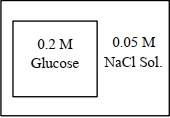
\(\mathrm{NaCl} \longrightarrow \mathrm{Na}^{+}+\mathrm{Cl}^{-}\)\(0.05 \mathrm{M} \quad 0.05 \mathrm{M} \quad 0.05 \mathrm{M}\)
\(\text { Total } \mathrm{C}_1=0.05+0.05=0.1 \mathrm{M}(\mathrm{NaCl})\)
\(\mathrm{C}_2=0.2 \mathrm{M}(\text { glucose })\)
\(\pi=\left(\mathrm{C}_2-\mathrm{C}_1\right) \mathrm{RT}\)
\(=(0.2-0.1) \times 0.083 \times 300\)
\(=2.49 \text { bar }\)
\(=24.9 \times 10^{-1} \text { bar }\)
-
- (A) \(76\)
- (B) \(77\)
- (C) \(79\)
- (D) \(80\)
Show answer and solution
Correct Answer: (A)
\(\mathrm{HX} \rightleftharpoons \mathrm{H}^{+}+\mathrm{X}^{-} \quad \mathrm{K}_{\mathrm{a}}=1.2 \times 10^{-5}\)\(0.03 \mathrm{M}\)
\(0.03-\mathrm{x} \quad \mathrm{x} \quad \mathrm{x}\)
\(\mathrm{K}_{\mathrm{a}}=1.2 \times 10^{-5}=\frac{\mathrm{x}^2}{0.03-\mathrm{x}}\)
\(0.03-\mathrm{x} \approx 0.03\left(\mathrm{~K}_{\mathrm{a}}\right. \text { is very small) }\)
\(\frac{\mathrm{x}^2}{0.03}=1.2 \times 10^{-5}\)
\(\mathrm{x}=6 \times 10^{-4}\)
\(\text { Final solution }: 0.03-\mathrm{x}+\mathrm{x}+\mathrm{x}\)
\(=0.03+\mathrm{x}=0.03+6 \times 10^{-4}\)
\(\Pi=\left(0.03+\left(6 \times 10^{-4}\right)\right) \times 0.083 \times 300\)
\(=76.19 \times 10^{-2} \approx 76 \times 10^{-2}\)
-
- (A) \(19\)
- (B) \(20\)
- (C) \(25\)
- (D) \(30\)
Show answer and solution
Correct Answer: (A)
\(\text { Mass of } \mathrm{CH}_3 \mathrm{COOH}=\mathrm{V} \times \mathrm{d}\)\(=5 \mathrm{ml} \times 1.2 \mathrm{~g} / \mathrm{ml}\)
\(=6 \mathrm{gm}\)
\(\mathrm{n}_{\mathrm{CH}_3 \mathrm{COOH}}=\frac{6}{60}=0.1 \mathrm{~mol}\)
\(\mathrm{~m}_{\mathrm{CH}_3 \mathrm{COOH}} \approx \mathrm{M}_{\mathrm{CH}_3 \mathrm{COOH}}=\frac{0.1}{1}=0.1 \mathrm{M}\)
\(\mathrm{CH}_3 \mathrm{COOH} \rightleftharpoons \mathrm{CH}_3 \mathrm{COO}^{-}+\mathrm{H}^{+}\)
\(\mathrm{C}\)
\(\mathrm{C}-\mathrm{C} \alpha\)
\(\mathrm{K}_{\mathrm{a}}=\frac{\mathrm{C} \alpha^2}{1-\alpha}\)
\(1-\alpha \approx 1 \Rightarrow \mathrm{K}_{\mathrm{a}}=\mathrm{C}^2\)
\(\alpha=\sqrt{\frac{\mathrm{Ka}^2}{\mathrm{C}}}=\sqrt{\frac{6.25 \times 10^{-5}}{0.1}}=25 \times 10^{-3}\)
\(\mathrm{~V} . \mathrm{f} .(\mathrm{i})=1+\alpha(\mathrm{n}-1)=1+\alpha(2-1)=1+\alpha\)
\(=1+25 \times 10^{-3}=1.025\)
\(\Delta \mathrm{T}_{\mathrm{r}}=i \mathrm{~K} \mathrm{~m}\)
\(=(1.025)(1.86)(0.1)\)
\(=0.19\)
\(=19 \times 10^{-2}\)
-
- (A) (A) and (B) only
- (B) (C) and (E) only
- (C) (B) and (E) only
- (D) (C) and (D) only
Show answer and solution
Correct Answer: (B)
\(KMnO _4 \& NaOH \rightarrow\) Secondary standard.
Primary standard should not be Hygroscopic. -
- (A) \(\left(\mathrm{CH}_3\right)_2 \mathrm{CO}+\mathrm{C}_6 \mathrm{H}_5 \mathrm{NH}_2\)
- (B) \(\mathrm{CHCl}_3+\mathrm{C}_6 \mathrm{H}_6\)
- (C) \(\mathrm{CHCl}_3+\left(\mathrm{CH}_3\right)_2 \mathrm{CO}\)
- (D) \(\left(\mathrm{CH}_3\right)_2 \mathrm{CO}+\mathrm{CS}_2\)
Show answer and solution
Correct Answer: (D)
\(\left(\mathrm{CH}_3\right)_2 \mathrm{CO}+\mathrm{CS}_2\) Exibits positive deviations from Raoult's Law. -
- (A) \(15\)
- (B) \(10\)
- (C) \(9\)
- (D) \(8\)
Show answer and solution
Correct Answer: (A)
\(\Delta \mathrm{T}_{\mathrm{f}}=\mathrm{i} \mathrm{K}_{\mathrm{f}} \times \text { molality }\)\(24=(1) \times 1.86 \times \frac{\mathrm{W}}{62 \times 18.6}\)
\(\mathrm{~W}=14880 \mathrm{gm}\)
\(=14.880 \mathrm{~kg}\)
-
- (A) \(36\)
- (B) \(73\)
- (C) \(45\)
- (D) \(15\)
Show answer and solution
Correct Answer: (B)
\( \text { (72.56) or (73) } \)\( \pi=\text { CRT } \)
\( \Rightarrow \frac{\pi_1}{\pi_2}=\frac{\mathrm{T}_1}{\mathrm{~T}_2} \)
\( \Rightarrow \pi_2=\frac{\pi_1 \mathrm{~T}_2}{\mathrm{~T}_1}=\frac{7 \times 10^5 \times 283}{273} \)
\( =72.56 \times 10^4 \mathrm{Nm}^{-2}\)
- 62. The solution from the following with highest depression in freezing point/lowest freezing point is _______. 2024 Hard
- (A) \(180 \mathrm{~g}\) of acetic acid dissolved in water
- (B) \(180 \mathrm{~g}\) of acetic acid dissolved in benzene
- (C) \(180 \mathrm{~g}\) of benzoic acid dissolved in benzene
- (D) \(180 \mathrm{~g}\) of glucose dissolved in water
Show answer and solution
Correct Answer: (A)
\(\Delta \mathrm{T}_{\mathrm{f}}\) is maximum when \(\mathrm{i} \times \mathrm{m}\) is maximum.1) \(\mathrm{m}_1=\frac{180}{60}=3, \mathrm{i}=1+\alpha\)
Hence
\(\Delta \mathrm{T}_{\mathrm{f}}=(1+\alpha) \cdot \mathrm{k}_{\mathrm{f}}=3 \times 1.86=5.58^{\circ} \mathrm{C}(\alpha<<1)\)
\(2)\) \(\mathrm{m}_2=\frac{180}{60}=3, \mathrm{i}=0.5, \Delta \mathrm{T}_{\mathrm{f}}=\frac{3}{2} \times \mathrm{k}_{\mathrm{f}}{ }^{\prime}=7.68^{\circ} \mathrm{C}\)
3) \(\mathrm{m}_3=\frac{180}{122}=1.48, \mathrm{i}=0.5, \Delta \mathrm{T}_{\mathrm{f}}=\frac{1.48}{2} \times \mathrm{k}_{\mathrm{f}}^{\prime}=3.8^{\circ} \mathrm{C}\)
4) \(\mathrm{m}_4=\frac{180}{180}=1, \mathrm{i}=1, \Delta \mathrm{T}_{\mathrm{f}}=1 \cdot \mathrm{k}_{\mathrm{f}}^{\prime}=1.86^{\circ} \mathrm{C}\)
As per NCERT, \(\mathrm{k}_{\mathrm{f}}{ }^{\prime}\left(\mathrm{H}_2 \mathrm{O}\right)=1.86 \mathrm{k} \cdot \mathrm{kg} \mathrm{mol}^{-1}\)
\(\mathrm{k}_{\mathrm{f}}{ }^{\prime}(\) Benzene \()=5.12 \mathrm{k} \cdot \mathrm{kg} \mathrm{mol}^{-1}\)
-
- (A) \(20\)
- (B) \(25\)
- (C) \(23\)
- (D) \(30\)
Show answer and solution
Correct Answer: (C)
\(\mathrm{X}_{\text {methylbezzene }}=0.5\)\(\mathrm{Y}_{\text {mehylibenzene }}=\frac{\mathrm{P}_{\text {methylbenzene }}}{\mathrm{P}_{\text {total }}}\)
\(\mathrm{Y}_{\text {mehhylibenzene }}=\frac{0.5 \times 24}{0.5 \times 80+0.5 \times 24}\)
\(=\frac{12}{40+12}=0.23=23 \times 10^{-2}\)
-
- (A) \(i_A < i_B < i_C\)
- (B) \(i_A < i_C < i_B\)
- (C) \(i_A=i_B=i_C\)
- (D) \(i_A>i_B>i_C\)
Show answer and solution
Correct Answer: (A)
Salt Values of \(i\) (for different conc. of a Salt) \(0.1 M\) \(0.01 M\) \(0.001 M\) \(NaCl\) \(1.87\) \(1.94\) \(1.94\) \(i\) approach \(2\) as the solution become very dilute.
- 65. What happens to freezing point of benzene when small quantity of napthalene is added to benzene? 2024 Hard
- (A) Increases
- (B) Remains unchanged
- (C) First decreases and then increases
- (D) Decreases
Show answer and solution
Correct Answer: (D)
On addition of naphthalene to benzene there is depression in freezing point of benzene. -
- (A) \(540\)
- (B) \(542\)
- (C) \(543\)
- (D) \(550\)
Show answer and solution
Correct Answer: (C)
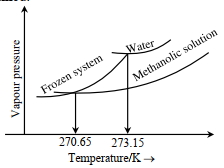
\(\Delta \mathrm{T}_{\mathrm{f}}=273.15-270.65=2.5 \mathrm{~K}\)\(\Delta \mathrm{T}_{\mathrm{f}}=\mathrm{K}_{\mathrm{f}} \mathrm{m} \Rightarrow 2.5=1.86 \times \frac{\mathrm{n}}{0.1}\)
\(\Rightarrow \mathrm{n}=0.1344 \text { moles }\)
\(\Rightarrow \mathrm{w}=0.1344 \times 32=4.3 \mathrm{~g}\)
\(\text { Volume }=\frac{4.3}{0.792}=5.43 \mathrm{ml}=543 \times 10^{-2} \mathrm{ml}\)
-
- (A) \(71\)
- (B) \(73\)
- (C) \(74\)
- (D) \(75\)
Show answer and solution
Correct Answer: (D)
Isotonic solutions,\(\pi_{ K _2 SO _4}=\pi_{ Glucose }\)
\(i \times 0.004 \times RT =0.01 \times RT\)
\(i =2.5\)
For \(K _2 SO _4 \quad\{\) for dissociation \(i =1+( n -1) \alpha\}\)
\(\operatorname{DOD}(\alpha)=\frac{ i -1}{ n -1}=\frac{2.5-1}{3-1}=0.75\)
\(\%\) dissociation \(=75\)
-
- (A) \(371\)
- (B) \(372\)
- (C) \(373\)
- (D) \(375\)
Show answer and solution
Correct Answer: (B)
\(i =1+( n -1) \alpha\)\( i =1+0.2(2-1)=1.2\)
\(\Delta T _{ f }= i K _{ f } m\)
\(\Delta T _{ f }=1.2 \times 1.86 \times \frac{5 \times 1000}{60 \times 500}\)
\(\Delta t _{ f }=3.72\)
\(\Delta T _{ f }=372 \times 10^{-2}\)
-
- (A) \(47\)
- (B) \(48\)
- (C) \(46\)
- (D) \(45\)
Show answer and solution
Correct Answer: (B)
\(MgCl _2 \rightarrow Mg ^{+2}+2 Cl ^{-}\)\(1-\alpha \quad \alpha \quad 2 \alpha\)
\(i =1+2 \alpha(\alpha=0.8)\)
\(i =2.6\)
\(\frac{\Delta p }{ p ^{\circ}}=\frac{ i \times n _2}{ n _1}\)
\(\Delta p =2.34\)
\(p _s=47.66\)
\(p _{ s } \cong 48\)
-
- (A) \(10\)
- (B) \(100\)
- (C) \(80\)
- (D) \(90\)
Show answer and solution
Correct Answer: (B)
\(\Delta T _{ b }=373.52-373\)\(=0.52\)
\(\Delta T _{ b }= Kb \cdot m\)
\(0.52=0.52 \times \frac{2}{\text { Molar Mass }} \times \frac{1}{20 \times 10^{-3}}\)
\(\text { Molar Mass }=100\,g / mol\)
- 71. A solution is prepared by adding \(2\,g\) of " \(X\) " of \(1\,mole\) of water. Mass percent of " \(X\) " in the solution is \(.............\%\) 2023 Medium
- (A) \(20\)
- (B) \(5\)
- (C) \(2\)
- (D) \(10\)
Show answer and solution
Correct Answer: (D)
Solute \(( X )=2\,g\)Solvent \(\left( H _2 O \right)=1\) mole \(=18\,g\)
Total mass \(=2+18=20\,g\)
\(\%\) mass of \(X =\frac{2}{20} \times 100=10 \%\)
-
- (A) \(40536\)
- (B) \(40537\)
- (C) \(40535\)
- (D) \(40538\)
Show answer and solution
Correct Answer: (C)
\(\because \pi= CRT\)\(\pi=\frac{n}{V} R T\)
\(\pi=\frac{\omega}{V} \frac{R T}{M}\)
\(M=\frac{\omega R T}{\pi \times V}\)
\(M=\frac{0.63 \times 0.083 \times 300}{1.29 \times 10^{-3} \times 300 \times 10^{-3}}\)
\(M=40535\,gm / moL\)
-
- (A) \(62240\)
- (B) \(62258\)
- (C) \(62240\)
- (D) \(62250\)
Show answer and solution
Correct Answer: (D)
\(\pi= CRT\)\(\frac{400\,Pa }{10^5}=\frac{\frac{2.5\,g }{ M _o}}{250 / 1000\,L } \times 0.83 \frac{ L - bar }{ K \cdot mol } \times 300\,K\)
\(M _0=62250\)
-
- (A) \(B, D\) and \(E\) only
- (B) \(A, B\) and \(D\) only
- (C) \(A\) and \(C\) only
- (D) \(B\) and \(D\) only
Show answer and solution
Correct Answer: (D)
\((A)\) \(\Delta T _{ b } \propto i \times c\)\((B)\) Azeotropic mixtures have same composition in both liquid and vapour phase.
\((C)\) Osmosis always takes place from hypotonic to hypertonic solution.
\((D)\) \(M =\frac{30 \times 10 \times 1.26}{98} \approx 4.09\,M\)
\((E)\) When \(KI\) solutions is added to \(AgNO _3\) solution, positively charged solution results due to adsorption of \(Ag ^{ F }\) ions from dispersion medium
\(AgI / Ag ^{+}\)
Positively charged
-
- (A) Both \(A\) and \(R\) are true but \(R\) is NOT the correct explanation of \(A\).
- (B) \(A\) is false but \(R\) is true.
- (C) \(A\) is true but \(R\) is false.
- (D) Both \(A\) and \(R\) are true and \(R\) is the correct explanation of \(A\).
Show answer and solution
Correct Answer: (D)
Assertion is correct.\(H _2 C _2 O _4 \cdot 2 H _2 O\)
\(M =\frac{3.15 \times 1000}{126 \times 250}\)
\(\frac{12.6}{126}=0.1\)
Reason is correct. It is used as a fact in explanation of assertion.
-
- (A) \(8\)
- (B) \(6\)
- (C) \(4\)
- (D) \(2\)
Show answer and solution
Correct Answer: (A)
\(\frac{\left( T _{ B }\right)_{ x }}{\left( T _{ B }\right)_{ y }}=\frac{2}{1} \quad \frac{(\Delta H )_{ x }}{(\Delta H )_{ y }}=\frac{1}{2}\)\(\frac{\left(\Delta T _{ B }\right)_{ x }}{\left(\Delta T _{ B }\right)_{ y }}= m =\frac{\left( K _{ B }\right)_{ x } \times \text { molality }}{\left( K _{ B }\right)_{ y } \times \text { molality }}\)
\(=\frac{( T \cdot B )_{ x }^2}{( T \cdot B )_{ y }^2} \times \frac{\Delta H _{ y }}{\left(\Delta H _{ x }\right.}=(2)^2 \times 2=8\)
-
- (A) \(31\)
- (B) \(30\)
- (C) \(32\)
- (D) \(33\)
Show answer and solution
Correct Answer: (B)
\(i=1+\alpha(\text { for } HA )\)\(=1.3\)
\(\%\) increase \(=\frac{\left(\Delta T _{ f }\right)_{ obs }-\left(\Delta T _{ f }\right)_{ cal }}{\left(\Delta T _{ f }\right)_{ cal }} \times 100\)
\(=\frac{K_f \times i \times m-K_f \times m}{K_f \times m} \times 100\)
\(=\frac{i-1}{1} \times 100=30 \%\)
-
- (A) A and D only
- (B) B and C only
- (C) A and C only
- (D) A only
Show answer and solution
Correct Answer: (A)
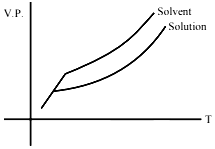
Vapour pressure (V.P.) of solvent is greater than vapour pressure (V.P.) of solution. Only solvent freezes. -
- (A) \(241\)
- (B) \(242\)
- (C) \(256\)
- (D) \(243\)
Show answer and solution
Correct Answer: (D)
\(\Delta T _{ f }= i \cdot K _{ f } \cdot m\)\(\Rightarrow \Delta T _{ f }=2.67 \times 1.8 \times \frac{38}{98} \times \frac{1000}{62}\)
\(\Rightarrow \Delta T _{ f }=30.05\)
\(\therefore \text { F.P. }=243\,K\)
-
- (A) \(1112\)
- (B) \(1113\)
- (C) \(1114\)
- (D) \(1111\)
Show answer and solution
Correct Answer: (D)
\(\frac{ P ^0- P _{ s }}{ P _{ s }}=\frac{ n _{\text {solute }}}{ n _{\text {solvent }}}=\frac{\frac{ x }{60}}{\frac{1000}{18}}=\frac{ P ^0-0.75 P ^0}{0.75 P ^0}\)\(\Rightarrow x =\frac{10000}{9}=1111\,gm\)
-
- (A) \(A-III, B-I, C-II, D-IV\)
- (B) \(A-III, B-II, C-I, D-IV\)
- (C) \(A-III, B-I, C-IV, D-II\)
- (D) \(A-I, B-III, C-II, D-IV\)
Show answer and solution
Correct Answer: (A)
\((A)\) van't Hoff factor, \(i\)\(i =\frac{\text { Normal molar mass }}{\text { Abnormal molar mass }}\)
\((B)\) \(k _{ f }=\) Cryoscopic constant
\((C)\) Solutions with same osmotic pressure are known as isotonic solutions.
\((D)\) Solutions with same composition of vapour over them are called Azeotrope.
-
- (A) \(115\)
- (B) \(114\)
- (C) \(113\)
- (D) \(116\)
Show answer and solution
Correct Answer: (D)
\(\text { Amount of solvent }=100-(29.25+19)=51.75\,g\)\(\Delta T _{ b }=\left[\frac{2 \times 29.25 \times 1000}{58.5 \times 51.75}+\frac{3 \times 19 \times 1000}{95 \times 51.75}\right] \times 0.52\)
\(\Delta Tb =16.075\)
\(\Delta Tb =\left( T _{ b }\right)_{\text {solution }}-\left( T _{ b }\right)_{\text {solvent }}\)
\(\left( T _{ b }\right)_{\text {solution }}=100+16.07\)
-
- (A) \(241\)
- (B) \(242\)
- (C) \(240\)
- (D) \(243\)
Show answer and solution
Correct Answer: (C)
\(\pi_1=\pi_2\)\(\Rightarrow C_1=C_2\)
\(\frac{12}{ x }=0.05[ x \rightarrow \text { Molar Mass of } A ]\)
\(X =240\)
-
- (A) \(220\)
- (B) \(148\)
- (C) \(256\)
- (D) \(250\)
Show answer and solution
Correct Answer: (B)
Molarity \(=\frac{\text { mole }}{\text { volume }}\)\(2.6 \times 10^{-3}=\frac{ x / 85}{0.67141}\)
\(x =0.148\,g\)
conc. Fo \(DCM\) in \(ppm\) \(=\frac{0.148}{1.49 \times 671.141} \times 10^6\)
\(=148\,ppm\)
-
- (A) \(2.00\)
- (B) \(6.00\)
- (C) \(8.00\)
- (D) \(4\)
Show answer and solution
Correct Answer: (D)
\(\pi= iCRT\)\(\pi \propto iC\)
\(A, B, D\) and \(E\) have same value of osmatic pressure.
-
- (A) 3
- (B) 4
- (C) 5
- (D) 6
Show answer and solution
Correct Answer: (C)
Mole fraction, molarity, molality, mass % and ppm describes the concentration of solution. -
- (A) \(314\)
- (B) \(312\)
- (C) \(311\)
- (D) \(310\)
Show answer and solution
Correct Answer: (A)
Let \(V.P.\) of pure \(A\) be \(P _{ A }^0\)Let \(V.P\) of pure \(B\) be \(P _B^0\)
When \(X _{ A }=0.7 \& X _{ B }=0.3\) \(P _{ s }=350\)
\(\Rightarrow P _{ A }^0 \times 0.7+ P _{ B }^0 \times 0.3=350\)
When \(X _{ A }=0.2 \& X _{ B }=0.8\)
\(P _{ s }=410\)
\(\Rightarrow P _{ A }^0 \times 0.2+ P _{ B }^0 \times 0.8=410\)
Solving \((i)\) and \((ii)\) \(P _{ A }^0=314\,mm\,Hg\)
\(P _{ B }^0=434\,mm\,Hg\)
\(=(314)\)
-
- (A) \(550\)
- (B) \(552\)
- (C) \(553\)
- (D) \(555\)
Show answer and solution
Correct Answer: (D)
\(P _{ X }=\chi_{ X } P _{ T }\)\(=\frac{\frac{0.6}{20}}{\frac{0.6}{20}+\frac{0.45}{45}} \times 740\)
\(P _{ X }=555\,mm\,Hg\)
-
- (A) \(23\)
- (B) \(22\)
- (C) \(21\)
- (D) \(24\)
Show answer and solution
Correct Answer: (A)
\(\frac{24- P _{ s }}{ P _{ s }}=\frac{ m \times 18}{1000}\)wt of solute \(=30\,gm\)
Volume of solution \(=100\,mL\)
wt. of solution \(=1.2 \times 100=120\,gm\)
wt. of solvent \(=120-30=90\,gm\)
\(m =\frac{30 \times 1000}{180 \times 90}=1.85\)
\(\frac{24- P _{ s }}{ P _{ s }}=\frac{1.85 \times 18}{1000}\)
\(24- P _{ s }=0.0333 P _{ s }\)
\(P _{ s }(1.033)=24\)
\(P _{ s }=23.22\)
-
- (A) \(81\)
- (B) \(82\)
- (C) \(83\)
- (D) \(84\)
Show answer and solution
Correct Answer: (B)
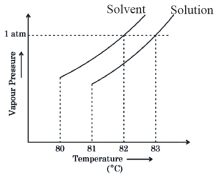
Boiling point of solvent is \(82^{\circ} C\)Boiling point of solution is \(83^{\circ} C\)
-
- (A) \(4.69\,g\)
- (B) \(3.59\,g\)
- (C) \(2.59\,g\)
- (D) \(3.69\,g\)
Show answer and solution
Correct Answer: (D)
\(\frac{ P ^0- P _5}{ P ^0}=\frac{ n }{ N }\) (for dilute solution)\(\frac{0.2}{54.2}=\frac{ n \times 18}{100}\)
\(n =\frac{100}{271 \times 18}\)
\(w =\frac{100 \times 180}{271 \times 18} ; w =3.69\,g\)
-
- (A) \(50\)
- (B) \(5\)
- (C) \(45\)
- (D) \(24\)
Show answer and solution
Correct Answer: (B)
\(M = d \times V =1.02 \times 1.2=1.224\, gm\)Moles of acetic acid \(=0.0204\) \(moles\) in \(2\, L\)
So molality \(=0.0102 \,mol / kg\)
Now \(\Delta T _{ f }= i \times K _{ f } \times M\)
\(i=1+\alpha\) for acetic acid
\(0.0198=(1+\alpha) \times 1.85 \times 0.0102\)
\(\alpha=0.04928\)
\(\cong 5\, \%\)
-
- (A) \(81\)
- (B) \(80\)
- (C) \(82\)
- (D) \(83\)
Show answer and solution
Correct Answer: (B)
Mass of \(C _{2} H _{5} OH =62.5 \times 0.8=50\,g\)\(\Delta T _{ f }= K _{ f } \times m\)
\(0.9=2 \times \frac{1.8 \times 1000}{ M _{ \pi } \times 50}\)
\(M _{ w }=\frac{2 \times 1.8 \times 1000}{0.9 \times 50}=80\)
-
- (A) \(120\)
- (B) \(330\)
- (C) \(450\)
- (D) \(903\)
Show answer and solution
Correct Answer: (B)
\(\pi= CRT\)\(5.03 \times 10^{-3}= C \times 0.083 \times 300\)
\(C =0.202 \times 10^{-3}\, M\)
Moles of protein \(=0.202 \times 10^{-3} \times 0.5\)
\(=10^{-4} \times 1.01\)
\(1.01 \times 10^{-4}=\frac{2.5}{ M }\)
\(M (\) molar mass of protein \()=24752\)
\(\therefore\) No. of glycine units \(=\frac{24752}{75}=330.03\)
-
- (A) \(41\)
- (B) \(60\)
- (C) \(80\)
- (D) \(98.5\)
Show answer and solution
Correct Answer: (D)
\(0.5\, \%\) solution of \(KCl\)So \(m =\frac{0.5}{74.6} \times \frac{1}{0.1}\)
\(\Delta T _{ f }= i \times m _{ f }\)
\(0.24=i \cdot \frac{0.5}{74.6} \times \frac{1.80}{0.1}\)
\(i=\frac{0.24 \times 74.6}{0.5 \times 1.80} \times 0.1\)
\(=1.989\)
\(1.989=1+\alpha( n -1)\)
\(1.989=1+\alpha\)
\(\alpha=.989\)
\(\% \alpha=98.9 \%\)
Ans \(99 \,\%\)
If mass of \(H _{2} O =99.5\)
\(m =\frac{0.5}{74.5} \times \frac{1}{.0995}\)
\(i =\frac{0.24 \times 74.6 \times .0995}{.5 \times 1.80}\)
\(=1.979\)
\(1.979=1+\alpha( n -1)\)
\(1.979=1+\alpha\)
\(\alpha=.979\)
\(\% \alpha=97.9\, \%\)
\(98\, \%\)
-
- (A) \(1\)
- (B) \(0\)
- (C) \(2\)
- (D) \(3\)
Show answer and solution
Correct Answer: (C)
\(Y _{ A }= 0 . 5 \Rightarrow Y _{ B }= 0 . 5\)\(P _{ A }= P _{ B }= 0 . 4 a t m\)
\(P _{ A }= P _{ A }^{0} X _{ A }\)
\(P _{ A }^{0}=2\)
-
- (A) \(50\)
- (B) \(93\)
- (C) \(10\)
- (D) \(45\)
Show answer and solution
Correct Answer: (D)
\(w =2.5\, g\quad\quad\) \(K _{ b }=0.52\)\(w _{solvent}=75 g\quad\quad\) \(M =\) Mol . Wt .of solute
\(T _{ B }^{\prime}=373.535\, K\)
\(T _{ B }^{o}=373.15\, K\)
\(\Delta T _{ B }=0.385= K _{ b } \text { molality }\)
\(0.385=0.52 \times\left(\frac{2.5}{ M } \times \frac{1000}{75}\right)\)
\(M =45 \,g\, mol ^{-1}\)
-
- (A) \(M _{ A }=4 M _{ B }\)
- (B) \(M _{ B }=4 M _{ A }\)
- (C) \(M _{ A }=8 M _{ B }\)
- (D) \(M _{ B }=8 M _{ A }\)
Show answer and solution
Correct Answer: (B)
For A: \(100 gm\) solution \(\rightarrow 2\,gm\) solute \(A\)\(\therefore \text { Molality }=\frac{2 / M _{ A }}{0.098}\)
For \(B\) : \(100\,gm\) solution \(\rightarrow 8\,gm\) solute \(B\)
\(\therefore \text { Molality }=\frac{8 / M _{ B }}{0.092}\)
\(\because\left(\Delta T _{ B }\right)_{ A }=\left(\Delta T _{ B }\right)_{ B }\)
\(\therefore\) Molality of \(A=\) Molality of \(B\)
\(\therefore \frac{2}{0.098 M _{ A }}=\frac{8}{0.092 M _{ B }}\)
\(\frac{2}{98} \times \frac{92}{8}=\frac{M_{A}}{M_{B}}\)
\(\frac{1}{4.261}=\frac{ M _{ A }}{ M _{ B }}\)
\(\therefore M_{B}=4.261 \times M_{A}\)
-
- (A) \(4\)
- (B) \(1\)
- (C) \(2\)
- (D) \(3\)
Show answer and solution
Correct Answer: (D)
\(\Delta T _{ b }= i\,K _{ b } \,m\)\(\Delta T _{ f }= i\,K _{ i } \,m\)
\(\frac{4}{4}=\frac{ K _{ b } 1.5}{ K _{ f } 4.5}\)
\(\frac{ K _{ b }}{ K _{ f }}=3\)
-
- (A) \(0\)
- (B) \(1\)
- (C) \(2\)
- (D) \(3\)
Show answer and solution
Correct Answer: (B)
\(p = K _{ H } \times x\)\(0.920=46.82 \times 10^{3} \text { bar } \times \frac{ mol of O _{2}}{ molof H _{2} O }\)
\(0.920=46.82 \times 10^{3} \times \frac{ mol \text { of } O _{2}}{1000 / 18}\)
\(0.920=46.82 \times n _{ O _{2}}\)
\(p =\frac{0.920}{46.82 \times 18}= n _{0_{2}}\)
\(\Rightarrow 1.09 \times 10^{-3}= n _{0_{2}}\)
\(\Rightarrow m\;mol\;of\;O_{2}=1\)
No questions on this page match these filters.