


JEE Mains · Chemistry · STD 12 - 3. Chemical kinetics
\(\mathrm{A} \rightarrow \mathrm{~B}\)
The molecule A changes into its isomeric form B by following a first order kinetics at a temperature of 1000 K . If the energy barrier with respect to reactant energy for such isomeric transformation is \(191.48 \mathrm{~kJ} \mathrm{~mol}^{-1}\) and the frequency factor is \(10^{20}\), the time required for \(50 \%\) molecules of A to become \(B\) is _________ picoseconds (nearest integer). \(\left[\mathrm{R}=8.314 \mathrm{~J} \mathrm{~K}^{-1} \mathrm{~mol}^{-1}\right]\)
- A 68
- B 69
- C 70
- D 71
Answer & Solution
Correct Answer
(B) 69
Step-by-step Solution
Detailed explanation
\begin{aligned} & \mathrm{t}_{1 / 2}=\frac{0.693}{\mathrm{~K}} \\ & \mathrm{~K}=\mathrm{Ae}^{-\mathrm{Ea} / \mathrm{RT}} \\ & =10^{20} \times \mathrm{e}^{-\frac{191.48 \times 10^3}{8.314 \times 1000}} \\ & =10^{20} \times \mathrm{e}^{-23.031}=10^{20} \times-\mathrm{e}^{\ln 10…
See the Complete Solution
Get step-by-step explanations for this and 2.5 Lakh+ more JEE, NEET & CET questions.
- Unlock all solutions
- Practice the full chapter
- Track accuracy across PYQs
4.8 rated on Google Play · 14,000+ reviews
More questions from Chemistry
- The standard heat of formation \(\left(\Delta_{t} \mathrm{H}_{298}^{0}\right)\) of ethane in \((kJ/mol)\), if the heat of combustion of ethane, hydrogen and graphite are \(-1560\), \(-393.5\) and \(-286 \;\mathrm{kJ} / \mathrm{mol},\) respectively is ........... \(\mathrm{kJ/mol}\)JEE Mains 2020 Hard
- The ratio of spin-only magnetic moment values \(\mu_{\text {eff }}\left[ Cr ( CN )_6\right]^{3-} / \mu_{\text {eff }}\left[ Cr \left( H _2 O \right)_6\right]^{3+}\) is \(.........\).JEE Mains 2023 Medium
- If a reaction follows the Arrhenius equation, the plot \(\ln k\) vs \(1/(RT)\) gives straight line with a gradient \((-y)\) \(unit\). The energy required to activate the reactant isJEE Mains 2019 Medium
- When a salt is treated with sodium hydroxide solution it gives gas \(\mathrm{X}\). On passing gas \(\mathrm{X}\) through reagent \(\mathrm{Y}\) a brown coloured precipitate is formed. \(\mathrm{X}\) and \(\mathrm{Y}\) respectively are _______.JEE Mains 2025 Medium
- One mole of phenol is treated with dilute HNO\(_3\) at \(298\) K to give a mixture of products. The mixture is separated by steam distillation. The steam volatile compound (X) is separated. The increase in percentage of oxygen in (X) with respect to phenol is _____ \(\times 10^{-1}\) %
(Given molar mass in g mol\(^{-1}\) H:\(1\), C:\(12\), N:\(14\), O:\(16\))JEE Mains 2026 Hard - Given below are two statements:
Statement I: Cross aldol condensation between two different aldehydes will always produce four different products.
Statement II: When semicarbazide reacts with a mixture of benzaldehyde and acetophenone under optimum pH, it forms a condensation product with acetophenone only.
In the light of the above statements, choose the correct answer from the options given below :JEE Mains 2026 Medium
More PYQs from JEE Mains
- Let the lines \(\frac{x-1}{\lambda}=\frac{y-2}{1}=\frac{z-3}{2}\) and \(\frac{ x +26}{-2}=\frac{ y +18}{3}=\frac{ z +28}{\lambda}\) be coplanar and \(P\) be the plane containing these two lines. Then which of the following points does \(NOT\) lies on \(P\)?JEE Mains 2022 Hard
- Let \(N\) be the set of natural numbers and a relation \(R\) on \(N\) be defined by \(R=\left\{(x, y) \in N \times N: x^{3}-3 x^{2} y-x y^{2}+3 y^{3}=0\right\} .\) Then the relation \(R\) is:JEE Mains 2021 Hard
- Given below are two statements Statement \(I : CeO _{2}\) can be used for oxidation of aldehydes and ketones. Statement \(II :\) Aqueous solution of \(EuSO _{4}\) is a strong reducing agent. In the light of the above statements, choose the correct answer from the options given belowJEE Mains 2021 Medium
- The equations of the sides \(A B, B C \& C A\) of a triangle \(A B C\) are \(2 x+y=0, x+p y=21 a(a \neq 0)\) and \(x-y=3\) respectively. Let \(P(2, a)\) be the centroid of the triangle \(A B C\), then \((B C)^2\) is equal toJEE Mains 2023 Medium
- \(0.01\, M\, KMnO _{4}\) solution was added to \(20.0\, mL\) of \(0.05\, M\) Mohr's salt solution through a burette. The initial reading of \(50\, mL\) burette is zero. The volume of \(KMnO _{4}\) solution left in the burette after the end point is \(.....\,mL\). (nearest integer)JEE Mains 2022 Medium
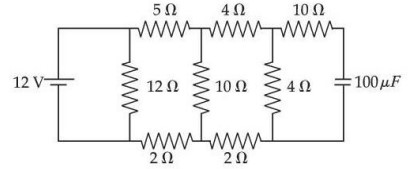
- The stored charge in the capacitor in steady state of the following circuit is ________ \(\mu\)C.
 JEE Mains 2026 Medium