


JEE Mains · Chemistry · STD 12 - 3. Chemical kinetics
For reaction \(A \rightarrow P\), rate constant \(k = 1.5 \times 10^3\) s\(^{-1}\) at \(27°\)C. If activation energy for the above reaction is \(60\) kJ mol\(^{-1}\), then the temperature (in \(°\)C) at which rate constant, \(k = 4.5 \times 10^3\) s\(^{-1}\) is _______. (Nearest integer)
Given : \(\log 2 = 0.30\), \(\log 3 = 0.48\), \(R = 8.3\) J K\(^{-1}\) mol\(^{-1}\), \(\ln 10 = 2.3\)
- A 41
- B 42
- C 43
- D 44
Answer & Solution
Correct Answer
(A) 41
Step-by-step Solution
Detailed explanation
Using the Arrhenius equation: \(\log \left( \dfrac{k_2}{k_1} \right) = \dfrac{E_a}{2.3 R} \left( \dfrac{1}{T_1} - \dfrac{1}{T_2} \right)\) Given: \(k_1 = 1.5 \times 10^3 \text{ s}^{-1}\) \(k_2 = 4.5 \times 10^3 \text{ s}^{-1}\) \(T_1 = 27^\circ\text{C} = 300 \text{ K}\)…
See the Complete Solution
Get step-by-step explanations for this and 2.5 Lakh+ more JEE, NEET & CET questions.
- Unlock all solutions
- Practice the full chapter
- Track accuracy across PYQs
4.8 rated on Google Play · 14,000+ reviews
More questions from Chemistry
- What amount of bromine will be required to convert 2 g of phenol into 2,4,6-tribromophenol? (Given molar mass in \(\mathrm{g} \mathrm{mol}^{-1}\) of \(\mathrm{C}, \mathrm{H}, \mathrm{O}, \mathrm{Br}\) are \(12,1,16,80\) respectively )JEE Mains 2025 Medium
- The compound that has the largest \(H - M - H\) bond angle \(( M = N , O , S , C ),\) is :JEE Mains 2020 Hard
- A sample of \(NaClO_3\) is converted by heat to \(NaCl\) with a loss of \(0.16\, g\) of oxygen. The residue is dissolved in water and precipitated as \(AgCl\). The mass of \(AgCl\) (in \(g\)) obtained will be (Given: Molar mass of \(AgCl = 143.5\, g\,mol^{-1}\) )JEE Mains 2018 Hard
- Match List \(I\) with List \(II\). Choose the correct answer from the options given below:
List \(-I\) List \(-II\) \(A.\) Melting point \([\mathrm{K}]\) \(I.\) \(\mathrm{Tl}>\mathrm{In}>\mathrm{Ga}>\mathrm{Al}>\mathrm{B}\) \(B.\) Ionic Radius \(\left[\mathrm{M}^{+3} / \mathrm{pm}\right]\) \(II.\) \(\mathrm{B}>\mathrm{Tl}>\mathrm{Al} \approx \mathrm{Ga}>\mathrm{In}\) \(C.\) \(\Delta_{\mathrm{i}} \mathrm{H}_1 \) \([\mathrm{~kJ} \mathrm{~mol}^{-1}]\) \(III.\) \(\mathrm{Tl}>\mathrm{In}>\mathrm{Al}>\mathrm{Ga}>\mathrm{B}\) \(D.\) Atomic Radius \([pm]\) \(IV.\) \(\mathrm{B}>\mathrm{Al}>\mathrm{Tl}>\mathrm{In}>\mathrm{Ga}\) JEE Mains 2024 Medium - Among the statements \((a)-(d)\), the incorrect ones are \((a)\) Octahedral \(Co(III)\) complexes with strong field ligands have very high magnetic moments \((b)\) When \(\Delta_{0}< P\), the \(d-\)electron configuration of \(Co(III)\) in an octahedral complex is \(t_{\text {eg }}^{4} e_{g}^{2}\) \((c)\) Wavelength of light absorbed by \(\left[\mathrm{Co}(\mathrm{en})_{3}\right]^{3+}\) is lower than that of \(\left[\mathrm{CoF}_{6}\right]^{3-}\) \((d)\) If the \(\Delta_{0}\) for an octahedral complex of \(\mathrm{Co}(\mathrm{III})\) is \(18,000 \;\mathrm{cm}^{-1},\) the \(\Delta_{\mathrm{t}}\) for its tetrahedral complex with the same ligand will be \(16,000\;\mathrm{cm}^{-1}\)JEE Mains 2020 Hard
- The product of the following reaction is \(\mathrm{P}\).
The number of hydroxyl groups present in the product \(\mathrm{P}\) is ______. JEE Mains 2024 Hard
More PYQs from JEE Mains
- The value of \(1^3 - 2^3 + 3^3 - \ldots + 15^3\) is:JEE Mains 2026 Medium
- Element not showing variable oxidation state is :JEE Mains 2024 Hard
- Match the LIST-I with LIST-II.
LIST-I LIST-II (A) \(_0^1n + _{92}^{235}U \rightarrow _{54}^{140}Xe + _{38}^{94}Sr + 2_0^1n\) (I) Chemical reaction (B) \(2H_2 + O_2 \rightarrow 2H_2O\) (II) Fusion with +ve Q value (C) \(_1^2H + _1^2H \rightarrow _2^3He + _0^1n\) (III) Fission (D) \(_1^1H + _1^3H \rightarrow _1^2H + _1^2H\) (IV) Fusion with -ve Q value
Choose the correct answer from the options given below :JEE Mains 2025 Medium - A body of mass \(50 \mathrm{~kg}\) is lifted to a height of \(20 \mathrm{~m}\) from the ground in the two different ways as shown in the figures. The ratio of work done against the gravity in both the respective cases will be _______.
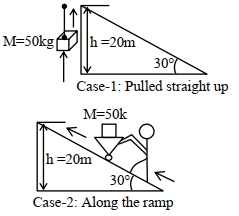 JEE Mains 2024 Hard
 - \(\lim _{t \rightarrow 0}\left(1^{\frac{1}{\sin ^2 t}}+2^{\frac{1}{\sin ^2 t}}+\ldots .+n^{\frac{1}{\sin ^2 t}}\right)^{\sin ^2 t}\) is equal to \(.......\)JEE Mains 2023 Hard
- The curve satisfying the differential equation, \(ydx-(x + 3y^2 )\, dy = 0\) and passing through the point \((1, 1)\) , also passes through the pointJEE Mains 2017 Hard