


JEE Mains · Chemistry · STD 12 - 3. Chemical kinetics
Consider the reaction \(aX \rightarrow bY\), for which the rate constant at \(30°C\) is \(1 \times 10^{-3}\) mol\(^{-1}\) L s\(^{-1}\). Which of the following statements are true?
A. When concentration of 'X' is increased to four times, the rate of reaction becomes \(16\) times.
B. The reaction is a second order reaction.
C. The half-life period is independent of the concentration of X.
D. Decomposition of \(N_2 O_5\) is an example of the above reaction.
E. \(\ln\dfrac{[R_o]}{[R]}\) vs time is valid for the above reaction.
Choose the correct answer from the options given below:
- A A and B Only
- B A, B and C Only
- C A, B, D and E Only
- D C and D Only
Answer & Solution
Correct Answer
(A) A and B Only
Step-by-step Solution
Detailed explanation
The unit of the rate constant \(k\) is mol\(^{-1}\) L s\(^{-1}\). The general unit of the rate constant for an \(n\)-th order reaction is (mol L\(^{-1}\))\(^{1-n}\) s\(^{-1}\). Equating the powers of the concentration units, we get \(1-n = -1 \Rightarrow n = 2\). Thus, the…
See the Complete Solution
Get step-by-step explanations for this and 2.5 Lakh+ more JEE, NEET & CET questions.
- Unlock all solutions
- Practice the full chapter
- Track accuracy across PYQs
4.8 rated on Google Play · 14,000+ reviews
More questions from Chemistry
- Consider the following statements: \((A)\) \(NF _3\) molecule has a trigonal planar structure. \((B)\) Bond length of \(N _2\) is shorter than \(O _2\). \((C)\) Isoelectronic molecules or ions have identical bond order. \((D)\) Dipole moment of \(H _2 S\) is higher than that of water molecule. Choose the correct answer from the option below:JEE Mains 2023 Medium
- Ionic reactions with organic compounds proceed through _______ \((A)\) Homolytic bond cleavage \((B)\) Heterolytic bond cleavage \((C)\) Free radical formation \((D)\) Primary free radical \((E)\) Secondary free radical Choose the correct answer from the options given below:JEE Mains 2024 Hard
- an oxidation-reduction reaction in which \(3\) electrons are transferred has a \(\Delta G ^{\circ}\) of \(17.37\, kJ\) \(mol ^{-1}\) at \(25^{\circ} C\). The value of \(E _{\text {cell }}^{\circ}\) (in \(V\) ) is........ \(\times 10^{-2}\) \(\left(1 F =96,500\, C\, mol ^{-1}\right)\)JEE Mains 2020 Medium
- Given below are two statements: one is labelled as Assertion \((A)\) and the other is labelled as Reason \((R)\) Assertion \((A) :\) At \(10^{\circ} C\), the density of a \(5\, M\) solution of \(KCl\) [atomic masses of \(K\) and \(Cl\) are \(39\) and \(35.5\, g \,mol ^{-1}\) ]. The solution is cooled to \(-21^{\circ} C\). The molality of the solution will remain unchanged. Reason \((R):\) The molality of a solution does not change with temperature as mass remains unaffected with temperature. In the light of the above statements, choose the correct answer from the options given belowJEE Mains 2022 Hard
- The stable carbocation formed in the above reaction is ......
 JEE Mains 2022 Medium
 - Benzene on nitration gives nitrobenzene in presence of \(\mathrm{HNO}_{3}\) and \(\mathrm{H}_{2} \mathrm{SO}_{4}\) mixture, where :JEE Mains 2021 Hard
More PYQs from JEE Mains
- Let the line of the shortest distance between the lines \(L_1: \vec{r}=(\hat{i}+2 \hat{j}+3 \hat{k})+\lambda(\hat{i}-\hat{j}+\hat{k})\) and \(L_2: \vec{r}=(4 \hat{i}+5 \hat{j}+6 \hat{k})+\mu(\hat{i}+\hat{j}-\hat{k})\) intersect \(\mathrm{L}_1\) and \(\mathrm{L}_2\) at \(\mathrm{P}\) and \(\mathrm{Q}\) respectively. If \((\alpha, \beta, \gamma)\) is the midpoint of the line segment \(PQ\), then \(2(\alpha+\beta+\gamma)\) is equal to ...........JEE Mains 2024 Hard
- For an ideal heat engine, the temperature of the source is \(127\,^{\circ} C\). In order to have \(60\, \%\) efficiency the temperature of the sink should be \(........\,{ }^{\circ} C\). (Round off to the Nearest Integer)JEE Mains 2021 Medium
-
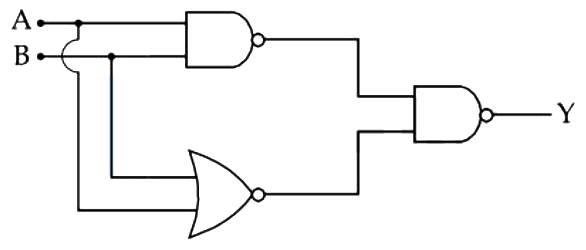
For the circuit shown above, equivalent GATE is :JEE Mains 2025 Easy - Let \(f: \left(-\frac{\pi}{4}, \frac{\pi}{4}\right) \rightarrow \mathrm{R}\) be defined as \(f(x)=(1+|\sin x|)^{\frac{3 a}{\sin x \mid}} ,\quad -\frac{\pi}{4}\,<\,x\,<\,0\) \(\quad\quad\quad\quad\quad\quad b ,\quad\quad\quad\quad\quad x=0\) \(\quad\quad\quad\quad e^{\cot 4 x / \cot 2 x} ,\quad\quad\quad 0\,<\,x\,<\,\frac{\pi}{4}\) If \(\mathrm{f}\) is continuous at \(\mathrm{x}=0\), then the value of \(6 \mathrm{a}+\mathrm{b}^{2}\) is equal to:JEE Mains 2021 Medium
- The nature of oxides \(\mathrm{V}_{2} \mathrm{O}_{3}\) and \(\mathrm{CrO}\) is indexed as \('\mathrm{X}^{\prime}\) and \('\mathrm{Y}^{\prime}\) type respectively. The correct set of \(\mathrm{X}\) and \(\mathrm{Y}\) is:JEE Mains 2021 Medium
- An engine takes in \(5\) moles of air at \(20\,^{\circ} C\) and \(1\) \(atm,\) and compresses it adiabaticaly to \(1 / 10^{\text {th }}\) of the original volume. Assuming air to be a diatomic ideal gas made up of rigid molecules, the change in its internal energy during this process comes out to be \(X\, kJ\). The value of \(X\) to the nearest integer isJEE Mains 2020 Hard