


JEE Mains · Chemistry · STD 12 - Chemical kinetics
- JEE Mains 2026
- Easy
- Numerical
If the half life of a first order reaction is \(6.93\) minutes then the time required for completion of \(99\)% of the reaction will be _____ minutes.
(Given : \(\log 2 = 0.3010\))
Pick an option to check your answer.
Answer & Solution
Correct Answer
(D) 46.06
Step-by-step Solution
Detailed explanation
Explanation:
Let us calculate the time required for 99% completion of the first-order reaction step-by-step:
1. Finding the Rate Constant (\(k\)):
The relation between the half-life (\(t_{1/2}\)) and the rate constant (\(k\)) for a first-order reaction is:
\(k = \frac{2.303 \times \log 2}{t_{1/2}}\)
Using the standard approximation \(2.303 \times \log 2 \approx 0.693\):
\(k = \frac{0.693}{6.93} = 0.1\text{ min}^{-1}\)
2. Using the Integrated Rate Law Equation:
The time expression for a first-order reaction is given by:
\(t = \frac{2.303}{k} \log\left(\frac{a}{a-x}\right)\)
Where:
- \(a\) = Initial concentration = 100
- \(x\) = Reacted concentration = 99
- \(a - x\) = Remaining concentration = \(100 - 99 = 1\)
3. Substituting the Values:
\(t = \frac{2.303}{0.1} \log\left(\frac{100}{1}\right)\)
\(t = 23.03 \times \log(10^2)\)
Since \(\log(10^2) = 2\):
\(t = 23.03 \times 2 = 46.06\text{ minutes}\)
Hence, Option D is the correct choice.
More questions from Chemistry
- A sample of a hydrate of barium chloride weighing \(61\,g\) was heated until all the water of hydration is removed. The dried sample weight is \(52\,g.\) The formula of the hydrated salt is : ( atomic mass, \(Ba = 137\,amu,\,\,Cl = 35.5\,amu\) )JEE Mains 2015 Hard
- The most stable carbocation for the following is:
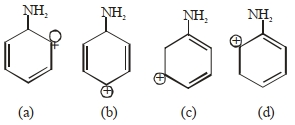 JEE Mains 2023 Medium
- Match List-I with List-II.
List-I (Purification technique) List-II (Used to separate) A. Simple distillation I. Steam volatile compound B. Fractional distillation II. Two liquids with large difference in boiling points C. Steam distillation III. Liquid decomposing at its boiling point D. Distillation under reduced pressure IV. Two liquids with close boiling points
Choose the correct answer from the options given below :JEE Mains 2026 Easy - Phenol on reaction with dilute nitric acid, gives two products. Which method will be most effective for large scale separation ?JEE Mains 2022 Medium
- The correct order of total number of atoms present in
(A) \(2\) moles of cyclohexane
(B) \(684\) g of sucrose
(C) \(90.8\) L of dihydrogen at STP
is:JEE Mains 2026 Medium - Which of the following statement(s) is/are correct? \((A)\) The \(pH\) of \(1 \times 10^{-8}\,M\,HCl\) solution is \(8\). \((B)\) The conjugate base \(H _2 PO _4^{-}\)is \(HPO _4{ }^{2-}\). \((C)\) \(K _{ w }\) increases with increase in temperature. \((D)\) When a solution of weak monoprotic acid is titrated against a strong base at half neutralisation point, \(pH =\frac{1}{2} pK _{ a }\) Choose the correct answer from the option given below.JEE Mains 2023 Medium
More PYQs from JEE Mains
- Refer to the logic circuit given below. For two inputs \((A=1, B=1)\) and \((A=0, B=1)\), output \((Y)\) will be __________.
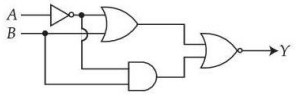 JEE Mains 2026 Medium
- The magnetic field at the centre of a wire loop formed by two semicircular wires of radii \(R_1=2 \pi\ \mathrm{m}\) and \(R_2=4 \pi\ \mathrm{m}\) carrying current \(I=4 \mathrm{~A}\) as per figure given below is \(\alpha \times 10^{-7} \mathrm{~T}\). The value of \(\alpha\) is___________ (Centre \(\mathrm{O}\) is common for all segments)
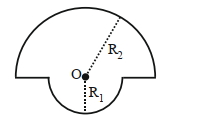 JEE Mains 2024 Hard
- A \(20\,cm\) long metallic rod is rotated with \(210\,rpm\) about an axis normal to the rod passing through its one end. The order end of the rod is in contact with a circular metallic ring. A constant and uniform magnetic field \(0.2\,T\) parallel to the axis exists everywhere. The emf developed between the centre and the ring is \(.......\,mV\).Take \(\pi=\frac{22}{7}\)JEE Mains 2023 Medium
- Two resistances are given as \(R _1=(10 \pm 0.5)\,\Omega\) and \(R_2=(15 \pm 0.5)\, \Omega\). The percentage error in the measurement of equivalent resistance when they are connected in parallel isJEE Mains 2023 Hard
- Simplified absorption spectra of three complexes \(((i),\)\(( ii)\) and \(( iii ))\) of \(M ^{ n +}\) ion are provided below; their \(\lambda_{\max }\) values are marked as \(A, B\) and \(C\) respectively. The correct match between the complexes and their \(\lambda_{\max }\) values is \((i)\) \(\left[ M ( NCS )_{6}\right]^{(-6+ n )}\) \((ii)\) \(\left[ MF _{6}\right]^{(-6+ n )}\) \((iii)\) \(\left[ M \left( NH _{3}\right)_{6}\right]^{ n ^{+}}\)
 JEE Mains 2020 Hard
- The metal \(d-\) orbital that can directly facing the ligands in \(K_3[Co(CN)_6]\) areJEE Mains 2019 Hard