


JEE Mains · Chemistry · STD 12 - Chemical kinetics
- JEE Mains 2025
- Easy
- MCQ
In a reaction \(A+B \rightarrow C\), initial concentrations of \(A\) and \(B\) are related as \([A]_0=8[B]_0\). The half lives of \(A\) and \(B\) are 10 min and 40 min. respectively. If they start to disappear at the same time, both following first order kinetics, after how much time will the concentration of both the reactants be same?
Pick an option to check your answer.
Answer & Solution
Correct Answer
(D) 40 min
Step-by-step Solution
Detailed explanation
Given : \([\mathrm{A}]_0=8[\mathrm{~B}]_0\)
\(\left[\mathrm{t}_{1 / 2}\right]_{\mathrm{A}}=10 \mathrm{~min}\).
\(\left[\mathrm{t}_{1 / 2}\right]_{\mathrm{B}}=40 \mathrm{~min}\).
\(\mathrm{I}^{\text {st }}\) order kinetics
\(\mathrm{t}=\) ?
\([\mathrm{A}]_{\mathrm{t}}=[\mathrm{B}]_{\mathrm{t}}\)
\(-\mathrm{k}_{\mathrm{A}} \times \mathrm{t} \quad-\mathrm{k}_{\mathrm{B}} \times \mathrm{t}\)
\(\Rightarrow \quad[\mathrm{A}]_0 \mathrm{e}=[\mathrm{B}]_0 \mathrm{e}\)
\(\Rightarrow \quad \frac{[\mathrm{A}]_0}{[\mathrm{~B}]_0}=\mathrm{e}^{\left(\mathrm{k}_{\mathrm{A}}-\mathrm{k}_{\mathrm{B}}\right) \mathrm{t}}\)
\(\Rightarrow \quad 8=\mathrm{e}^{\left(\mathrm{k}_{\mathrm{A}}-\mathrm{k}_{\mathrm{B}}\right) \times \mathrm{t}}\)
\(\Rightarrow \quad \ell \mathrm{n} 8=\left(\mathrm{k}_{\mathrm{A}}-\mathrm{k}_{\mathrm{B}}\right) \times \mathrm{t}\)
\(\Rightarrow \quad \ln 8=\ln 2\left(\frac{1}{\left(\operatorname{ta}_2\right)_{\mathrm{A}}}-\frac{1}{\left(\operatorname{ta}_2\right)_{\mathrm{B}}}\right) \times \mathrm{t}\)
More questions from Chemistry
- The rate constant for a first order reaction is \(20\,min ^{-1}\). The time required for the initial concentration of the reactant to reduce to its \(\frac{1}{32}\) level is \(........\times 10^{-2}\,min\). (Nearest integer)(Given: \(\quad \ln 10=2.303, \log 2=0.3010)\)JEE Mains 2023 Hard
- In which of the following pairs, electron gain enthalpies of constituent elements are nearly the same or identical ? \((A)\) \(Rb\) and \(Cs\) \((B)\) \(Na\) and \(K\) \((C)\) \(Ar\) and \(Kr\) \((D)\) \(I\) and \(At\) Choose the correct answer from the options given below.JEE Mains 2022 Easy
- The process that is \(NOT\) endothermic in nature is :-JEE Mains 2020 Medium
- Boric acid in solid, whereas \(BF _3\) is gas at room temperature because ofJEE Mains 2023 Medium
- Which of the following oxidation reactions are carried out by both \(\mathrm{K}_2 \mathrm{Cr}_2 \mathrm{O}_7\) and \(\mathrm{KMnO}_4\) in acidic medium?
A. \(\Gamma^{-} \rightarrow \mathrm{I}_2\)
B. \(S^{2-} \rightarrow S\)
C. \(\mathrm{Fe}^{2+} \rightarrow \mathrm{Fe}^{3+}\)
D. \(\Gamma^{-} \rightarrow \mathrm{IO}_3{ }^{-}\)
E. \(\mathrm{S}_2 \mathrm{O}_3{ }^{2-} \rightarrow \mathrm{SO}_4{ }^{2-}\)
Choose the correct answer from the options given below:JEE Mains 2025 Medium - Match List\(-I\) with List\(-II.\)
Choose the correct answer from the options given belowList\(-I\) (Oxide) List\(-II\) (Nature) \((A)\) \(Cl _{2} O _{7}\) \((I)\) Amphoteric \((B)\) \(Na _{2} O\) \((II)\) Basic \((C)\) \(Al _{2} O _{3}\) \((III)\) Neutral \((D)\) \(N _{2} O\) \((IV)\) Acidic JEE Mains 2022 Medium
More PYQs from JEE Mains
- An electron is constrained to move along the \(y-\)axis with a speed of \(0.1\, c\) (c is the speed of light) in the presence of electromagnetic wave, whose electric field is \(\overrightarrow{ E }=30 \hat{ j } \sin \left(1.5 \times 10^{7} t -5 \times 10^{-2} x \right)\, V / m\) The maximum magnetic force experienced by the electron will be: (given \(c=3 \times 10^{8}\, ms ^{-1}\) and electron charge \(\left.=1.6 \times 10^{-19} C \right)\)JEE Mains 2020 Medium
- The induced \(emf\) can be produced in a coil by \(A.\) moving the coil with uniform speed inside magnetic field \(B.\) moving the coil with non-uniform speed inside uniform magnetic field \(C.\) rotating the coil inside the uniform magnetic field \(D.\) changing the area of the coil inside the uniform magnetic field Choose the correct answer from the options given below:JEE Mains 2023 Medium
- The correct statements among \(I\) to \(III\) are \(I\). Valence bond theory cannot explain the color exhibited by transition metal complexes \(II\). Valence bond theory can predict quantitatively the magnetic properties of transition metal complexes \(III\). Valence bond theory cannot distinguish ligands as weak and strong field onesJEE Mains 2019 Hard
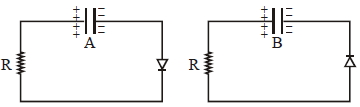
- Two identical capacitors \(\mathrm{A}\) and \(\mathrm{B}\), charged to the same potential \(5\; \mathrm{V}\) are connected in two different circuits as shown below at time \(\mathrm{t}=0\) If the charge on capacitors \(A\) and \(B\) at time \(\mathrm{t}=\mathrm{CR}\) is \(\mathrm{Q}_{\mathrm{A}}\) and \(\mathrm{Q}_{\mathrm{B}}\) respectively, then (Here \(e\) is the base of natural logarithm)
 JEE Mains 2020 Medium
- \(\left( 1 \right)\,{N_2}\left( g \right) + 3{H_2}\left( g \right) \rightleftharpoons 2N{H_3}\left( g \right)\,,\,{K_1}\) \(\left( 2 \right)\,{N_2}\left( g \right) + {O_2}\left( g \right) \rightleftharpoons 2NO\left( g \right)\,,\,{K_2}\) \(\left( 3 \right)\,{H_2}\left( g \right) + \frac{1}{2}{O_2}\left( g \right) \rightleftharpoons {H_2}O\left( g \right)\,,\,{K_3}\) The equation for the equilibrium constart of the reaction \(2N{H_3}\left( g \right) + \frac{5}{2}{O_2}\left( g \right) \rightleftharpoons 2NO\left( g \right) + 3{H_2}O\left( g \right)\) \((K_4)\) in terms of \(K_1 , K_2\) , and \(K_3\) isJEE Mains 2013 Hard