


JEE Mains · Chemistry · STD 12 - Chemical kinetics
- JEE Mains 2025
- Easy
- Numerical
For the thermal decomposition of \(\mathrm{N}_2 \mathrm{O}_5(\mathrm{~g})\) at constant volume, the following table can be formed, for the reaction mentioned below.
\(2 \mathrm{~N}_2 \mathrm{O}_5(\mathrm{~g}) \rightarrow 2 \mathrm{~N}_2 \mathrm{O}_4(\mathrm{~g})+\mathrm{O}_2(\mathrm{~g})\)
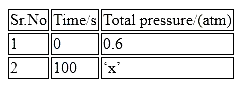
\(\mathrm{x}=\ldots \times 10^{-3} \mathrm{~atm} \text { [nearest integer] }\)
Given : Rate constant for the reaction is \(4.606 \times 10^{-2} \mathrm{~s}^{-1}\).
Pick an option to check your answer.
Answer & Solution
Correct Answer
(C) 897
Step-by-step Solution
Detailed explanation
\(2 \mathrm{~N}_2 \mathrm{O}_5(\mathrm{~g}) \rightarrow 2 \mathrm{~N}_2 \mathrm{O}_4(\mathrm{~g})+\mathrm{O}_2(\mathrm{~g})\)
\(\begin{aligned} & k=\frac{2.303}{t} \log \frac{0.9-0.6}{(0.9-x)} \\ & 2 \times 10^{-2} \times 100=\log \frac{0.3}{(0.9-x)} \\ & 100=\frac{0.3}{(0.9-x)} \\ & =\frac{0.9-x}{0.3}=0.01 \\ & 0.9-X=0.003 \\ & =897 \times 10^{-3}\end{aligned}\)
More questions from Chemistry
- Total number of ions from the following with noble gas configuration is__________. \( \mathrm{Sr}^{2+}(\mathrm{Z}=38), \mathrm{Cs}^{+}(\mathrm{Z}=55), \mathrm{La}^{2+}(\mathrm{Z}=57) \mathrm{Pb}^{2+} \) \( (\mathrm{Z}=82), \mathrm{Yb}^{2+}(\mathrm{Z}=70) \text { and } \mathrm{Fe}^{2+}(\mathrm{Z}=26)\)JEE Mains 2024 Hard
- The correct match between items of List \(-I\) and List \(-II\) is
List \(-I\) List \(-II\) \((A)\) Phenelzine \((p)\) Pyrimidine \((B)\) Chloroxylenol \((q)\) Furan \((C)\) Uracil \((r)\) Hydrazine \((D)\) Ranitidine \((s)\) Phenol JEE Mains 2018 Hard - Williamson synthesis of ether is an example ofJEE Mains 2014 Hard
- The number of water molecule \((s)\) not coordinated to copper ion directly in \(CuSO_4.5H_2O,\) isJEE Mains 2019 Hard
- The fusion of chromite ore with sodium carbonate in the presence of air leads to the formation of products \(\mathrm{A}\) and \(\mathrm{B}\) along with the evolution of \(\mathrm{CO}_2\). The sum of spin-only magnetic moment values of \(A\) and \(B\) is _______ \(B.M.\) (Nearest integer) (Given atomic number: \(\mathrm{C}: 6, \mathrm{Na}: 11, \mathrm{O}: 8\), \(\mathrm{Fe}: 26, \mathrm{Cr}: 24 \mathrm{~J}\)JEE Mains 2024 Medium
- Among the following species the one which causes the highest \(CFSE,\,\,\Delta _0\) as a ligand isJEE Mains 2014 Hard
More PYQs from JEE Mains
- Identify the correct statementJEE Mains 2016 Hard
- Two different wires having lengths \(L _{1}\) and \(L _{2}\) and respective temperature coefficient of linear expansion \(\alpha_{1}\) and \(\alpha_{2},\) are joined end-to-end. Then the effective temperature coefficient of linear expansion isJEE Mains 2020 Hard
- Match List - I with List - II.
Choose the correct answer from the options given\(\text{ }\)below\(\text{ }\):List - I (Complex) List - II (Hybridisation Magnetic characters) (A) \(\left[\mathrm{MnBr}_4\right]^{2-}\) (I) \(d^2 s^3\) diamagnetic (B) \(\left[\mathrm{FeF}_6\right]^{3-}\) (II) \(\mathrm{sp}^3 \mathrm{~d}^2\) paramagnetic (C) \(\left[\mathrm{Co}\left(\mathrm{C}_2 \mathrm{O}_4\right)_3\right]^{3-}\) (III) \(\mathrm{sp}^3\) diamagnetic (D) \(\left[\mathrm{Ni}(\mathrm{CO})_4\right]\) (IV) \(\mathrm{sp}^3\) paramagnetic JEE Mains 2025 Medium - In a Young's double slit experiment, the slits are separated by 0.2 mm. If the slits separation is increased to 0.4 mm , the percentage change of the fringe width is _______.JEE Mains 2025 Easy
- Two travelling waves of equal amplitudes and equal frequencies move in opposite directions along a string. They interfere to produce a stationary wave whose equation is given by \(y=\left(10 \cos \pi x \sin \frac{2 \pi t}{T}\right)\, cm\) The amplitude of the particle at \(x =\frac{4}{3} \,cm\) will be........ \(cm\).JEE Mains 2022 Easy
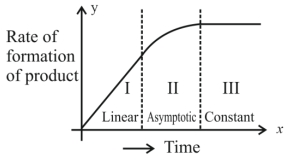
- For certain chemical reaction \(X \rightarrow Y\), the rate of formation of product is plotted against the time as shown in the figure. The number of Correct statement/s from the following is \(.......\). \((A)\) Over all order of this reaction is one \((B)\) Order of this reaction can't be determined \((C)\) In region\(-I\) and \(III\), the reaction is of first and zero order respectively \((D)\) In region\(-II\), the reaction is of first order \((E)\) In region\(-II\), the order of reaction is in the range of \(0.1\) to \(0.9\).
 JEE Mains 2023 Hard