


All Chemical kinetics questions
Newest firstShowing 151–184 of 184 questions
-
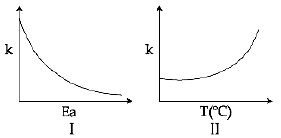
- (A) \(I\) is right but \(II\) is wrong
- (B) Both \(I\) and \(II\) are correct
- (C) \(I\) is wrong but \(II\) is right
- (D) Both \(I\) and \(II\) are wrong
Show answer and solution
Correct Answer: (A)
\(K = A{e^{ - {E_a}/RT}}\)
\((i)\) is true but \((ii)\) is false
\((ii)\) should be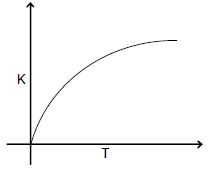
-
- (A) \(50\)
- (B) \(25\)
- (C) \(20\)
- (D) \(40\)
Show answer and solution
Correct Answer: (A)
According to unit of rate constant it is a zero order reaction then half life of reaction will be \({t_{1/2}} = \frac{{{C_0}}}{{2k}} = \frac{{5\,\mu g}}{{2 \times 0.05\,\mu g/year}} = 50\,years\) -
- (A) \(10^{-6}\,s^{-1}\)
- (B) \(2\times 10^{-4}\,s^{-1}\)
- (C) \(10^{-4}\,s^{-1}\)
- (D) \(4\times 10^{-4}\,s^{-1}\)
Show answer and solution
Correct Answer: (C)
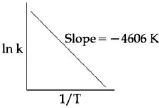
\(\ln \, = \,\ln \,A\, - \,\frac{{Ea}}{{RT}}\, = \,\ln \,A\, - \,\frac{{4606}}{T}\)\(\ln \,\left( {\frac{k}{{{{10}^{ - 5}}}}} \right) = \left( {\frac{{Ea}}{R}} \right)\, \times \,\frac{{500 - 400}}{{500 \times 400}}\)
\(\ln \,\left( {\frac{k}{{{{10}^{ - 5}}}}} \right) = 4606 \times \frac{1}{{2000}}\, = \,2.303\, = \,\ln \,10\)
\(\ln \,\left( {\frac{k}{{{{10}^{ - 5}}}}} \right) = \,\ln \,10\)
\(k\,=\,10^{-4}\)
-
- (A) \(\left( {\frac{{{k_1}}}{{{k_2}}}} \right)\left[ A \right]\)
- (B) \(\left( {{k_1} - {k_2}} \right)\left[ A \right]\)
- (C) \({k_1}{k_2}\left[ A \right]\)
- (D) \(\left( {{k_1} + {k_2}} \right)\left[ A \right]\)
Show answer and solution
Correct Answer: (A)
Applying steady state of approximation\(\frac{d}{{dt}}[B]\, = \,{K_1}[A]\, - \,{K_2}[B]\)
\(O\, = \,{K_1}[A]\, - \,{K_2}[B]\)
\(\frac{{{K_1}}}{{{K_2}}}[A]\, = \,[B]\)
-
- (A) \({k_1}\left[ {{A_2}} \right] - {k_{ - 1}}{\left[ A \right]^2}\)
- (B) \(2{k_1}\left[ {{A_2}} \right] - {k_{ - 1}}{\left[ A \right]^2}\)
- (C) \({k_1}\left[ {{A_2}} \right] + {k_{ - 1}}{\left[ A \right]^2}\)
- (D) \(2{k_1}\left[ {{A_2}} \right] - {2k_{ - 1}}{\left[ A \right]^2}\)
Show answer and solution
Correct Answer: (D)
\(\frac{1}{2}\frac{{d[A]}}{{dt}}\, = \, - \,{K_1}\,{[A]_2}\, + \,{K_{ - 1}}\,{[A]^2}\)\(\frac{{d[A]}}{{dt}}\, = \,2{K_1}\,{[A]_2}\, - \,2{K_{ - 1}}\,{[A]^2}\)
-
- (A) Rate \(= k[A]^2[B]^2\)
- (B) Rate \(= k[A][B]^2\)
- (C) Rate \(= k[A][B]\)
- (D) Rate \(= k[A]^2[B]\)
Show answer and solution
Correct Answer: (B)
\(r\, = \,K{[A]^x}\,{[B]^y}\)\(0.045\, = \,K{(0.05)^x}{(0.05)^y}\) ...... \((1)\)
\(0.090\, = \,K{(0.10)^x}{(0.05)^y}\) .......\((2)\)
\(0.72\, = \,K{(0.20)^x}{(0.10)^y}\) ........\((3)\)
Diving \((1)\) by \((2)\) We get
\(\frac{{0.045}}{{0.090}}\, = \,{\left( {\frac{{0.05}}{{0.10}}} \right)^x}\, \Rightarrow \,x = 1\)
Diving \((2)\) by \((3)\)
\(\frac{{0.090}}{{0.720}}\, = \,{\left( {\frac{{0.10}}{{0.20}}} \right)^x}\,{\left( {\frac{{0.05}}{{0.10}}} \right)^y}\, \Rightarrow \,y = 2\,\)
Hence, \(r\, = \,K[A]\,{[B]^2}\)
-
- (A) Total order of the reaction is \(4\)
- (B) Order of the reaction with respect to \(B\) is \(2\)
- (C) Order of the reaction with respect to \(B\) is \(1\)
- (D) Order of the reaction with respect to \(A\) is \(2\)
Show answer and solution
Correct Answer: (B)
\(2A+B\to \) productsRate \(=\,K\,[A]^x[B]^y\)
\(r\,=\,K\,[A]^x[B]^y\) ..... \((i)\)
\(0.3\,=\,K\,[A]^x[B]^y\) ..... \((1)\)
\(2.4\, = \,K{[2A]^x}\,{[2B]^y}\) ...... \((2)\)
\(0.6\, = \,K{[2A]^x}\,{[B]^y}\) ...... \((3)\)
From \((1)\,(2)\) and \((3)\)
\(X\,=\,1,\) \(Y\,=\,2\)
Overall order \(=\,2+1\,=3\)
Order w.r.t \(A=1\)
Order w.r.t \(B=2\)
-
- (A) \(72\)
- (B) \(166\)
- (C) \(150\)
- (D) \(59\)
Show answer and solution
Correct Answer: (B)
\({H_2}(g)\, + \,{I_2}(g)\, \to \,2HI\,(g)\)Apply Arrhenius equation
\(\log \,\frac{{{K_2}}}{{{K_1}}}\, = \,\frac{{{E_a}}}{{2.303\,R}}\left( {\frac{1}{{600}} - \frac{1}{{800}}} \right)\)
\(\log \,\frac{1}{{2.5 \times {{10}^{ - 4}}}}\, = \,\frac{{{E_a}}}{{2.303 \times 8.31}}\,\left( {\frac{{200}}{{600 \times 800}}} \right)\)
\(\therefore \,\,{E_a}\, \approx \,166\,\,kJ\,/\,mol\)
-
- (A) \(y/R\,\)unit
- (B) \(y\,\)unit
- (C) \(yR\,\)unit
- (D) \(-y\,\)unit
Show answer and solution
Correct Answer: (B)
\(\ln \,k = - \frac{{{E_a}}}{{RT}} + \ln \,A\)\(\therefore \) Slope \(= - E_a = -y\)
-
- (A) \(C_2H_2\) and \(C_6H_6\)
- (B) \(n-\) Butane and Iso-butane
- (C) \(N_2O_4\) and \(NO_2\)
- (D) \(C_2H_4\) and \(C_4H_8\)
Show answer and solution
Correct Answer: (D)
The correct option is \(B C _2 H _4\) and \(C _4 H _8\)\(\log \frac{- d [ A ]}{ dt }=\log \frac{ d [ B ]}{ dt }+0.3010 \)
\(\frac{- d [ A ]}{ dt }=2 \times \frac{ d [ B ]}{ dt } \)
\(\frac{1}{2} \times \frac{- d [ A ]}{ dt }=\frac{ d [ B ]}{ dt } \)
\(2 A \rightarrow B \)
\(2 C _2 H _4 \rightarrow C _4 H _8\)
-
- (A) \(1.667\times10^{-2}\)
- (B) \(4.167\times10^{-3}\)
- (C) \(8.333\times10^{-3}\)
- (D) \(2.083\times10^{-3}\)
Show answer and solution
Correct Answer: (A)
\(2N_2O_5 (g) \to 4NO_2 (g) + O_2 (g)\)\(t=0\) \(3.0\,M\)
\(t=30\) \(2.75\,M\)
\(\frac{{ - \,\Delta \,[{N_2}{O_5}]}}{{\Delta t}}\, = \,\frac{{0.25}}{{30}}\)
\(\frac{1}{2}\, \times \frac{{ - \,\Delta \,[{N_2}{O_5}]}}{{\Delta t}}\, = \frac{1}{4}\, \times \frac{{ - \,\Delta \,[N{O_2}]}}{{\Delta t}}\)
\(\frac{{\Delta \,[N{O_2}]}}{{\Delta t}}\, = \,\frac{{0.25}}{{30}}\, \times \,2\, = \,1.66\, \times \,{10^{ - 2}}\,M/\min \)
-
- (A) \(5\)
- (B) \(10\)
- (C) \(1\)
- (D) \(100\)
Show answer and solution
Correct Answer: (B)
\(R\,\, = \,k{[A]^x}\,{[B]^y}\)\(6.93\, \times \,{10^{ - 3}}\, = \,k\,{(0.1)^x}\,{(0.2)^y}\) ...... \((i)\)
\(6.93\, \times \,{10^{ - 3}}\, = \,k\,{(0.1)^x}\,{(0.25)^y}\) ...... \((ii)\)
\(1.386 \times \,{10^{ - 2}}\, = \,k\,{(0.2)^x}\,{(0.3)^y}\) . .... \((iii)\)
\( \Rightarrow \,y = 0\) (from \((i)\) and \((ii)\)), zero order w.r.t. \(B\)
\(x=1\) (from \((i)\) and \((ii)\))
\( \Rightarrow \,\) First order wrt \(A\)
\( \Rightarrow 6.93\times 10^{-3}\,=\,k(0.1)\)
\( \Rightarrow k=6.93\times 10^{-3}\,min^{-1}\)
-
- (A) \(1,1\)
- (B) \(0,2\)
- (C) \(0,1\)
- (D) \(1,0\)
Show answer and solution
Correct Answer: (D)
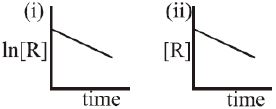
For first order reaction\(\ln \,{[R]_t}\, = \, - \,Kt\, + \,\ln \,{[R]_0}\)
For zero oeder reaction
\({[R]_t}\, = \, - \,Kt\, + \,{[R]_0}\)
Where \('R'\) is reactant.
-
- (A) \(9.0\)
- (B) \(12.0\)
- (C) \(18.0\)
- (D) \(7.2\)
Show answer and solution
Correct Answer: (C)
For zero order reaction\({C_o}\, - \,{C_t}\, = \,Kt\)
\(0.5M\, - \,0.2M\, = \,Kt\)
\(0.3\, = \,Kt\) ....... \((1)\)
\('K'\) can be calculated by
\({t_{1/2}}\, = \,\frac{{{C_o}}}{{2K}}\)
\(6\, = \,\frac{{0.2}}{{2K}}\)
\(K\, = \,\frac{{0.2}}{{12}}\, = \,\frac{{2 \times {{10}^{ - 1}}}}{{12}}\, = \,\frac{1}{{60}}\)
Putting the value of \(K\) in eq \((1)\)
\(t\, = \,\frac{{0.3}}{K}\, = \,\frac{{0.3}}{{1/60}}\, = \,60\, \times \,0.3\, = \,18\,Hr\)
-
- (A) \(3.2\)
- (B) \(2.5\)
- (C) \(4.1\)
- (D) \(5\)
Show answer and solution
Correct Answer: (C)
The half life \(t_{1/2}\,=\,10\,days\)The decay constant
\(k\, = \,\frac{{0.693}}{{{t_{1/2}}}}\, = \,\frac{{0.693}}{{10\,\,days}}\, = \,0.0693\,\,day{s^{ - 1}}\)
The time required for one fourth conversion
\(t\, = \,\frac{{2.303}}{k}\,{\log _{10}}\frac{a}{{a - x}}\)
\( = \,\frac{{2.303}}{{0.0693\,\,da{y^{ - 1}}}}\,{\log _{10}}\,\frac{1}{{1 - (1/4)}} = 4.1\,days\)
-
- (A) \(2\)
- (B) \(3\)
- (C) \(0\)
- (D) \(1\)
Show answer and solution
Correct Answer: (D)
First order reaction as halflife is constant.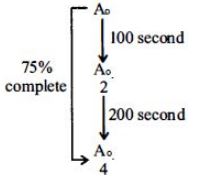
-
- (A) \(136.25\)
- (B) \(106.25\)
- (C) \(175.0\)
- (D) \(116.25\)
Show answer and solution
Correct Answer: (B)
\({N_2}{O_5}\, \to \,2N{O_2}\, + \,\frac{1}{2}{O_2}\)At \(t=0\) \(50\) \(0\) \(0\)
At \(t=50\,min\) \(50-p_1\) \(2p_1\) \(\frac {p_1}{2}\)
Total pressure at \(50\,\min\)
\(=\,50-p_1+2p_1+\frac {p_1}{2}=87.5\)
\(50+\frac {3p_1}{2}=87.5\)
\(\frac{{3{p_1}}}{2}\, = \,37.5\)
\(\therefore \,\,{p_1}\, = \frac{{\,37.5\, \times 2}}{3}\, = \,25\)
At \(t=100\,min\) \(50-p_2\) \(2p_2\) \(\frac {p_2}{2}\)
\(50\,\min\) is half life period
For \(100\,\min\) i.e., for \(2\) half lives \(50-p_2=12.5\)
\(\therefore \,\,{p_2}\, = 37.5\,mm\) of \(Hg\)
Total pressure at \(100\,\min\)
\( = {\mkern 1mu} 50 - {p_2} + 2{p_2} + \frac{{{p_2}}}{2}\)
\( = {\mkern 1mu} 50 + \frac{{3{p_2}}}{2}\, = \,50 + \frac{3}{2} \times 37.5\)
\(=\,50\,+\,56.25\)
\(=\,106.25\,mm\) of \(Hg\)
-
- (A) \(9.84\)
- (B) \(4.92\)
- (C) \(2.45\)
- (D) \(19.67\)
Show answer and solution
Correct Answer: (B)
In order to calculate the enthalpy change for \(H_2O\) at \(5\,^oC\) to ice at \(-\,5\,^oC\) , we need to calculated the enthalpy change of all the transformation involved in the process.\((a)\) Energy change of \(1\,mol\), \(H_2O\,(l)\), at \(5\,^oC\)
\(\to \,1\,mol\), \(H_2O\,(l)\) , \(0\,^oC\)
\((b)\) Energy change of \(1\,mol\), \(H_2O\,(l)\), at \(0\,^oC\)
\(\to \,1\,mol\), \(H_2O\,(s)\) (ice) , \(0\,^oC\)
\((c)\) Energy change of \(1\,mol\), Ice \((s)\), at \(0\,^oC\)
\(\to \,1\,mol\), Ice \((s)\) , \(-5\,^oC\)
Total \(\Delta H\)
\( = \,{C_P}\,[{H_2}O\,(l)]\,\,\Delta T\,\, + \,\Delta H\) freezing \( + \,\,{C_P}\,[{H_2}O\,(s)]\,\,\Delta T\)
\( = \,(75.3\,\,J\,\,mo{l^{ - 1}}\,{K^{ - 1}})\,( - 5)\,K\, + ( - \,6\, \times \,{10^3}\,\,J\,mo{l^{ - 1}}\,{K^{ - 1}})\) \(+ \,(36.8\,\,J\,mo{l^{ - 1}}\,{K^{ - 1}})\,( - 5)\,K\)
\(\Delta H\,\, = \,\, - \,6.56\,\,kJ\,mo{l^{ - 1}}\) (exothermic process)
So, \(\Delta H\,\, = \,\,6.56\,\,kJ\,mo{l^{ - 1}}\)
\( \Rightarrow \,{T_2}\, = \,304.92\,\,K\)
\({T_1}\, = \,300\,\,K,\,\) \({T_2}\, = 304.92\,\,K\)
\(\Delta T\, = \,\,{T_1}\, - {T_2}\, = 4.92\,\,K\)
-
- (A) \(107.2\)
- (B) \(53.6\)
- (C) \(26.8\)
- (D) \(214.4\)
Show answer and solution
Correct Answer: (A)
\(\ln \,\frac{{{K_2}}}{{{K_1}}}\, = \,\frac{{{E_a}}}{R}\,\left( {\frac{1}{{{T_1}}}\, - \,\frac{1}{{{T_2}}}} \right)\)\(\ln \,\,4\, = \,\frac{{{E_a}}}{{8.314}}\left( {\frac{{310 - 300}}{{310 \times 300}}} \right)\)
\(2\,\ln \,2\, = \,\frac{{{E_a}}}{{8.314}}\left( {\frac{{310 - 300}}{{310 \times 300}}} \right)\)
\({E_a} = \frac{{0.693\, \times 2\, \times \,8.314 \times 300 \times 310}}{{10}}\)
\( = 107.2\,\,kJ/mol\)
-
- (A) \(8\)
- (B) \(12\)
- (C) \(6\)
- (D) \(4\)
Show answer and solution
Correct Answer: (D)
According to Arrhenius equation\( k=A e^{-E_{2} / R T} \)
\( k_{1} =A e^{-E_{\mathrm{A} 1} / R T} \quad (1)\)
\(k_{2} =A e^{-E_{22} / R T} \quad (2)\)
Dividing Eq. \(( 2 )\) by Eq. \(( 1 )\), we get
\(\frac{k_{2}}{k_{1}}=e^{\left(\frac{E_{21}-E_{22}}{R T}\right)}\)
Taking natural logarithm of both sides, we get
\(\ln \left(\frac{k_{2}}{k_{1}}\right) =\frac{E_{\mathrm{al}}-E_{\mathrm{a} 2}}{R T} \)
\(=\frac{10,000}{8.314 \times 300}=4\)
-
- (A) \(2.66\,L\,min^{-1}\,\) at \(STP\)
- (B) \(1.34 \times 10-^{-2} \,mol\, min^{-1}\)
- (C) \(6.96 \times 10-^{-2} \,mol\, min^{-1}\)
- (D) \(6.93 \times 10-^{-2} \,mol\, min^{-1}\)
Show answer and solution
Correct Answer: (D)
\(H_{2} O_{2}(a q) \rightarrow H_{2} O(a q)+\frac{1}{2} O_{2}(g)\)For a first order reaction
\(k=\frac{2.303}{t} \log \frac{a}{(a-x)}\)
Given \(a=0.5,(a-x)=0.125,\,t=50\,min\)
\(k=\frac{2.303}{50} \log \frac{0.5}{0.125}\)
\(=2.78 \times 10^{-2} \,\mathrm{min}^{-1}\)
\(r=k\left[H_{2} O_{2}\right]=2.78 \times 10^{-2} \times 0.05\)
\(=1.386 \times 10^{-3} \,\,\mathrm{mol} \,\mathrm{min}^{-1}\)
Now
\(-\frac{d\left|H_{d} O_{2}\right|}{d t}=\frac{d\left|H_{2} O\right|}{d t}=\frac{2 d\left|O_{2}\right|}{d t}\)
\(\frac{2 d\left[O_{2}\right]}{d t}-\frac{d\left[H_{2} O_{2}\right]}{d t}\)
\(\frac{d\left[O_{2}\right]}{d t}=\frac{1}{2} \times \frac{d\left[H_{2} O_{2}\right]}{d t}\)
\(=\frac{1.386 \times 10^{-3}}{2}=6.93 \times 10^{-4}\,\, \mathrm{mol}\, \mathrm{min}^{-1}\)
-
- (A) \(3k\)
- (B) \(9k\)
- (C) \(k/3\)
- (D) \(k\)
Show answer and solution
Correct Answer: (D)
Rate constant is independent of concentration -
- (A) \(1.4 \times {10^{20}}\)
- (B) \(3.1 \times {10^{10}}\)
- (C) \(5.2 \times {10^9}\)
- (D) \(2.6 \times {10^{10}}\)
Show answer and solution
Correct Answer: (A)
On adding eq. \((i)\) and eq. \((ii)\) we get\({{O}_{3}}(g)+O(g)\to 2{{O}_{2}}(g)\)
Hence overall rate constant \(=\,K_i\times K_{ii}\)
\( = \,5.2 \times \,{10^9}\, \times \,2.6\, \times \,{10^{10}}\, \approx \,\) \(1.4\, \times \,{10^{20}}\,mo{l^{ - 1}}\,L{s^{ - 1}}\)
\({{O}_{3}}(g)+C{{l}^{*}}(g)\to {{O}_{2}}(g)+Cl{{O}^{*}}(g),\,\,{{K}_{i}}\)
\(Cl{{O}^{*}}(g)+{{O}^{*}}(g)\to {{O}_{2}}(g)+C{{l}^{*}}(g),\,\,{{K}_{ii}}\)
\({{O}_{3}}(g)+{{O}^{*}}(g)\to 2{{O}_{2}}(g),\) \(K_{Rate}\,=\,K_i\times K_{ii}\)
-
- (A) halved
- (B) the same
- (C) doubled
- (D) quadrupled
Show answer and solution
Correct Answer: (C)
Rate \(= K[A][B]=R\)\(R'\, = \,K\left[ A \right]\left[ {2B} \right]\)
\(\frac{R}{{R'}}\, = \,\frac{{k[A][B]}}{{k[A][2B]}}\, = \,\frac{{k[A][B]}}{{2k[A][B]}}\)
\( \Rightarrow \,2R\, = \,R'\) i.e., rate become doubles.
-
- (A) \(E_f\, = 80\, k\,J/mol ; E_b\, = 120\, k\,J/mol\)
- (B) \(E_f\, = 60\, k\,J/mol ; E_b\, = 100\, k\,J/mol\)
- (C) \(E_f\, = 30\, k\,J/mol ; E_b\, = 70\, k\,J/mol\)
- (D) \(E_f\, = 70\, k\,J/mol ; E_b\, = 30\, k\,J/mol\)
Show answer and solution
Correct Answer: (A)
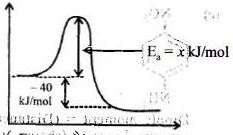
\(\left( {\frac{{{E_{\mathop {forwad}\limits_{(A \to B)} }}}}{{{E_{\mathop {backward}\limits_{(B \to A)} }}}}} \right) = \frac{2}{3} = \frac{x}{{ - 40 + x}}\)\( \Rightarrow - 80 + 2x = 3x\)
\( \Rightarrow x = - 80\,kJ/mol\) for forward
For backward \( = - 40 + ( - 80 = - 120\,kJ/mol)\)
Because activation energy cannot be negative
so, for forwad reaction \(E_a=80\,kJ/mol\)
for forwad reaction \(E_a=120\,kJ/mol\)
-
- (A) shifting of equilibrium towards reactants due to elastic collisions
- (B) loss of active species on collision
- (C) low probability of simultaneous collision of all the reacting species
- (D) increase in entropy and activation energy as more molecules are involved
Show answer and solution
Correct Answer: (C)
Reactions of higher order \((>3 )\) are very rate due to very less chances of many molecules to undergo effective collisions. -
- (A) \(106.25\)
- (B) \(150\)
- (C) \(125\)
- (D) \(116.25\)
Show answer and solution
Correct Answer: (A)
\((a)\) Rate law forr first order reaction \(=\,k[N_2O_5]\)\(2{{N}_{2}}{{O}_{5}}\,(g)\,\to \,4N{{O}_{2}}\,(g)\,+\,{{O}_{2}}(g)\)
\(\mathop {t = 0\,\,\min }\limits_{(\Pr essure\,\,\,in\,\,\,mm\,\,\,Hg)} \) \(50\) \(0\) \(0\)
\(\mathop {t =30\,\,\min }\limits_{(\Pr essure\,\,\,in\,\,\,mm\,\,\,Hg)} \) \(50-2p\) \(4p\) \(p\)
Total pressure \(50-2p+4p+p=50+3p=87.5\,mm\,Hg\)
\(\therefore \,\,P\, = \,12.5\,mm\,Hg\)
\(\therefore \,\,{P_0}\, = 50\) and \(P\) \((t=30\,min)\)
\(=\,25\) for \(N_2O_5\) reactant
\(\therefore \,\,k\, = \,\frac{{2.303}}{{30\,\,\min }}\, \times \,\log \,\left( {\frac{{50}}{{25}}} \right)\,\) \( = \,\frac{{2.303}}{{60\,\,\min }}\, \times \,\log \,\left( {\frac{{50}}{x}} \right)\)
On solving \(x=12.5\,\,mm\,Hg\,=\,50-2p\)
\(\therefore P=18.75\,\,mm\,Hg\)
\(\therefore \) Total pressure \(=50+3P=106.25\,\,mm\,Hg\)
-
- (A) \(\frac{1}{3}\frac{{d\left[ A \right]}}{{dt}} = \frac{{d\left[ C \right]}}{{dt}} = k{\left[ A \right]^n}{\left[ B \right]^m}\)
- (B) \( - \frac{{d\left[ A \right]}}{{dt}} = \frac{{d\left[ C \right]}}{{dt}} = k{\left[ A \right]^n}{\left[ B \right]^m}\)
- (C) \( + \frac{1}{3}\frac{{d\left[ A \right]}}{{dt}} = - \frac{{d\left[ C \right]}}{{dt}} = k{\left[ A \right]^n}{\left[ B \right]^m}\)
- (D) \( - \frac{1}{3}\frac{{d\left[ A \right]}}{{dt}} = \frac{{d\left[ C \right]}}{{dt}} = k{\left[ A \right]^n}{\left[ B \right]^m}\)
Show answer and solution
Correct Answer: (D)
For the reaction\(3A+2B\to C+D\)
Rate of disappearance of \(A\,=\) Rate of appearance of \(C\) reation
\( = \, - \,\frac{1}{3}\,\frac{{d[A]}}{{dt}}\, = \,\frac{{d[C]}}{{dt}}\, = \,k\,{[A]^n}\,{[B]^m}\)
-
- (A) \(- 1.25\times10^{-4}\)
- (B) \(- 2.50\times10^{-4}\)
- (C) \(- 3.75\times10^{-4}\)
- (D) \(-5.00\times10^{-4}\)
Show answer and solution
Correct Answer: (D)
From rate law\( - \frac{1}{2}\frac{{dS{O_2}}}{{dt}}\, - \,\frac{{d{O_2}}}{{dt}} - \frac{1}{2}\frac{{dS{O_3}}}{{dt}}\)
\(\therefore \,\,\frac{{dS{O_2}}}{{dt}}\, = -\,2 \times \frac{{d{O_2}}}{{dt}}\)
\(=\,-\,2\times 2.5\times 10^{-4}\)
\(=\,-\,5\times 10^{-4}\,mol\,L^{-1}\,s^{-1}\)
- 180. The half-life period of a first order reaction is \(15\,minutes\). The amount of substance left after one hour will be 2014 Hard
- (A) \(\frac{1}{4}\) of the original amount
- (B) \(\frac{1}{8}\) of the original amount
- (C) \(\frac{1}{16}\) of the original amount
- (D) \(\frac{1}{32}\) of the original amount
Show answer and solution
Correct Answer: (C)
Given \(t_{1/2}\,=\,15\,minutes\)Total time \((T)\,=\,1\,hr\,=\,60\,min.\)
From \(T\,=\,n\times t_{1/2}\)
\(n\,=\,\frac {60}{15}\,=\,4\)
Now from the formula \(\frac{N}{{{N_0}}}\, = \,{\left( {\frac{1}{2}} \right)^n}\)
\( = \,{\left( {\frac{1}{2}} \right)^4}\, = \,\frac{1}{{16}}\)
Where \(N_0\,=\) initial amount
\(N\,=\) amount left after time \(t\)
hence the amount of substance left after \(1\,hour\) will be \(\frac {1}{16}\)
-
- (A) \(16\)
- (B) \(60\)
- (C) \(99\)
- (D) \(132\)
Show answer and solution
Correct Answer: (B)
According to arrhenius equation\(\log \,\frac{{{k_2}}}{{{k_1}}}\, = \,\frac{{{E_a}}}{{2.303\,\,R}}\,\left( {\frac{1}{{{T_1}}}\, - \,\frac{1}{{{T_2}}}} \right)\)
\(\log \,\frac{{1.3 \times {{10}^{ - 3}}}}{{1.3 \times {{10}^{ - 4}}}}\, = \,\frac{{{E_a}}}{{2.303 \times 8.314}}\,\left[ {\frac{1}{{373}} - \frac{1}{{423}}} \right]\)
\(1 = \frac{{{E_a}}}{{2.303 \times 8.314}}\,\left[ {\frac{1}{{373}} - \frac{1}{{423}}} \right]\)
\({E_a}\, = \,60\,\,kJ/mole\)
-
- (A) \(0.0456\)
- (B) \(1.14\)
- (C) \(0.114\)
- (D) \(0.57\)
Show answer and solution
Correct Answer: (B)
Given \( - \,\frac{{dMnO_4^ - }}{{dt}}\, = \,4.56\, \times {10^{ - 3}}\,M{s^{ - 1}}\)From the reaction given,
\( - \frac{1}{2}\,\frac{{dMnO_4^ - }}{{dt}}\, = \,\frac{{4.56 \times {{10}^{ - 3}}}}{2}\,M{s^{ - 1}}\)
\( - \frac{1}{2}\,\frac{{dMnO_4^ - }}{{dt}}\, = \,\frac{1}{5}\,\frac{{d{I_2}}}{{dt}}\)
\(\therefore \,\, - \frac{5}{2}\,\frac{{dMnO_4^ - }}{{dt}}\,\, = \frac{{d{I_2}}}{{dt}}\)
On substituting the given value
\(\therefore \frac{{d{I_2}}}{{dt}}\, = \,\frac{{4.56\, \times {{10}^{ - 3}} \times 5}}{2}\, = \,1.14\, \times \,{10^{ - 2}}\,M/s\)
-
- (A) \(0.5\)
- (B) \(1.25\)
- (C) \(12.5\)
- (D) \(1.0\)
Show answer and solution
Correct Answer: (D)
For a zero order reactionRate constant \( = \,k\, = \,\frac{{a - x}}{t}\)
\(2\, \times \,{10^{ - 2}}\, = \,\frac{{a\, - \,0.5}}{{25}}\)
\(a\, - \,0.5\, = \,0.5\)
\(a\, = \,1.0\,M\)
-
- (A) \(53.6\)
- (B) \(48.6\)
- (C) \(58.5\)
- (D) \(60.5\)
Show answer and solution
Correct Answer: (A)
Activation energy can be calculated from the equation \(\frac{\log \,k_{2}}{\log k_{1}}=\frac{E_{a}}{2.303 R}\left(\frac{1}{T_{1}}-\frac{1}{T_{2}}\right)\)given \(\frac{k_{2}}{k_{1}}=2 T_{2}=310\, K T_{1}=300 K\)
\(=\log \,2=\frac{-E_{a}}{2.303 \times 8.314}\left(\frac{1}{310}-\frac{1}{300}\right)\)
\(E_{a}=53598.6 \,J / \mathrm{mol}\)
\(=53.6\, \mathrm{kJ} / \mathrm{mol} .\)
No questions on this page match these filters.