


JEE Mains · Chemistry · STD 12 - Chemical kinetics
- JEE Mains 2025
- Hard
- MCQ
The reaction \(\mathrm{A}_2+\mathrm{B}_2 \rightarrow 2 \mathrm{AB}\) follows the mechanism
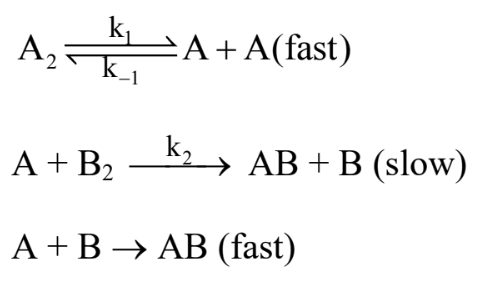
The overall order of the reaction is :
Pick an option to check your answer.
Answer & Solution
Correct Answer
(D) 1.5
Step-by-step Solution
Detailed explanation
\(\begin{aligned}
& \text { rate }=\mathrm{k}_2[\mathrm{~A}]\left[\mathrm{B}_2\right] \ldots \ldots \\
& \left(\frac{\mathrm{k}_1}{\mathrm{k}_{-1}}\right)=\left(\frac{[\mathrm{A}]^2}{\left[\mathrm{~A}_2\right]}\right) \\
& \Rightarrow[\mathrm{A}]=\sqrt{\frac{\mathrm{k}_1}{\mathrm{k}_{-1}}} \cdot \sqrt{\left[\mathrm{~A}_2\right]}
\end{aligned}\)
Substituting in (1) ; we get
\(\begin{aligned} & \text { Rate }=\mathrm{k}_2 \sqrt{\frac{\mathrm{k}_1}{\mathrm{k}_{-1}}} \cdot\left[\mathrm{~A}_2\right]^{\frac{1}{2}} \cdot\left[\mathrm{~B}_2\right] \\ & \therefore \text { order }=\left(\frac{3}{2}\right)=1.5\end{aligned}\)
More questions from Chemistry
- Identify the metal ions among \(Co ^{2+}, Ni ^{2+}, Fe ^{2+}, V ^{3+}\) and \(Ti ^{2+}\) having a spin-only magnetic moment value more than 3.0 BM . The sum of unpaired electrons present in the high spin octahedral complexes formed by those metal ions is ______.JEE Mains 2026 Medium
- If the Thomson model of the atom was correct, then the result of Rutherford's gold foil experiment would have been:JEE Mains 2021 Medium
- Complete the following reaction sequence and give the name of major product 'P'.
\(CH_3-CH_2-C\equiv N \xrightarrow[\text{(ii) } H_3O^+]{\text{(i) } OH^-/H_2O/\Delta} \xrightarrow[\text{(iv) } H_2O]{\text{(iii) } Cl_2/\text{Red P}} P \text{ (Major product)}\)JEE Mains 2026 Medium - The gas evolved on heating \(CaF_2\) and \(SiO_2\) with concentrated \(H_2SO_4\), on hydrolysis gives a white gelatinous precipitate. The precipitate isJEE Mains 2014 Hard
- Mass of magnesium required to produce 220 mL of hydrogen gas at STP on reaction with excess of dil. HCl is _______.
Given : Molar mass of Mg is \(24 \mathrm{~g} \mathrm{~mol}^{-1}\).JEE Mains 2025 Medium - When \(5\) moles of \(He\) gas expand isothermally and reversibly at \(300 \,K\) from \(10\, litre\) to \(20 \,litre,\) the magnitude of the maximum work obtained is \(.......\,J\). [nearest integer] (Given: \(R =8.3 \,J \,K ^{-1} \,mol ^{-1}\) and \(\log 2=0.3010\) )JEE Mains 2022 Medium
More PYQs from JEE Mains
- In a hydrogen like atom, when an electron jumps from the \(M -\) shell to the \(L-\) shell the wavelength of emitted radiation is \(\lambda \). If an electron jumps from \(N-\) shell to the \(L-\) shell the wavelength of emitted radiation will beJEE Mains 2019 Medium
- Match List - I with List - II.
Choose the correct answer from the options given\(\text{ }\)below\(\text{ }\):List - I List - II (A) Electric field inside (distance \(r>0\) from center) of a uniformly charged spherical shell with surface charge density \(\sigma\), and radius R. (I) \(\sigma / \epsilon_0\) (B) Electric field at distance \(r >0\) from a uniformly charged infinite plane sheet with surface charge density \(\sigma\). (II) \(\sigma / 2 \epsilon_0\) (C) Electric field outside (distance \(r>0\) from center) of a uniformly charged spherical shell with surface charge density \(\sigma\), and radius R. (III) \(0\) (D) Electric field between 2 oppositely charged infinite plane parallel sheets with uniform surface charge density \(\sigma\). (IV) \(\frac{\sigma R^2}{\epsilon_0 r^2}\) JEE Mains 2025 Medium - Molality (m) of \(3 \mathrm{M}\) aqueous solution of \(\mathrm{NaCl}\) is _______. (Given : Density of solution \(=1.25 \mathrm{~g} \mathrm{~mL}^{-1}\), Molar mass in \(\left.\mathrm{g} \mathrm{mol}^{-1}: \mathrm{Na}-23, \mathrm{Cl}-35.5\right)\)JEE Mains 2024 Medium
- If the maximum value of accelerating potential provided by a ratio frequency oscillator is \(12\, {kV}\). The number of revolution made by a proton in a cyclotron to achieve one sixth of the speed of light is ....... . \(\left[{m}_{{p}}=1.67 \times 10^{-27} {kg}, {e}=1.6 \times 10^{-19} {C},\right.\) Speed of light \(\left.=3 \times 10^{8} {m} / {s}\right]\)JEE Mains 2021 Hard
- A litre of buffer solution contains \(0.1\) mole of each of \(NH _3\) and \(NH _4 Cl\). On the addition of \(0.02\,mole\) of \(HCl\) by dissolving gaseous \(HCl\), the \(pH\) of the solution is found to be \(......\times 10^{-3}(\) Nearest integer) \(\left[\right.\) Given : \(pK _{ b }\left( NH _3\right)=4.745\) \(\log 2=0.301\) \(\log 3=0.477\) \(T =298\,K ]\)JEE Mains 2023 Hard
- Consider the cell \(Pt ( s )\left| H _2( s )( latm )\right| H ^{+}\left( aq ,\left[ H ^{+}\right]=1\right)|| Fe ^{3+}( aq ), Fe ^{2+}( aq ) \mid \operatorname{Pt}( s )\) Given : \(E _{ Fe ^{3+} / e ^{2 *}}^0=0.771\,V\) and \(E _{ H ^{+}+\frac{1}{2} H _2}^0=0 V , T =298\,K\) If the potential of the cell is \(0.712\,V\) the ratio of concentration of \(Fe ^{2+}\) to \(Fe ^{2+}\) is \(........\).(Nearest integer)JEE Mains 2023 Medium