


JEE Mains · Chemistry · STD 12 - Chemical kinetics
- JEE Mains 2026
- Medium
- MCQ
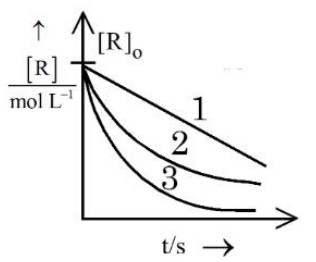
Consider the given graph showing variation of reactant concentration with time.
Three different reactions were started with identical initial concentration of reactants. Which of the following statement is correct?
Pick an option to check your answer.
Answer & Solution
Correct Answer
(B) The rate constant of reaction \(3\) is larger than the rate constant of reaction \(2\) if the order of reaction is same for both.
Step-by-step Solution
Detailed explanation
Analysis of the graph:
The graph shows reactant concentration \([R]\) vs time \(t\) for three reactions starting from the same initial concentration.
Curve 1 is a straight line with negative slope. For a zero-order reaction, the integrated rate law is \([R] = [R]_0 - kt\), which is a straight line in \([R]\) vs \(t\). Hence, reaction \(1\) is a zero-order reaction.
Curves 2 and 3 are non-linear (exponential-type decays), so they correspond to reactions of order greater than zero (e.g., first or second order).
Evaluating the options:
\((1)\) The order of all three reactions is the same.
Reaction \(1\) is zero order while reactions \(2\) and \(3\) are of higher order, so this statement is incorrect.
\((2)\) The rate constant of reaction \(3\) is larger than that of reaction \(2\), assuming both have the same order.
Assuming both curves \(2\) and \(3\) correspond to the same order (say first order), the integrated rate law is \([R] = [R]_0 e^{-kt}\). At any given time \(t\), the curve for reaction \(3\) lies below that of reaction \(2\), i.e., \([R]_3 < [R]_2\). Since both start from the same \([R]_0\), reaction \(3\) is decaying faster, which implies a larger rate constant. Hence \(k_3 > k_2\), and this statement is correct.
\((3)\) The SI unit of the rate constant of reaction \(1\) is \(\text{s}^{-1}\).
For a zero-order reaction, \(\text{Rate} = k[R]^0 = k\), so the unit of \(k\) is that of rate, i.e., \(\text{mol L}^{-1}\text{s}^{-1}\). The unit \(\text{s}^{-1}\) corresponds to a first-order reaction, so this statement is incorrect.
\((4)\) Thermal decomposition of \(HI\) on a gold surface is an example of reaction \(2\).
The thermal decomposition of \(HI\) on a gold surface is a well-known zero-order reaction, which corresponds to curve \(1\), not curve \(2\). Hence this statement is incorrect.
Therefore, the correct option is \((2)\).
More questions from Chemistry
- Match List \(I\) with List \(II\)
Choose the correct answer from the options given below :List-\(I\) (Elements) List-\(II\) (Properties in their respective groups) \((A)\) \(\mathrm{Cl}, \mathrm{S}\) \((I)\) Elements with highest electronegativity \((B)\) \(\mathrm{Ge}, \mathrm{As}\) \((II)\) Elements with largest atomic size \((C)\) \(\mathrm{Fr}, \mathrm{Ra}\) \((III)\) Elements which show properties of both metals and non metal \((D)\) \(\mathrm{F}, \mathrm{O}\) \((IV)\) Elements with highest negative electron gain enthalpy JEE Mains 2024 Medium - \({image}\) The above reaction requires which of the following reaction conditions ?
 JEE Mains 2021 Medium
- The normality of \(H _{2} SO _{4}\) in the solution obtained on mixing \(100 mL\) of \(0.1\,M H _{2} SO _{4}\) with \(50 mL\) of \(0.1\) \(M\,NaOH\) is \(\times 10^{-1}\,N\). (Nearest Integer)JEE Mains 2022 Medium
- Which one of the following species is stable in aqueous solution ?JEE Mains 2016 Hard
- Match List-I with List-II
List-I
Pair of CompoundsList-II
Type of IsomersA. 2-Methylpropene and but-1-ene I. Stereoisomers B. Cis-but-2-ene and trans-but-2-ene II. Position isomers C. 2-Butanol and diethyl ether III. Chain isomers D. But-1-ene and but-2-ene IV. Functional group isomers
Choose the correct answer from the options given below:JEE Mains 2026 Easy - The ammonia \((NH_{3} )\) released on quantitative reaction of \(0.6\; \mathrm{g}\) urea \(\left(\mathrm{NH}_{2} \mathrm{CONH}_{2}\right)\) with sodium hydroxide (\(NaOH\)) can be neutralized byJEE Mains 2020 Hard
More PYQs from JEE Mains
- Consider the following reactions: \(PCl _{3}+ H _{2} O \longrightarrow A + HCl\) \(A + H _{2} O \longrightarrow B + HCl\) number of ionisable protons present in the product \(B\,.....\)JEE Mains 2022 Medium
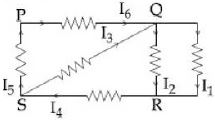
- In the given circuit diagram, the currents, \({I_1} = - \,0.3\,A,\,{I_4} = 0.8\,A\) and \({I_5} = 0.4\,A,\) are flowing as shown. The currents \(I_2,\,I_3\) and \(I_6,\) respectively are
 JEE Mains 2019 Medium
- \(2 \mathrm{MnO}_4^{-}+\mathrm{bI}^{-}+\mathrm{cH}_2 \mathrm{O} \rightarrow \mathrm{xI}_2+\mathrm{yMnO}_2+\mathrm{zOH}^{-}\) If the above equation is balanced with integer coefficients, the value of \(z\) is _______.JEE Mains 2024 Hard
- The conjugate base of hydrazoic acid isJEE Mains 2014 Easy
- A radioactive element \({ }_{92}^{242} X\) emits two \(\alpha\)-particles, one electron and two positrons. The product nucleus is represented by \({ }_{ P }^{234} Y\). The value of \(P\) is \(..................\)JEE Mains 2023 Medium
- A car is standing \(200\, m\) behind a bus, which is also at rest. The two start moving at the same instant but with different forward accelerations. The bus has acceleration \(2\,m/s^2\) and the car has acceleration \(4\, m/s^2\) . The car will catch up with the bus after a time ofJEE Mains 2017 Hard