


JEE Mains · Chemistry · STD 12 - Chemical kinetics
- JEE Mains 2025
- Medium
- Numerical
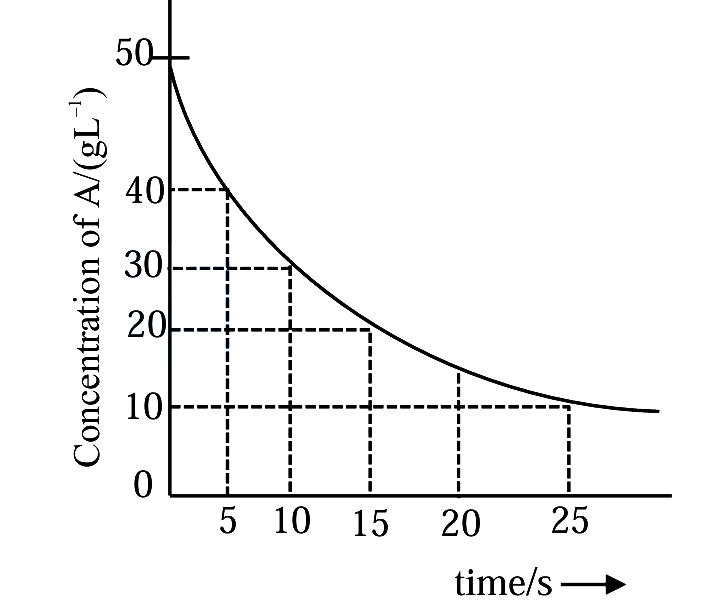
For the reaction \(\mathrm{A} \rightarrow \mathrm{B}\) the following graph was obtained. The time required (in seconds) for the concentration of A to reduce to \(2.5 \mathrm{~g} \mathrm{~L}^{-1}\) (if the initial concentration of A was \(50 \mathrm{~g} \mathrm{~L}^{-1}\)) is _______ (Nearest integer)
Given : \(\log 2=0.3010\) [We can assume in a hypothetical situation that the graph is correct, assuming its first order reaction, in reality the question is wrong.]
Pick an option to check your answer.
Answer & Solution
Correct Answer
(A) 43
Step-by-step Solution
Detailed explanation
As it is difficult to predict order using data provided in graph.
For specific time interval \(0-5 \mathrm{sec}, 5-10 \mathrm{sec}\) and \(10-15 \mathrm{sec}\). order comes to be zero, but graph is not a straight line.
Assuming \(1^{\text {st }}\) order kinetics
\(\begin{aligned}
& \mathrm{K}=\frac{1}{\mathrm{t}} \ln \frac{\mathrm{~A}_0}{\mathrm{~A}_{\mathrm{t}}} \\
& \mathrm{~K}=\frac{1}{10} \ln \frac{40}{20}
\end{aligned}\)
Time required to reduce to \(2.5 \mathrm{~g} / \mathrm{L}\)
\(\begin{aligned}
& \mathrm{K}=\frac{1}{\mathrm{t}} \ln \frac{50}{2.5} \\
& \frac{1}{10} \ln 2=\frac{1}{\mathrm{t}} \ln 20 \\
& \mathrm{t}=\frac{1.3010 \times 10}{0.3010}=43.3 \mathrm{sec}
\end{aligned}\)
More questions from Chemistry
- Which one of the following molecules is expected to exhibit diamagnetic behaviour ?JEE Mains 2013 Medium
- Ferrous sulphate heptahydrate is used to fortify foods with iron. The amount (in \(grams\)) of the salt required to achieve \(10 \;ppm\) of iron in \(100 \;\mathrm{kg}\) of wheat is Atomic weight : \(Fe =55.85 ; \mathrm{S}=32.0\) \(\mathrm{O}=16.00\)JEE Mains 2020 Hard
- The incorrect statement is :JEE Mains 2020 Medium
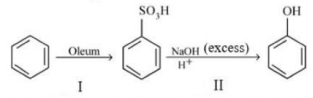
- In the following reaction The \(\%\) yield for reaction \(I\) is \(60 \%\) and that of reaction II is \(50 \%\). The overall yield of the complete reaction is \(..........\%\) [nearest integer]
 JEE Mains 2022 Hard
- Complex \(\mathrm{X}\) of composition \(\mathrm{Cr}\left(\mathrm{H}_{2} \mathrm{O}\right)_{6} \mathrm{Cl}_{\mathrm{n}}\) has a spin only magnetic moment of \(3.83\; BM\). It reacts with \(AgNO_{3}\) and shows geometrical isomerism. The \(IUPAC\) nomenclature of \(X\) isJEE Mains 2020 Hard
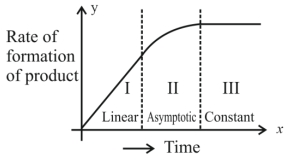
- For certain chemical reaction \(X \rightarrow Y\), the rate of formation of product is plotted against the time as shown in the figure. The number of Correct statement/s from the following is \(.......\). \((A)\) Over all order of this reaction is one \((B)\) Order of this reaction can't be determined \((C)\) In region\(-I\) and \(III\), the reaction is of first and zero order respectively \((D)\) In region\(-II\), the reaction is of first order \((E)\) In region\(-II\), the order of reaction is in the range of \(0.1\) to \(0.9\).
 JEE Mains 2023 Hard
More PYQs from JEE Mains
- The correct order of ligands arranged in increasing field strength :JEE Mains 2024 Medium
- In a single slit diffraction pattern, a light of wavelength \(6000\) A is used. The distance between the first and third minima in the diffraction pattern is found to be \(3 \mathrm{~mm}\) when the screen in placed 50 \(\mathrm{cm}\) away from slits. The width of the slit is _______ \(\times 10^{-4} \mathrm{~m}\).JEE Mains 2024 Hard
- An electromagnetic wave travelling in the \(x-\) direction has frequency of \(2 \times 10^{14}\,Hz\) and electric field amplitude of \(27\,Vm^{-1}\) . From the options given below, which one describes the magnetic field for this wave ?JEE Mains 2015 Medium
- For a cell, \(Cu ( s ) \mid Cu ^{2+}\left(0.001 M || Ag ^{+}(0.01\,M ) \mid Ag ( s )\right.\) the cell potential is found to be \(0.43\,V\) at \(298 K\). The magnitude of standard electrode potential for \(Cu ^{2+} / Cu\) \(.........\times 10^{-2}\,V\) \(\left[\text { Given }: E _{ Ag ^{+} / Ag }^{\Theta}=0.80 V \text { and } \frac{2.303 \,RT }{ F }=0.06\,V \right]\)JEE Mains 2022 Medium