


All Some basic concept of chemistry questions
Newest firstShowing 101–150 of 170 questions
-
- (A) \(6418\)
- (B) \(5418\)
- (C) \(5118\)
- (D) \(5948\)
Show answer and solution
Correct Answer: (B)
M.M. of \(C _{7} H _{5} N _{3} O _{6}\) is \(84+5+42+96=227\)\(n _{ C _{7} H _{5} N _{3} O _{6}}=\frac{681}{227}=3\)
\(n _{ N }=\frac{681}{227} \times 3=9 mol\)
no. of \(N\) atoms \(=9 \times 6.02 \times 10^{23}\)
\(=5418 \times 10^{21}\)
\(\therefore\) The answer is \(5418 .\)
- 102. Using the rules for significant figures, the correct answer for the expression \(\frac{0.02858 \times 0.112}{0.5702}\) will be .... . 2022 Easy
- (A) \(0.005613\)
- (B) \(0.00561\)
- (C) \(0.0056\)
- (D) \(0.006\)
Show answer and solution
Correct Answer: (B)
Reported answer should not be more precise than least precise term in calculations, so there should be three significant figures in reported answer. -
- (A) \(1\)
- (B) \(0.2\)
- (C) \(2\)
- (D) \(20\)
Show answer and solution
Correct Answer: (C)
weight of wood charcoal \(=0.6\, g\)Mass of acetic acid adsorbed \(=\frac{ M _{1} V _{1}- M _{2} V _{2}}{1000} \times 60\)
\(=\frac{0.2 \times 200-0.1 \times 200}{1000} \times 60\)
\(=1.2 \,g\)
Mass of acetic acid adsorbed per gram of carbon \(=\frac{1.2}{0.6}=2\)
-
- (A) \(51\)
- (B) \(52\)
- (C) \(53\)
- (D) \(54\)
Show answer and solution
Correct Answer: (D)
\(n _{ HNO _{3}}=0.5 \times 0.8\)\(=0.4 mole\)
\(\left( n _{ HNO _{3}}\right)_{\text {remains }}=0.4\)
\(=0.4-0.1825\)
\(=0.2175\)
\(Molarity\) \(=\frac{0.2175}{400} \times 1000\)
\(=\frac{0.2175}{0.4}\)
\(=0.5437\,mole / lit\)
\(\simeq 0.54 mole / lit\)
\(=54 \times 10^{-2} mol / lit\)
-
- (A) \(1782\)
- (B) \(2152\)
- (C) \(1203\)
- (D) \(1575\)
Show answer and solution
Correct Answer: (D)
\(\mathrm{n}_{\mathrm{eq}} \mathrm{KMnO}_{4}=\mathrm{n}_{\text {eq }}=\mathrm{H}_{2} \mathrm{C}_{2} \mathrm{O}_{4} \cdot 2 \mathrm{H}_{2} \mathrm{O}\)or, \(\frac{10 \times 0.05}{1000} \times 5=\frac{10 \times \mathrm{M}}{1000} \times 2\)
\(\therefore\) Conc. of oxalic acid solution \(=0.125 \,\mathrm{M}\)
\(=0.125 \times 126\, \mathrm{~g} / \mathrm{L}=15.75 \,\mathrm{~g} / \mathrm{L}\)
\(=1575 \times 10^{-2}\, \mathrm{~g} / \mathrm{L}\)
-
- (A) \(19\)
- (B) \(1900\)
- (C) \(190\)
- (D) \(1.9\)
Show answer and solution
Correct Answer: (A)
\(\mathrm{C}_{3} \mathrm{H}_{8(\mathrm{~s})}+5 \mathrm{O}_{2(\mathrm{~g})} \longrightarrow 3 \mathrm{CO}_{2(\mathrm{~g})}+4 \mathrm{H}_{2} \mathrm{O}_{(b)}\)\(\mathrm{t}=0\quad 2.27\, \mathrm{~mole} \quad 31.25\, \mathrm{~mol}\)
\(\mathrm{t}=\infty \quad 0 \quad\quad\quad\quad 19.9 \,\mathrm{~mol} \quad 6.81\, \mathrm{~mol} \quad 9.08\, \mathrm{~mol}\)
mole fraction of \(\mathrm{CO}_{2}\) in the final reaction mixture (heterogenous)
\(\mathrm{X}_{\mathrm{CO}_{2}}=\frac{6.81}{19.9+6.81+9.08}\)
\(=0.1902=19.02 \times 10^{-2}\)
\(\Rightarrow 19\)
-
- (A) \(500\)
- (B) \(50\)
- (C) \(5\)
- (D) \(0.50\)
Show answer and solution
Correct Answer: (B)
\(\mathrm{Na}_{3} \mathrm{PO}_{4} \longrightarrow \quad3 \mathrm{Na}\)\(\frac{1}{3} \times \frac{3.45}{23} \mathrm{~mol} \quad\) \(3.45 \mathrm{~g}\)
\(\quad\quad\quad\quad\quad\quad\quad\frac{3.45}{23} \mathrm{~mol}\)
therefore molarity of \(\mathrm{Na}_{3} \mathrm{PO}_{4}\) Solution =
\(\frac{\mathrm{n}_{\mathrm{Na}_{3} \mathrm{PO}_{4}}}{\text { volume of solution in } \mathrm{L}}\)
\(=\frac{\frac{1}{3} \times \frac{3.45}{23}\, \mathrm{~mol}}{0.1\, \mathrm{~L}}\)
\(=0.5=50\, \times 10^{-2}\)
-
- (A) \(32\)
- (B) \(20\)
- (C) \(24\)
- (D) \(42\)
Show answer and solution
Correct Answer: (C)
\(n _{ eq } Fe ^{2+}= n _{ eq } Cr _{2} O _{7}^{2-}\)or, \(\left(\frac{15 \times M _{ Fe ^{2+}}}{1000}\right) \times 1=\left(\frac{20 \times 0.03}{1000}\right) \times 6\)
\(\therefore M _{ Fe ^{2+}}=0.24 M =24 \times 10^{-2} M\)
-
- (A) \(226\)
- (B) \(235\)
- (C) \(462\)
- (D) \(521\)
Show answer and solution
Correct Answer: (A)
We known that no. of moles \(=\text { Vlitre } \times \text { Molarity and No. of millimoles }\) \(=V_{m l} \times \text { Molarity }\)\(\text { so millimoles of } \mathrm{NaOH}=250 \times 0.5=125\)
\(\text { Millimoles of } \mathrm{HCl}=500 \times 1=500\)
\(\text { Now reaction is }\)
\(\mathrm{NaOH}+\mathrm{HCL} \rightarrow \mathrm{NaCl}+\mathrm{H}_{2} \mathrm{O}\)
\(\mathrm{t}=0 \quad 125\quad 500 \quad 0 \quad 0\)
\(\mathrm{t}=0 \quad 0 375 \quad 125 \quad 125\)
\(\text { so millimoles of } \mathrm{HCl} \text { left }=375\)
\(\text { Moles of } \mathrm{HCl}=375 \times 10^{-3}\)
\(\text { No. of } \mathrm{HCl} \text { molecules }\)\(=6.022 \times 10^{23} \times 375 \times 10^{-3}\)
\(=225.8 \times 10^{21}\)
\(\approx 226 \times 10^{21}=226\)
-
- (A) \(1\)
- (B) \(2\)
- (C) \(3\)
- (D) \(4\)
Show answer and solution
Correct Answer: (B)
Explanation:
1. Calculate the number of moles of compound A:
\( \text{Moles of solute} = \frac{\text{Given mass}}{\text{Molar mass}} = \frac{4.5 \text{ g}}{90 \text{ g/mol}} = 0.05 \text{ mol} \)
2. Convert the volume of the solution into liters:
\( \text{Volume of solution} = \frac{250 \text{ mL}}{1000} = 0.25 \text{ L} \)
3. Calculate the Molarity (M):
\( \text{Molarity} = \frac{\text{Moles of solute}}{\text{Volume of solution in Liters}} = \frac{0.05 \text{ mol}}{0.25 \text{ L}} = 0.2 \text{ M} \)
4. Determine the value of \( x \):
According to the question, the molarity is written as \( x \times 10^{-1} \text{ M} \):
\( 0.2 = 2 \times 10^{-1} \)
Comparing both sides gives \( x = 2 \).
Hence, Option B is the correct choice. -
- (A) \(3\)
- (B) \(4\)
- (C) \(9\)
- (D) \(7\)
Show answer and solution
Correct Answer: (C)
\(6.5\) molal \(KOH =1000\, gm\) solvent has \(6.5\) moles \(KOH\)so wt of solute \(=6.5 \times 56\)
\(=364\, gm\)
wt of solution \(=1000+364=1364\)
Volume of solution \(=\frac{1364}{1.89} m \ell\)
Molarity \(=\frac{\text { mole of solute }}{ V _{\text {solution }} \text { in Litre }}\)
\(=\frac{6.5 \times 1.89 \times 1000}{1364}\)
\(=9.00\)
-
- (A) \(3\)
- (B) \(2\)
- (C) \(1\)
- (D) \(4\)
Show answer and solution
Correct Answer: (A)
\(1000\, \mathrm{~kg}\) solvent has \(3.3\) \(moles\) of \(\mathrm{KCl}\)\(1000\, \mathrm{~kg} \text { solvent } \longrightarrow 3.3 \times 74.5\, \mathrm{gm} \mathrm{KCl}\)
\(\quad\quad\quad\quad\quad\quad\quad \longrightarrow 245.85\)
Weight of solution \(=1245.85\, \mathrm{gm}\)
Volume of solution \(=\frac{1245.85}{1.2}\, \mathrm{ml}\)
So molarity \(=\frac{3.3 \times 1.2}{1245.85} \times 1000=3.17\)
-
- (A) \(51.63\)
- (B) \(63.53\)
- (C) \(53.33\)
- (D) \(50.33\)
Show answer and solution
Correct Answer: (C)
\(n _{ c }= n _{ co _{2}}=\frac{2.64}{44}=0.06\)\(n _{ H }=2 \times n _{ H _{2} O }=\frac{1.08}{18} \times 2=0.12\)
\(m _{0}=1.80-12 \times \frac{2.64}{44}-\frac{1.08}{18} \times 2\)
\(=1.80-0.72-0.12=0.96 gm\)
\(\% 0=\frac{0.96}{1.80} \times 100=53.33 \%\)
-
- (A) \(24\)
- (B) \(22\)
- (C) \(20\)
- (D) \(18\)
Show answer and solution
Correct Answer: (D)
moles of ethane \(=\frac{3 \mathrm{~g}}{30 \mathrm{~g} / \mathrm{mol}}=0.1 \mathrm{~mol} \)\(\mathrm{C}_2 \mathrm{H}_6+3.5 \mathrm{O}_2 \rightarrow 2 \mathrm{CO}_2+3 \mathrm{H}_2 \mathrm{O}\)
\(1 \mathrm{~mol}\) of ethane gives \(3 \mathrm{~mol}\) of water
\(0.1 \mathrm{~mol}\) ethane gives \(0.3 \mathrm{~mol}\) of water
Number of molecules in \(0.3 \mathrm{~mol}\) water
\(=0.3 \times 6 \times 10^{23}=18 \times 10^{22}\) molecules
value of \(x\) is 18
-
- (A) \(123\)
- (B) \(742\)
- (C) \(652\)
- (D) \(464\)
Show answer and solution
Correct Answer: (D)
\(\mathrm{C}_{4} \mathrm{H}_{10}+\frac{13}{2} \mathrm{O}_{2} \longrightarrow 4 \mathrm{CO}_{2}+5 \mathrm{H}_{2} \mathrm{O}\)Moles of \(\mathrm{H}_{2} \mathrm{O}=\frac{72}{18}=4\)
Moles of \(\mathrm{C}_{4} \mathrm{H}_{10}\) used \(=\frac{1}{5} \times 4\)
Weight of \(\mathrm{C}_{4} \mathrm{H}_{10}\) used \(=\frac{4}{5} \times 58\)
\(=46.4\, \mathrm{gm} \Rightarrow 464 \times 10^{-1}\, \mathrm{gm}\)
-
- (A) \(6\)
- (B) \(16\)
- (C) \(32\)
- (D) \(1\)
Show answer and solution
Correct Answer: (A)
\(V _{ NaOH }=4.4\, ml\)eq. of \(NaOH =\) eq. of \(H _{2} C _{2} O _{4}\)
or, \(M \times 4.4 \times 1=1.25 \times 10 \times 2\)
or, \(M =5.68\, M\)
\(\therefore\) Nearest integer answer is \(6.\)
-
- (A) \(4\)
- (B) \(7\)
- (C) \(9\)
- (D) \(11\)
Show answer and solution
Correct Answer: (A)
molarty \(=\) moles/volume\(=\frac{0.72}{180}=4 \times 10^{-3}=\mathrm{M}\)
-
- (A) \(75\)
- (B) \(78\)
- (C) \(81\)
- (D) \(96\)
Show answer and solution
Correct Answer: (B)
Moles of \(\mathrm{C}_{6} \mathrm{H}_{6}=10 / 78\)moles of toluene \(=10 / 78\)
\(\mathrm{w}_{\mathrm{t}}\) of toluene should be \(=10 / 78 \times 92\)
\(\%\) yield \(=\frac{9.2}{\frac{10}{78} \times 92} \times 100=78\, \%\)
-
- (A) \(62\)
- (B) \(13\)
- (C) \(20\)
- (D) \(10\)
Show answer and solution
Correct Answer: (B)
\(\mathrm{Na}_{2} \mathrm{O}+\mathrm{H}_{2} \mathrm{O} \rightarrow 2 \mathrm{NaOH}\)\(\frac{20}{62} \mathrm{moles}\)
Moles of \(\mathrm{NaOH}\) formed \(=\frac{20}{62} \times 2\)
\([\mathrm{NaOH}]=\frac{\frac{40}{62}}{\frac{500}{1000}}=1.29\, \mathrm{M}=13 \times 10^{-1} \,\mathrm{M}\)
(Nearest integer)
-
- (A) \(6\)
- (B) \(5\)
- (C) \(4\)
- (D) \(1\)
Show answer and solution
Correct Answer: (B)
Consider \(1\, \ell\) solutionmass of solution \(=(1.2 \times 1000)\, \mathrm{g}\)
\(=1200\, \mathrm{gm}\)
Neglecting volume of \(\mathrm{NaOH}\)
Mass of water \(=1000\, \mathrm{gm}\)
\(\Rightarrow\) Mass of \(\mathrm{NaOH}=(1200-1000)\, \mathrm{gm}\)
\(=200\, \mathrm{gm}\)
\(\Rightarrow\) Moles of \(\mathrm{NaOH}=\frac{200\, \mathrm{~g}}{50\, \mathrm{~g} / \mathrm{mol}}=5\, \mathrm{~mol}\)
\(\Rightarrow\) molality \(=\frac{5 \,\mathrm{~mol}}{1\, \mathrm{~kg}}=5\, \mathrm{~m}\)
-
- (A) \(100 \,mL\) and \(100\, mL\)
- (B) \(100 \,mL\) and \(50\, mL\)
- (C) \(100\, mL\) and \(200 \,mL\)
- (D) \(50\, mL\) and \(50 \,mL\)
Show answer and solution
Correct Answer: (C)
\(H _{3} PO _{3}+2 NaOH \rightarrow Na _{2} HPO _{3}+2 H _{2} O\)\(\begin{array}{ll}50\, ml & 1\, M \\ 1\, M & V =?\end{array}\)
\(\Rightarrow \frac{ n _{ NaoH }}{ n _{ H _{3} PO _{3}}}=\frac{2}{1}\)
\(\Rightarrow \frac{1 \times V }{50 \times 1}=\frac{2}{1} \Rightarrow{ V _{ NaOH }=100\, ml }\)
\(H _{3} PO _{2}+2 NaOH \rightarrow NaH _{2} PO _{3}+ H _{2} O\)
\(\begin{array}{lc}100\, ml & 1\, M \\ 2\, M & V =?\end{array}\)
\(\Rightarrow \frac{ n _{ NaoH }}{ n _{ H _{3} PO _{3}}}=\frac{1}{1} \Rightarrow \frac{1 \times V }{2 \times 100}=\frac{1}{1} \Rightarrow V _{ NaOH }=200\, ml\)
-
- (A) \(13\)
- (B) \(10\)
- (C) \(8\)
- (D) \(5\)
Show answer and solution
Correct Answer: (C)
Combustion \(rx ^{ n }:\)
\(C _{ x } H _{ y ( g )}+\left( x +\frac{ y }{4}\right) O _{2}( g ) \rightarrow \)\(x CO _{2}( g )+\frac{ y }{2} H _{2} O (\ell)\)
\(V\,\quad\quad\quad\quad\quad6V\quad\quad\quad\quad\quad\quad-\)
\(-\,\quad\quad\quad\quad\quad-\quad\quad\quad\quad\quad Vx=4V\)
\(\Rightarrow x=4\)
Sinc: \((I)\) \(Vo _{2}=6 \times V _{ c _{ x } H _{y}}\)
\(\Rightarrow V \left( x +\frac{ y }{4}\right)=6 V\)
\(\left.\Rightarrow\left( x +\frac{ y }{4}\right)=6\right] \Rightarrow 4+\frac{ y }{4}=6\)
\(\Rightarrow y =8\) -
- (A) \(0.20\)
- (B) \(2\)
- (C) \(200\)
- (D) \(20\)
Show answer and solution
Correct Answer: (D)
\({\left[\mathrm{H}_{2} \mathrm{C}_{2} \mathrm{O}_{4} \cdot 2 \mathrm{H}_{2} \mathrm{O}\right]=\frac{\text { weight } / \mathrm{M}_{\mathrm{w}}}{\mathrm{V}(\mathrm{L})}}\)\(\Rightarrow \mathrm{x} \times 10^{-2}=\frac{6.3 / 126}{250 / 1000}\)
\(\mathrm{x}=20\)
-
- (A) \(64\)
- (B) \(52\)
- (C) \(44\)
- (D) \(62\)
Show answer and solution
Correct Answer: (A)
\(100\) molal aqueous solution means there is \(100\) mole solute in \(1 kg =1000 gm\) water. Now,mole-fraction of solute \(=\frac{ n _{\text {solute }}}{ n _{\text {solute }}+ n _{\text {solvent }}}\)
\(=\frac{100}{100+\frac{1000}{18}}=\frac{1800}{2800}=0.6428\)
\(=64.28 \times 10^{-2}\)
-
- (A) \(19\)
- (B) \(13\)
- (C) \(17\)
- (D) \(10\)
Show answer and solution
Correct Answer: (B)
\(Na ^{+}\) present in \(50\, ml\)\(=\frac{70\, mg }{1\, ml } \times 50\, ml =3500 mg =3.5\, gm\)
moles of \(Na ^{+}=\frac{3.5}{23}=\) moles of \(NaNO _{3}\)
weight of \(NaNO _{3}=\frac{3.5}{23} \times 85=12.993\, gm\)
-
- (A) \(6\)
- (B) \(8\)
- (C) \(2\)
- (D) \(34\)
Show answer and solution
Correct Answer: (C)
\(\text { No. of atoms }=\frac{8}{23} \times 6.02 \times 10^{23}= 2.09 \times 10^{23}\)\(\quad\quad\quad\quad\quad\quad\quad\quad\quad\quad\quad\quad\quad\quad\simeq 2 \times 10^{23}\)
\(\quad\quad\quad\quad\quad\quad\quad\quad\quad\quad\quad\quad\quad\quad=\mathrm{x} \times 10^{23}\)
\(\mathrm{x}=2\)
-
- (A) \(5\)
- (B) \(8\)
- (C) \(2\)
- (D) \(10\)
Show answer and solution
Correct Answer: (B)
\(\underline{50000.020} \times 10^{-3}\) - 128. The ratio of number of water molecules in Mohr's salt and potash alum is \(....\,\times 10^{-1}\) 2021 Hard
- (A) \(5\)
- (B) \(3\)
- (C) \(4\)
- (D) \(1\)
Show answer and solution
Correct Answer: (A)
Mohr's salt : \(\left(\mathrm{NH}_{4}\right)_{2} \mathrm{Fe}\left(\mathrm{SO}_{4}\right)_{2} \cdot 6 \mathrm{H}_{2} \mathrm{O}\)The number of water molecules in Mohr's salt \(=6\)
Potash alum : \(\mathrm{KAl}\left(\mathrm{SO}_{4}\right)_{2} \cdot 12 \mathrm{H}_{2} \mathrm{O}\)
The number of water molecules in potash alum \(=12\)
So ratio of number of water molecules in Mohr's salt and potash alum \(=\frac{6}{12}\)
\(=\frac{1}{2}\)
\(=0.5\)
\(=5 \times 10^{-1}\)
-
- (A) \(\mathrm{kg} \,\mathrm{m} \,\mathrm{s}^{-2}\)
- (B) \(\mathrm{dm}^{3}\, \mathrm{~mol}^{-1}\)
- (C) \(\mathrm{kg} \,\mathrm{m}\, \mathrm{s}^{-1}\)
- (D) \(\mathrm{atm} \,\mathrm{dm}^{6} \,\mathrm{~mol}^{-2}\)
Show answer and solution
Correct Answer: (D)
\(\frac{\mathrm{an}^{2}}{\mathrm{~V}^{2}}=\mathrm{atm} \Rightarrow \mathrm{a}=\mathrm{atm} \times \frac{\mathrm{d} \mathrm{m}^{6}}{\mathrm{~mol}^{2}}\) -
- (A) \(20\)
- (B) \(18\)
- (C) \(36\)
- (D) \(48\)
Show answer and solution
Correct Answer: (B)
\(\mathrm{Fe}^{+2}+\mathrm{Cr}_{2} \mathrm{O}_{7}^{-2} \rightarrow \mathrm{Fe}^{+3}+\mathrm{Cr}^{+3}\)Milli-equivalents of \(\mathrm{Fe}^{2+}=\) milli-equivalents of \(\mathrm{K}_{2} \mathrm{Cr}_{2} \mathrm{O}_{7}\)
\(\mathrm{M} \times 10 \times 1=0.02 \times 15 \times 6\)
\(\mathrm{M}=0.18=18 \times 10^{-2} \,\mathrm{M}\)
-
- (A) \(565\)
- (B) \(525\)
- (C) \(235\)
- (D) \(412\)
Show answer and solution
Correct Answer: (B)
\(3 Pb \left( NO _{3}\right)_{2}+ Cr _{2}\left( SO _{4}\right)_{3} \rightarrow \)\( 3 PbSO _{4}+2 Cr \left( NO _{3}\right)_{3}\)\(35\, ml \quad 20\, ml\)
\(0.15\, M \quad 0.12\, M\)
\(5.25\, m \cdot mol =2.4\, m \cdot mol \quad 5.25 \,m \cdot mol\)
\(=5.25 \times 10^{-3} \,mol\)
therefore moles of \(PbSO _{4}\) formed \(=5.25 \times 10^{-3}\) \(=525 \times 10^{-5}\)
-
- (A) \(20\)
- (B) \(25\)
- (C) \(22\)
- (D) \(18\)
Show answer and solution
Correct Answer: (B)
moles \(=\frac{\text { number of molecules }}{6 \times 10^{23}}=\frac{\text { given mass }}{\text { molar mass }}\)\(\Rightarrow\) molar mas \(=\frac{10 \times 6.023 \times 10^{23}}{6.023 \times 10^{22}}=100 g / mol\)
\(\Rightarrow\) molarity \(=\frac{\text { moles of solute }}{\text { volume of } \operatorname{sol}^{n}(\ell)}=\frac{(5 / 100)}{2}\)
\(=0.025\)
-
- (A) \(90\)
- (B) \(95\)
- (C) \(85\)
- (D) \(80\)
Show answer and solution
Correct Answer: (C)
\(Eq\) of \(H _{2} O _{2}= Eq\) of \(KMnO _{4}\)\(x \times 2=\frac{0.316}{158} \times 5\)
\(x=5 \times 10^{-3} mol\)
\(m _{ H _{2} O _{2}}=5 \times 10^{-3} \times 34=0.17 gm\)
\(\% H _{2} O _{2}=\frac{0.17}{0.2} \times 100=85\)
-
- (A) \(C _{2}=\frac{1000 x _{2}}{ M _{1}+ x _{2}\left( M _{2}- M _{1}\right)}\)
- (B) \(C _{2}=\frac{ d x _{2}}{ M _{2}+ x _{2}\left( M _{2}- M _{1}\right)}\)
- (C) \(C _{2}=\frac{ d x _{1}}{ M _{2}+ x _{2}\left( M _{2}- M _{1}\right)}\)
- (D) \(C _{2}=\frac{1000 dx _{2}}{ M _{1}+ x _{2}\left( M _{2}- M _{1}\right)}\)
Show answer and solution
Correct Answer: (D)
\(C_{2}=\frac{x_{2}}{\left[x_{2} M_{2}+\left(1-x_{2}\right) M_{2}\right] / C l} \times 1000\)\(C_{2}=\frac{1000 d x_{2}}{M_{1}+\left(M_{2}-M_{1}\right) x_{2}}\)
-
- (A) \(4:1\)
- (B) \(1:1\)
- (C) \(2:1\)
- (D) \(3:1\)
Show answer and solution
Correct Answer: (D)
\(\quad \quad{ }^{35} Cl \quad{ }^{37} Cl \quad\) Av. molarlet \(\quad x \quad: \quad 1 \quad\) mass \(=35.5\)
mole ratio
Av. molar mass \(=\frac{ n _{1} M _{1}+ n _{2} M _{2}}{\left( n _{1}+ n _{2}\right)}\)
\(35.5=\frac{x \times 35+1 \times 37}{x+1}\)
\(x=3\)
-
- (A) \(1\) and \(0.5\)
- (B) \(2\) and \(0.5\)
- (C) \(1\) and \(1\)
- (D) \(1\) and \(2\)
Show answer and solution
Correct Answer: (A)
IE values indicate, that the metal belongs to Ist group since second IE is very high ( only one valence electron) Metal hydroxide will be of type, \(MOH\). \(\mathrm{MOH}+\mathrm{HCl} \rightarrow \mathrm{MCl}+\mathrm{H}_{2} \mathrm{O}\)\((1mol)\) \((1 \mathrm{mol})\)
\(\mathrm{MOH}+\frac{1}{2} \mathrm{H}_{2} \mathrm{SO}_{4} \rightarrow \frac{1}{2} \mathrm{M}_{2} \mathrm{SO}_{4}+\mathrm{H}_{2} \mathrm{O}\)
\((1mol) \)\(\left(\frac{1}{2} \mathrm{mol}\right)\)
So one mole of HCl required to react with one mole \(MOH.\)
So \(\frac{1}{2}\) mole of \(\mathrm{H}_{2} \mathrm{SO}_{4}\) required to react with one mole \(MOH.\)
- 137. The mass of ammonia in grams produced when \(2.8\, kg\) of dinitrogen quantitatively reacts with \(1\, kg\) of dihydrogen is............. 2020 Medium
- (A) \(3400\)
- (B) \(3425\)
- (C) \(3390\)
- (D) \(3000\)
Show answer and solution
Correct Answer: (A)
\(N _{2} \quad+\) \(3 H _{2} \rightarrow\) \(2 NH _{3}\) \(\frac{2.8}{28} K mol\) \(\frac{1}{2} K mol\) \(=0.1 K mol\) \(0.5 K mol\) \(-\) \(0\) \(0.2 K mol\) \(0.2 K mol\) mass \(\left( NH _{3}\right)=0.2 \times 17 Kg\)
\(=3.4 Kg\)
\(=3400 gm\)
-
- (A) \(37.84\)
- (B) \(42.67\)
- (C) \(33.33\)
- (D) \(62.16\)
Show answer and solution
Correct Answer: (A)
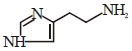
M.F. of Histamine is \(\mathrm{C}_{5} \mathrm{H}_{9} \mathrm{N}_{3}\)Molecular mass of Histamine is 111
Now, mass \(\%\) of nitrogen \(=\left(\frac{42}{111}\right) \times 100\)
\(=37.84 \%\)
-
- (A) \(22\)
- (B) \(19\)
- (C) \(17\)
- (D) \(14\)
Show answer and solution
Correct Answer: (D)
\(100\, \mathrm{gm}\) soln \(\rightarrow 63\, \mathrm{gm} \mathrm{HNO}_{3}\)\(\frac{100}{1.4} \mathrm{mL} \rightarrow 1\) mole \(\mathrm{HNO}_{3}\)
Molarity \(=\frac{1}{\frac{100}{1.4} \times \frac{1}{1000}}=14 \;\mathrm{M}\)
-
- (A) \(8\)
- (B) \(10\)
- (C) \(12\)
- (D) \(5\)
Show answer and solution
Correct Answer: (D)
\(C : H =4: 1\)\(C: O=3: 4\)
Mass ratio
\(C : H : O =12: 3: 16\)
Mole ratio
\(C : H : O =1: 3: 1\)
Empirical formula \(= CH _{3} O\)
Molecular formula \(= C _{2} H _{6} O _{2}\)
(saturated acyclic organic compound)
\(C _{2} H _{6} O _{2}+\frac{5}{2} O _{2} \longrightarrow 2 CO _{2}+3 H _{2} O\)
\(2\, mole\) \(5 \,mol\)
Moles of \(O _{2}\) required \(=5\) moles
- 141. The volume (in \(mL\) ) of \(0.1\, N\) \(NaOH\) required to neutralise \(10\, mL\) of \(0.1\, N\) phosphinic acid is........ 2020 Hard
- (A) \(15\)
- (B) \(18\)
- (C) \(10\)
- (D) \(5\)
Show answer and solution
Correct Answer: (C)
\(H _{3} PO _{2}+ NaOH \rightarrow NaH _{2} PO _{2}+ H _{2} O\)\(\frac{ n _{ H_3 PO _{2}} \text { reacted }}{1}=\frac{ n _{ NaOH } \text { reacted }}{1}\)
\(\Rightarrow \frac{0.1 \times 10}{1}=0.1 \times V _{ NaOH }\)
\(\Rightarrow V _{ NaOH }=10 ml\)
-
- (A) \(32.06\)
- (B) \(38.25\)
- (C) \(26.92\)
- (D) \(24.34\)
Show answer and solution
Correct Answer: (C)
Number of moles of \(\mathrm{Cl}^{-}\) precipitated in \(\left[\mathrm{Co}\left(\mathrm{NH}_{3}\right)_{6}\right] \mathrm{Cl}_{3}\) is equal to number of moles of \(\mathrm{AgNO}_{3}\) used.\(\frac{0.3}{267.46} \times 3=\frac{0.125 \times \mathrm{V}}{1000}\)
where \(\left.\mathrm{V} \text { is volume of } \mathrm{AgNO}_{3} \text { (in } \mathrm{mL}\right)\) \(\mathrm{V}=26.92 \mathrm{mL}\)
-
- (A) \(2.0\,pm\)
- (B) \(2.0\,nm\)
- (C) \(1.0\,pm\)
- (D) \(0.1\,nm\)
Show answer and solution
Correct Answer: (A)
\(Moles = \frac{{MV\,ml}}{{1000}} = \frac{{{{10}^{ - 3}} \times 10}}{{1000}} = {10^{ - 5}}\,mole\)\(10^{-5}\) \(N_A\) molecules covering area \(= 0.24\,cm^2\)
\(1\) molecules covering area \( = \frac{{0.24}}{{{{10}^{ - 5}}\,{N_A}}}\)
\(\frac{{0.24}}{{{{10}^{ - 5}}\, \times 6 \times {{10}^{23}}}} = {a^2}\)
\(a^2 = 4 \times 10^{-20}\,cm^2\)
\(a = 2 \times 10^{-10}\,cm\)
\(a = 2 \times 10^{-12}\,cm\)
\(a = 2\,pm\)
-
- (A) \(25\)
- (B) \(75\)
- (C) \(50\)
- (D) \(12.5\)
Show answer and solution
Correct Answer: (A)
Apply law of equivalence :\(25 \times N = 30 \times 0.1 \times 2\)
\({N_{HCl}} = \frac{{30 \times 0.2}}{{25}} = \frac{6}{5} \times 0.2 = \frac{{1.2}}{5}\)
For the \(2^{nd}\) titration
\(\frac{{1.2}}{5} \times {V_{HCl}} = 30 \times 0.2\)
\({V_{HCl}} = \frac{{6 \times 5}}{{1.2}} = \frac{{30}}{{1.2}} = 25\,ml\)
-
- (A) \({M_A} = 50 \times {10^{ - 3}}\) and \({M_B} = 25 \times {10^{ - 3}}\)
- (B) \({M_A} = 10 \times {10^{ - 3}}\) and \({M_B} = 5 \times {10^{ - 3}}\)
- (C) \({M_A} = 5 \times {10^{ - 3}}\) and \({M_B} = 10 \times {10^{ - 3}}\)
- (D) \({M_A} = 25 \times {10^{ - 3}}\) and \({M_B} = 50 \times {10^{ - 3}}\)
Show answer and solution
Correct Answer: (C)
Mol. wt is of \(1\, mol\)
\(AB_2\) \(A + 2B = 25\)
\(A_2B_2\) \(2A + 2B = 30\) -
- (A) \(40\)
- (B) \(10\)
- (C) \(20\)
- (D) None of these
Show answer and solution
Correct Answer: (A)
Eq. of \((COOH)_2\) \(=\) Eq. of \(NaOH\)\(50 \times 0.5 \times 2 = 25 \times M \times 1\)
Mass of \(NaOH\) in \(50\, mL\) \( = \frac{{50 \times 2}}{{1000}} \times 40 = 4\,g\)
-
- (A) \(0.84\)
- (B) \(33.6\)
- (C) \(16.8\)
- (D) \(8.4\)
Show answer and solution
Correct Answer: (A)
Let \(NaHCO_3 = x\,gm\)Then, \(H_2C_2O_4 = (10-x)\,gm\)
\(\therefore \,{n_{NaHC{O_3}}} = \frac{x}{{84}}\)
\(2NaHC{O_3} \to N{a_2}C{O_3} + {H_2}O + C{O_2}\)
\(\therefore {n_{C{O_2}}} = \frac{x}{{168}}\)
Total \(C{O_2} = \frac{x}{{168}} + \frac{{10 - x}}{{90}} = \frac{{0.25}}{{25}}\)
On solving \('x'\)
\(\% = \frac{x}{{10}} \times 100 = 10\,x\)
\({n_{{H_2}{C_2}{O_4}}} = \left( {\frac{{10 - x}}{{90}}} \right)\)
\({H_2}{C_2}{O_4} \to {H_2}O + C{O_2} + CO\)
\(\therefore {n_{C{O_2}}} = \left( {\frac{{10 - x}}{{90}}} \right)\)
-
- (A) \(12\)
- (B) \(4\)
- (C) \(8\)
- (D) \(16\)
Show answer and solution
Correct Answer: (C)
Molality of \(N{a^ + } = \left( {\frac{w}{M} \times \frac{{1000}}{w}} \right) \times 2\) (\(Na_2SO_4\) contains two \(Na^+\) ions) \( = \left[ {\left( {\frac{{92}}{{23}} \times \frac{{1000}}{{1000}}} \right)} \right] \times 2 = 8\) -
- (A) \(C_4H_{10}\)
- (B) \(C_4H_6\)
- (C) \(C_4H_7Cl\)
- (D) \(C_4H_8\)
Show answer and solution
Correct Answer: (B)
\(\mathop {{C_x}{H_y}}\limits_{10} + \mathop {\left( {x + \frac{y}{4}} \right){O_2}}\limits_{10\left( {x + \frac{y}{4}} \right)} \to \mathop {xC{O_2}}\limits_{10x} + \frac{y}{2}{H_2}O\)By given data, \(10\left( {x + \frac{y}{4}} \right) = 55....(1)\)
\(10x = 40....(2)\)
\(\therefore x = 4,\,y = 6 \Rightarrow {C_4}{H_6}\)
-
- (A) \(490\)
- (B) \(445\)
- (C) \(495\)
- (D) \(890\)
Show answer and solution
Correct Answer: (C)
\(2{C_{57}}{H_{110}}{O_6}(s) + 163{O_2}(g) \to \) \(114C{O_2}(g) + 110{H_2}O(l)\)\(\frac{{Moles\,of\,{C_{57}}{H_{110}}{O_6}}}{2} = \frac{{Moles\,of\,{H_2}O}}{{110}}\)
\(\frac{{\frac{{445}}{{890}}}}{2} = \frac{{\frac{{Mass\,of\,{H_2}O}}{{18}}}}{{110}}\)
Mass of \(H_2O = 495\,g\)
No questions on this page match these filters.