


All Some basic concept of chemistry questions
Newest firstShowing 51–100 of 170 questions
-
- (A) \(6\)
- (B) \(7\)
- (C) \(8\)
- (D) \(9\)
Show answer and solution
Correct Answer: (B)
\(\text { Moles }=\text { Molarity } \times \text { Volume in litres }\)\(=0.35 \times 0.25\)
\(\text { Mass }=\text { moles } \times \text { molar mass }\)
\(=0.35 \times 0.25 \times 82.02=7.18 \mathrm{~g}\)
Ans. 7
-
- (A) \(20\)
- (B) \(0.2\)
- (C) \(2\)
- (D) \(4\)
Show answer and solution
Correct Answer: (B)
\(\mathrm{M}=\frac{\mathrm{n}_{\mathrm{NaCl}}}{\mathrm{V}_{\mathrm{sol}}(\text { in } \mathrm{L})}\)\(\mathrm{M}=\frac{\frac{5.85}{58.5}}{0.5}=0.2 \mathrm{M}\)
-
- (A) 9
- (B) 10
- (C) 11
- (D) 12
Show answer and solution
Correct Answer: (C)
Specific gravity (density) \(=1.54 \mathrm{~g} / \mathrm{cc}\).Volume \(=1 \mathrm{~L}=1000 \mathrm{ml}\)
Mass of solution \(=1.54 \times 1000\)
\(=1540 \mathrm{~g}\)
\(\%\) purity of \(\mathrm{H}_2 \mathrm{SO}_4\) is \(70 \%\)
So weight of \(\mathrm{H}_3 \mathrm{PO}_4=0.7 \times 1540=1078 \mathrm{~g}\)
Mole of \(\mathrm{H}_3 \mathrm{PO}_4=\frac{1078}{98}=11\)
Molarity \(=\frac{11}{1 \mathrm{~L}}=11\)
-
- (A) \(0.75\)
- (B) \(0.25\)
- (C) \(0.35\)
- (D) \(0.5\)
Show answer and solution
Correct Answer: (B)
\(\mathrm{C}_{\mathrm{n}} \mathrm{H}_{2 \mathrm{an} 2}+\frac{3 \mathrm{n}+1}{2} \mathrm{O}_2 \longrightarrow \mathrm{nCO}_2+(\mathrm{n}+1) \mathrm{H}_2 \mathrm{O}\)\(\underset{4 \mathrm{gm}}{\mathrm{CH}_4+2 \mathrm{O}_2} \longrightarrow \underset{11 \mathrm{gm}}{\mathrm{CO}_2+2 \mathrm{H}_2 \mathrm{O}}\)
\(0.25 \text { mole } \quad 0.25 \text { mole }\)
\(\left.0.25 \text { mole } \mathrm{CH}_4 \text { gives } 0.25 \text { mole (or } 11 \mathrm{gm}\right) \mathrm{CO}_2\)
-
- (A) Molarity
- (B) Mass percentage
- (C) Molality
- (D) Mole fraction
Show answer and solution
Correct Answer: (A)
\(\text { Molarity }=\frac{\text { Moles of solute }}{\text { Volume of solution }}\)Since volume depends on temperature, molarity will change upon change in temperature.
-
- (A) \(8\)
- (B) \(7\)
- (C) \(9\)
- (D) \(10\)
Show answer and solution
Correct Answer: (B)
\(\mathrm{M}=\frac{\mathrm{n}_{\mathrm{NaOH}}}{\mathrm{V}_{\mathrm{sol}}(\text { in } \mathrm{L})} \Rightarrow 3=\frac{(84 / 40)}{\mathrm{V}} \Rightarrow \)\(\mathrm{V}=0.7 \mathrm{~L}=7 \times 10^{-1} \mathrm{~L}\) -
- (A) \(200\)
- (B) \(300\)
- (C) \(50\)
- (D) \(100\)
Show answer and solution
Correct Answer: (D)
\(\underset{1\,gm }{ M _2 CO _3}+\underset{\text { Excess }}{2 HCl } \rightarrow \underset{0.02 \text { mole }}{2 MCl }+ H _2 O +\underset{0.01 \text { mole }}{ CO _2}\)From principle of atomic conservation of carbon atom,
Mole of \(M _2 CO _3 \times 1=\) Mole of \(CO _2 \times 1\)
\(\frac{1 gm }{\text { molar mass of } M _2 CO _3}=0.01 \times 1\)
\(\text { Molar mass of } M _2 CO _3=100\,gm / mole\)
-
- (A) \(2\)
- (B) \(3\)
- (C) \(1\)
- (D) \(4\)
Show answer and solution
Correct Answer: (C)
Reaction with \(HCl\)\(Ca ( OH )_2+2 HCl \rightarrow CaCl _2+2 H _2 O\)
Volume of \(Ca ( OH )_2=10 ml\)
Volume of \(HCl =20 ml\)
Concentration of \(HCl =0.5 M\).
No. of milli moles of \(HCl =10\)
No. of milli moles of \(Ca ( OH )_2=5\).
\(\text { i.e. }M _{ Ca ( OH )_2}=\frac{\text { no. of milli moles }}{ V ( ml )}=\frac{5}{10}\)
\(=0.5\,M.\)
Reaction with \(H _2 SO _4\)
\(Ca ( OH )_2+ H _2 SO _4 \rightarrow CaSO _4+2 H _2 O\)
No. of milli moles of \(Ca ( OH )_2=20 \times 0.5\)
\(=10\)
i.e. no. of milli moles of \(H _2 SO _4=10\)
\(\Rightarrow M _{ H _2 so }=\frac{\text { no. of mil lim oles }}{ V ( ml )}\)
\(=\frac{10}{10}\)
\(=1\,M\)
-
- (A) \(181\)
- (B) \(182\)
- (C) \(180\)
- (D) \(183\)
Show answer and solution
Correct Answer: (C)
\(M =\frac{5}{40} \times \frac{1000}{450}\)\(M _1 V _1= M _2 V _2\)
\(\left(\frac{5}{40} \times \frac{1000}{450}\right) \times V _1=0.1 \times 500\)
\(V _1=180\)
-
- (A) \(1361\)
- (B) \(1362\)
- (C) \(1360\)
- (D) \(1368\)
Show answer and solution
Correct Answer: (B)
Mole of \(CO _2=0.2\,M \times\left(300 \times 10^{-3}\right)\,L\)\(=0.06 Mole\)
Volume of \(0.06\) mole \(CO _2\) at S.T.P
\(=0.06 \times 22.7\)
\(=1.362\,L\)
-
- (A) \(MCl _2\)
- (B) \(MCl _4\)
- (C) \(MCl _3\)
- (D) \(MCl\)
Show answer and solution
Correct Answer: (A)
Molecular. weight of metal chloride\(=\frac{0.57}{100} \times 22700\)
\(=129.39\)
weight of \(Cl =129.39 \times 0.55\)
\(=71.1645\)
\(\therefore\) Mole of \(Cl =\frac{71.1645}{35.5} \cong 2\)
Hence \(MCl _2\)
-
- (A) \(51\)
- (B) \(52\)
- (C) \(56\)
- (D) \(53\)
Show answer and solution
Correct Answer: (C)
Moles of \(CO _2=\frac{0.22}{44}=\frac{1}{200}\)\(\therefore\) Moles of carbon
\(=\left(\text { Moles of } CO _2\right) \times 1\)
\(=\frac{1}{200}\)
\(\therefore\) wt. of \(C =\frac{1}{200} \times 12=0.06\)
\(\text { \% of } C =\frac{0.06}{ W } \times 100=24\)
\(( W = Wt \text {. of Organic Compound })\)
\(W =0.25\)
Moles of \(H _2 O =\frac{0.126}{18}=0.007\)
\(\therefore \text { Moles of } H \text { atom }=2 \times 0.007=0.014\)
\(\%\) of Hydrogen \(=\frac{0.014 \times 1}{ W } \times 100\)
\(=\frac{0.014 \times 1}{0.25} \times 100\)
\(=5.6\)
\(=56 \times 10^{-1}\)
-
- (A) \(226\)
- (B) \(223\)
- (C) \(227\)
- (D) \(229\)
Show answer and solution
Correct Answer: (C)
\(2 C ( s )+ O _2( g ) \rightarrow 2 CO ( g )\)\(1\,mol \qquad 1.5\,mol\)
Limiting reagent is carbon. One mole carbon produces one mole CO. Hence, volume at STP is \(227 \times 10^{-1}\) litre
-
- (A) \(2\)
- (B) \(3\)
- (C) \(4\)
- (D) \(1\)
Show answer and solution
Correct Answer: (D)
\(3 BaCl _2+2 Na _3 PO _4 \rightarrow Ba _3\left( PO _4\right)_2+6 NaCl\)\(Na _3 PO _4\) is limiting reagent.
\(2\) mole \(Na _3 PO _4\) gives \(1\) mole of \(Ba _3\left( PO _4\right)_2\)
-
- (A) \(4\)
- (B) \(5\)
- (C) \(3\)
- (D) \(2\)
Show answer and solution
Correct Answer: (B)
\(Na _2 O + H _2 O \rightarrow 2 NaOH\)\(Cl _2 O _7+ H _2 O \rightarrow 2 HClO _4\)
\(1+4=5\)
-
- (A) \(A-I, B-III, C-II, D-IV\)
- (B) \(A-II, B-III, C-IV, D-I\)
- (C) \(A-II, B-IV, C-III, D-I\)
- (D) \(A-II, B-IV, C-I, D-III\)
Show answer and solution
Correct Answer: (D)
\(16\,g\,CH _4=1\) mole \(CH _4\) contains \(10 \times 6.02 \times 10^{23}\) electrons\(=60.2 \times 10^{23}\)
\(1\,g\,H _2=0.5\) mole \(H _2\) gas occupy \(11.35\) litre volume at STP
\(1 \text { mole of } N _2=28\,g\)
\(0.5 \text { mole of } SO _2=32\,g\)
-
- (A) \(6\)
- (B) \(12\)
- (C) \(3\)
- (D) \(24\)
Show answer and solution
Correct Answer: (B)
millimole of \(NaOH =0.24 \times 25\)\(\therefore \quad \text { millimole of acid }=0.24 \times 25\)
\(\Rightarrow \quad \text { mass of acid }=0.24 \times 25 \times 24.2\,mg\)
\(\text { for pure acid, }\)
\(\qquad V =\frac{ w }{ d } ;( d =1.21\,kg / L =1.21\,g / ml )\)
\(\therefore V =\frac{0.24 \times 25 \times 24.2}{1.12} \times 10^{-3}\)
\(=120 \times 10^{-3}\,ml\)
\(=12 \times 10^{-2}\,ml\)
-
- (A) \(138\)
- (B) \(139\)
- (C) \(137\)
- (D) \(136\)
Show answer and solution
Correct Answer: (B)
\((10\,ml\) solute in \(90\,ml\) solvent\(\text { mass of solute }=10 \times 3.2=32\,g\)
\(\text { mass of solvent }=90 \times 1.6\,g\)
\(m =\frac{32 \times 1000}{160 \times 90 \times 1.6}=1.388\)
\(m =138.8 \times 10^{-2}=139\)
- 69. The number of molecules and moles in \(2.8375\) litres of \(O _2\) at STP are respectively 2023 Hard
- (A) \(7.527 \times 10^{22}\) and \(0.250\,mol\)
- (B) \(1.505 \times 10^{23}\) and \(0.250\,mol\)
- (C) \(7.527 \times 10^{23}\) and \(0.125\,mol\)
- (D) \(7.527 \times 10^{22}\) and \(0.125\,mol\)
Show answer and solution
Correct Answer: (D)
Number of moles of \(O _2=\frac{2.8375}{22.7}=0.125\)Number of molecules \(=0.125\,N _{ A }\)
\(=7.525 \times 10^{22}\)
-
- (A) \(4\)
- (B) \(3\)
- (C) \(2\)
- (D) \(1\)
Show answer and solution
Correct Answer: (A)
\(\left[ Cr \left( H _2 O \right)_5 Cl \right] Cl _2+2 AgNO _3 \rightarrow\)\(\begin{array}{ll}0.01\,M , 20\, mL & 0.1\, M \\ \text { For } 0.2 \text { milimole } & AgNO _3 \text { required }\end{array}\)
\(0.4=0.1 \times V ( ml )\)
\(V =4\,mL\)
-
- (A) \(14\)
- (B) \(12\)
- (C) \(15\)
- (D) \(13\)
Show answer and solution
Correct Answer: (C)
Mole of \(Na =\frac{0.69}{23}=3 \times 10^{-2}\)\(Na + H _2 O \longrightarrow NaOH +\frac{1}{2} H _2\)
By using \(POAC\)
Moles of \(NaOH =3 \times 10^{-2}\)
\(NaOH\) reacts with \(HCl\)
No. of equivalent of \(NaOH = No\). of equivalent of \(HCl\)
\(3 \times 10^{-2} \times 1=\frac{73}{36.5} \times V (\text { in L }) \times 1\)
\(V =1.5 \times 10^{-2}\,L\)
Volume of \(HCl =15\,ml\).
-
- (A) \(24\)
- (B) \(23\)
- (C) \(25\)
- (D) \(22\)
Show answer and solution
Correct Answer: (C)
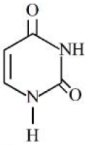
Mol. Wt of \(C _4 N _2 H _4 O _2=112\)\(\% N =\frac{28}{112} \times 100=25 \%\)
-
- (A) \(1: 1\)
- (B) \(3: 1\)
- (C) \(2: 1\)
- (D) \(1: 2\)
Show answer and solution
Correct Answer: (C)
Assume : Mass of solvent \(\approx\) Mass of solutionCase \(I:-\)
\(0.25=\frac{ W _1}{62} \times \frac{1000}{500}\)
Case \(II:-\)
\(0.25=\frac{ W _2}{62} \times \frac{1000}{250}\)
\(\frac{ W _1}{ W _2}=\frac{2}{1}\)
-
- (A) \(100\)
- (B) \(50\)
- (C) \(200\)
- (D) \(150\)
Show answer and solution
Correct Answer: (C)
Let \(M\) is the molar mass of the compound \(( g / mol )\) mass of compound \(=0.01\,M\,gm\)\(\text { mass of carbon }=0.01 M \times \frac{60}{100}\)
\(\text { moles of carbon }=\frac{0.01 M }{12} \times \frac{60}{100}\)
moles of \(CO _2\) from combustion \(=\frac{4.4}{44}=\) moles of carbon
\(\frac{0.01\,M }{12} \times \frac{60}{100}=\frac{4.4}{44}\)
\(M =\frac{4.4}{44} \times \frac{100}{60} \times \frac{12}{0.01}=200\, gm / mol\)
-
- (A) \(C _9 H _8\)
- (B) \(C _{11} H _4\)
- (C) \(C _5 H _8\)
- (D) \(C _{11} H _8\)
Show answer and solution
Correct Answer: (A)
\(C _{ x } H _{ y }+\left( x +\frac{ y }{4}\right) O _2 \rightarrow xCO _2+\frac{ y }{2} H _2 O\)\(\frac{ y }{2}=4 \therefore y =8\)
\(x +\frac{8}{4}=11\)
\(\therefore x =9\)
\(\therefore \text { Hydrocarbon will be }= C _9 H _8\)
-
- (A) \(A, B\) and \(C\) only
- (B) \(C\) and \(D\) only
- (C) \(A, C\) and \(D\) only
- (D) \(B\) and \(C\) only
Show answer and solution
Correct Answer: (C)
All non zero digits are significant.\(0.00253\)
\(\text { Significant figures }=3(2,5,3)\)
\(1.0003\)
Zeros between non-zero digit are significant.
Thus,\(1.0003\) has \(5\) significant figures.
\(15.0\)
Significant number \(=3\)
\(163\)
Significant number \(=3\)
Options (3) - \(A,C\) and \(D\)
-
- (A) \(2\)
- (B) \(6\)
- (C) \(8\)
- (D) \(4\)
Show answer and solution
Correct Answer: (D)
\(Zn +2 HCl \rightarrow ZnCl _2+ H _2 \uparrow\)Moles of \(Zn\) used \(=\frac{11.5}{65.4}=\) Moles of \(H _2\) evolved
Volume of \(H _2=\frac{11.5}{65.4} \times 22.7\,L =3.99\, L\)
-
- (A) \(30\)
- (B) \(45\)
- (C) \(85\)
- (D) \(75\)
Show answer and solution
Correct Answer: (A)
\(N _{1} V _{1}= N _{2} V _{2}\)\(0.01 \times 5 \times V _{1}=0.05 \times 1 \times 20\)
\(V_{1}=20 \,ml\) used
Volume left \(=50-20=30\, ml\)
-
- (A) \(3\)
- (B) \(1\)
- (C) \(2\)
- (D) \(0\)
Show answer and solution
Correct Answer: (D)
\(n _{ H _{2} SO _{4}}\) in \(Sol ^{ n } A =50 \%\) of original solution\(=0.01\, m \,mol\).
\(n _{ H _{2} SO _{4}}\) in Final solution \(=0.01+0.01\)
\(=0.02 \,m\,mol\)
\(=0.00002 \times 10^{3} \,m\,mol\)
-
- (A) \(4\)
- (B) \(3\)
- (C) \(2\)
- (D) \(1\)
Show answer and solution
Correct Answer: (C)
\(\% H =\frac{7.5}{116} \times 100=6.5\)\(\% O =\frac{60}{116} \times 100=51.7\)
\(\% C =\frac{48.5}{116} \times 100=41.8\)
Relative atomicities \(=\)
\(H \Rightarrow 6.5\)
\(O \Rightarrow \frac{51.7}{16}=3.25\)
\(C \Rightarrow \frac{41.8}{12}=3.5\)
Emperically formula is approx. \(CH _{2} O\)
\((A)\) \(C _{2} H _{4} O _{2}\) \((B)\) \(CH _{2} O\) relate to this formula.
-
- (A) \(25\) and \(75\)
- (B) \(40\) and \(60\)
- (C) \(60\) and \(40\)
- (D) \(75\) and \(25\)
Show answer and solution
Correct Answer: (D)
Given mass of organic compound \(=120\)mass of \(CO _{2}( g )=330\, g\)
mass of \(H _{2} O (\ell)=270\, g\)
mass of carbon \(= n _{ CO _{2}} \times 12\)
\(=\frac{330}{44} \times 12=90 \,g\)
\(\,\%\) of carbon \(=\frac{90}{120} \times 100=75 \,\%\)
mass of hydrogen \(= n _{ H _{2} O } \times 2\)
\(=\frac{270}{18} \times 2=30 \,g\)
\(\,\%\) of hydrogen \(=\frac{30}{120} \times 100=25 \,\%\)
-
- (A) \(24\)
- (B) \(23\)
- (C) \(22\)
- (D) \(25\)
Show answer and solution
Correct Answer: (D)
\(H _{2} SO _{4}+2 NaOH \rightarrow Na _{2} SO _{4}+2 H _{2} O\)\(0.4\,mol \quad 0.2 mol \quad-\)
\(0.3\,mol \quad-\quad\quad\quad\quad\quad 0.1 mol\)
Molarity of \(Na _{2} SO _{4}\) is \(\frac{0.1}{4}=0.025\,M\) \(=25\,mM\).
-
- (A) \(1.03\)
- (B) \(2.06\)
- (C) \(3.09\)
- (D) \(5.40\)
Show answer and solution
Correct Answer: (B)
\(C _{6} H _{12} O _{6} \rightarrow\) GlucoseWe know: \(\frac{\text { mass of } C }{\text { mass of glucose }}=\frac{72}{180}\)
Given: \(\% C =10.8=\frac{\text { mass of } C }{\text { mass of solution }} \times 100\)
\(\frac{10.8 \times 250}{100}=\) mass of \(C \Rightarrow\) Mass of \(C =27\,gm\)
\(\therefore\) mass of glucose \(=67.5\,gm\)
\(\therefore\) moles of glucose \(=0.375\,moles\)
Mass of solvent \(=250-67.5\,gm =182.5\,gm\)
\(\therefore\) Molality \(=\frac{0.375}{0.1825}=2.055 \approx 2.06\)
-
- (A) \(10.2\)
- (B) \(12.5\)
- (C) \(14.0\)
- (D) \(18.2\)
Show answer and solution
Correct Answer: (C)
Let total volume \(=1000 \,mL =1 \,L\)total mass of solution \(=1460 \,g\)
mass of \(HCl =\frac{35}{100} \times 1460\)
moles of \(HCl =\frac{35 \times 1460}{100 \times 36.5}\)
So molarity \(=\frac{35 \times 1460}{100 \times 36.5}=14 \,M\)
-
- (A) \(25\)
- (B) \(250\)
- (C) \(50\)
- (D) \(2\)
Show answer and solution
Correct Answer: (A)
\(0.30 \,\%\) glycine is equal to \(75\)\(1\, \% \longrightarrow \frac{75}{0.30}\)
\(100\, \% \longrightarrow \frac{75}{0.30} \times 100\)
\(=25000 \,g\)
-
- (A) \(33\)
- (B) \(32\)
- (C) \(31\)
- (D) \(30\)
Show answer and solution
Correct Answer: (A)
\(ROH + CH _{3} MgI \rightarrow ROMgI + CH _{4}( g )\)moles of \(CH _{4}=\) moles of \(ROH\)
\(\frac{ V }{22400}=\frac{ m }{ M \cdot M }\) (Assuming NTP Condition)
\(\frac{3.1}{22400}=\frac{4.5 \times 10^{-3}}{ M.M }\)
\(MM =32.51\)
Nearest Integer \(=33\)
-
- (A) \(22\)
- (B) \(24\)
- (C) \(23\)
- (D) \(20\)
Show answer and solution
Correct Answer: (B)
\(ppm =\frac{ W _{ Mg }}{ V _{ soln }} \times 10^{6}=48\)\(W _{ Mg }=\frac{48 \times 2 \times 1000}{10^{6}}\)
\(=48 \times 2 \times 10^{-3} g\)
\(n _{ Mg }=\frac{ W _{ Mg }}{24}=\frac{48 \times 2 \times 10^{-3}}{24}\)
\(=4 \times 10^{-3}\)
Number of \(Mg\) atoms \(=4 \times 10^{-3} \times 6.02 \times 10^{23}\)
\(=4 \times 6.02 \times 10^{20}\)
\(=24.08 \times 10^{20}\)
\(\therefore \quad x =24.08\)
-
- (A) \(143\)
- (B) \(134\)
- (C) \(167\)
- (D) \(189\)
Show answer and solution
Correct Answer: (A)
\(CH _{4}+2 O _{2} \rightarrow CO _{2}+2 H _{2} O\)Mole \(\frac{100}{16} \quad \frac{208}{32}\)
\(= 6.25\quad=6.5\)
\(\frac{\text { Mole }}{\text { Stoi. Coeff. }} \frac{6.25}{1} \quad \frac{6.5}{2}=3.25\)
So, \(O _{2}\) is limiting reagent
Mole-Mole analysis
\(\frac{ n _{ O _{2}}}{2}=\frac{ n _{ co _{2}}}{1}\)
\(\frac{6.5}{2}= n _{ co _{2}}\)
Mass of \(CO _{2}=\frac{6.5}{2} \times 44=143\, gm\)
-
- (A) \(C _{4} H _{6} N _{2}\)
- (B) \(C _{2} H _{3} N\)
- (C) \(C _{5} H _{7} N\)
- (D) \(C _{10} H _{14} N _{2}\)
Show answer and solution
Correct Answer: (D)
\(C\) \(74 \,\%\) \(\frac{74}{12}=6.16\) \(\frac{6.16}{1.23}=5\) \(N\) \(17.3\, \%\) \(\frac{17.3}{14}=1.23\) \(\frac{1.23}{1.23}=1\) \(H\) \(8.7 \,\%\) \(\frac{8.7}{1}=8.7\) \(\frac{8.7}{1.23}=7\) Emperical formula \(= C _{5} NH _{7}\)
Emperical weight \(=81\)
Multiplying factor \(=\frac{162}{81}=2\)
Molecular formula \(= C _{10} N _{2} H _{14}\)
-
- (A) \(32.2\)
- (B) \(69.4\)
- (C) \(91.5\)
- (D) \(162.5\)
Show answer and solution
Correct Answer: (C)
\(4 HNO _{3}(\ell)+3 KCl ( s ) \rightarrow Cl _{2}( g )+ NOCl\) \(( g )+2 H _{2} O ( g )+3 KNO _{3}( g )\)\(x \;g m \quad \quad 110\; gm\)
\(\frac{ x }{63} \quad \quad Mole =\frac{110}{101}\)
\(4 \rightarrow 3\)
\(1 \rightarrow \frac{3}{4}\)
\(\frac{x}{63} \rightarrow \frac{3}{4} \times \frac{x}{63}=\frac{110}{101}\)
\(x =\frac{110 \times 63 \times 4}{101 \times 3}=91.5 \;gm\)
-
- (A) Both \((A)\) and \((R)\) are true and \((R)\) is the correct explanation of \((A)\)
- (B) Both \((A)\) and \((R)\) are true but \((R)\) is not the correct explanation of \((A)\)
- (C) \((A)\) is true but \(( R )\) is false
- (D) \((A)\) is false but \((R)\) is true
Show answer and solution
Correct Answer: (A)
Molality is independent of temperature and hence both assertion and reason are true. -
- (A) \(1.21 \times 10^{5}\)
- (B) \(12.0 \times 10^{16}\)
- (C) \(1.21 \times 10^{20}\)
- (D) \(3.4 \times 10^{22}\)
Show answer and solution
Correct Answer: (C)
No. of Fe atoms \(=\frac{0.34}{100} \times \frac{3.3}{56} \times 6.022 \times 10^{23}\) \(=1.206 \times 10^{20}\) -
- (A) \(1188 \,g\) and \(1296 \,g\)
- (B) \(2376 \,g\) and \(2592 \,g\)
- (C) \(2592\, g\) and \(2376 \,g\)
- (D) \(3429\, g\) and \(3142 \,g\)
Show answer and solution
Correct Answer: (C)
\(C _{15} H _{30}+\frac{45}{2} O _{2} \rightarrow 15 CO _{2}+15 H _{2} O\)Mass of fuel \(=0.756 \times 1000 \,g\)
No. of moles of fuel \(=\frac{0.756 \times 1000}{210}\)
Wt. of oxygen \(=\frac{0.756 \times 1000}{210} \times \frac{45}{2} \times 32=2592 \,g\)
Wt of \(CO _{2}=\frac{0.756 \times 1000}{210} \times 15 \times 44=2376 \,g\)
-
- (A) \(1\)
- (B) \(3\)
- (C) \(0\)
- (D) \(2\)
Show answer and solution
Correct Answer: (D)
\(\underset{1 mol }{ X }+\underset{1 mol }{ Y }+\underset{0.05 mol }{3 Z } \rightleftharpoons X Y Z _{ 3 }\)\(Z\) is L.R.
\(\frac{0.05}{3}=1\,mole\) of \(XYZ _{3}\)
Mass of \(XYZ _{3}=\frac{0.05}{3} \times(10+20+30 \times 3)\)
\(=2\,g\)
-
- (A) \(H _{2}, 1.42 \;moles\)
- (B) \(H _{2}, 0.71\; moles\)
- (C) \(N _{2}, 1.42\; moles\)
- (D) \(N _{2}, 0.71\; moles\)
Show answer and solution
Correct Answer: (C)
\(N _{2}( g )+3 H _{2}( g ) \rightleftharpoons 2 NH _{3}( g )\)\(W _{2}=20 g \quad 5 g\)
\(n =\frac{20}{28} \quad \frac{5}{2}\)
Stoichiometric Amount
\(N _{2} \rightarrow \frac{20 / 28}{1}=\frac{20}{28} \quad H _{2} \rightarrow \frac{5 / 2}{3}=\frac{5}{6}\)
\(\therefore N _{2}\) is the Limiting Reagent.
\(\therefore \quad n \left( NH _{3}\right) =2 \times n \left( N _{2}\right)=2 \times \frac{20}{28}\)
\(=1.42\)
-
- (A) \(1143\)
- (B) \(1500\)
- (C) \(951\)
- (D) \(442\)
Show answer and solution
Correct Answer: (A)
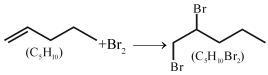
moles of \(Br _{2}=\) moles of \(C _{5} H _{10}\)\(\Rightarrow \frac{ w }{160}=\frac{5}{70}\)
\(\Rightarrow w =\frac{5 \times 160}{70}\, g\)
\(=11.428 \,g\)
\(=1142.8 \times 10^{-2}\, g\)
\(\approx 1143 \times 10^{-2}\, g\)
-
- (A) \(1400\)
- (B) \(2200\)
- (C) \(3360\)
- (D) \(4200\)
Show answer and solution
Correct Answer: (C)
Moles of \(Fe _{3} O _{4}=\frac{4.640 \times 10^{3}}{232}=20\)Moles of \(CO =\frac{2.52 \times 10^{3}}{28}=90\)
So limiting Reagent \(= Fe _{3} O _{4}\)
So moles of \(Fe\) formed \(=60\)
Weight of \(Fe =60 \times 56=3360\, gms\)
-
- (A) \(16\)
- (B) \(8\)
- (C) \(4\)
- (D) \(2\)
Show answer and solution
Correct Answer: (C)
Let \(n\left( SO _{2} Cl _{2}\right)= x\) moles\(\therefore n \left( H _{2} SO _{4}\right)= x , n ( HCl )=2 x\)
\(n \left( H ^{+}\right)=4\,x\)
For Neutralisation
\(n \left( H ^{+}\right)= n \left( OH ^{-}\right)\)
\(4 x =16\)
\(x =4\)
-
- (A) \(780\)
- (B) \(225\)
- (C) \(652\)
- (D) \(456\)
Show answer and solution
Correct Answer: (B)
\(CH _{4}+2 O _{2} \rightarrow CO _{2}+2 H _{2} O\)POAC on \(H\) atom
\(n _{ CH_4} \times 4= n _{ H_2 O } \times 2\)
\(n _{ CH _{4}}=\frac{81}{18} \times 2 \times \frac{1}{4}=\frac{81}{36}\)
\(n _{ CH _{4}}=2.25\)
\(=225 \times 10^{-2}\)
Nearest Integers \(=225\)
-
- (A) \(265\)
- (B) \(0.45\)
- (C) \(30\)
- (D) \(3\)
Show answer and solution
Correct Answer: (D)
Acid \(\quad+\) Base \(\longrightarrow\) Salt \(+ H _{2} O\)\(0.1 \,M \quad \,M ( OH )_{2}\)
\(10\, ml\,\quad 0.05\, M\)
\(\quad\quad\quad\quad30 \,ml\)
at equivalence point
equivalent of acid \(=\) equivalent of base
\(0.1 \times 10 \times n =30 \times 0.05 \times 2\)
\(n =3\)
No questions on this page match these filters.