


JEE Mains · Physics · STD 12 - Moving charges and magnetism
- JEE Mains 2025
- Hard
- MCQ
Consider a long thin conducting wire carrying a uniform current I. A particle having mass " M " and charge " \(q\) " is released at a distance " \(a\) " from the wire with a speed \(v_0\) along the direction of current in the wire. The particle gets attracted to the wire due to magnetic force. The particle turns round when it is at distance \(x\) from the wire. The value of \(x\) is [ \(\mu_0\) is vacuum permeability]
Pick an option to check your answer.
Answer & Solution
Correct Answer
(A) \(a e^{-\frac{4 \pi \mathrm{mv}_{\mathrm{o}}}{\mathrm{q} \mu_{\mathrm{o}} \mathrm{I}}}\)
Step-by-step Solution
Detailed explanation
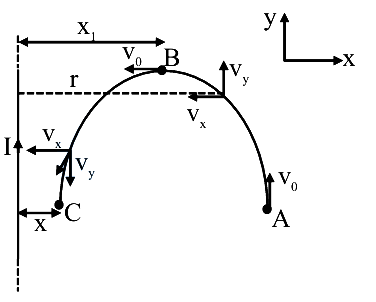
\(\begin{aligned} & A \rightarrow B \\ & \vec{V}=-v_x \hat{i}+v_y \hat{j} \\ & \vec{B}=\frac{\mu_0 I}{2 \pi r}(-\hat{k}) \\ & \overrightarrow{\mathrm{F}}=\mathrm{q}(\overrightarrow{\mathrm{v}} \times \overrightarrow{\mathrm{B}})=\frac{\mu_0 \mathrm{Iq}}{2 \pi r}\left[-\mathrm{v}_{\mathrm{x}} \hat{\mathrm{j}}-\mathrm{v}_{\mathrm{y}} \hat{\mathrm{i}}\right] \\ & \mathrm{a}_{\mathrm{x}}=-\frac{\mu_0 \mathrm{Iq}}{2 \pi \mathrm{~m}} \cdot \frac{v_y}{\mathrm{r}} \\ & \mathrm{a}_{\mathrm{y}}=-\frac{\mu_0 \mathrm{Iq}}{2 \pi m} \cdot \frac{v_x}{\mathrm{r}}\end{aligned}\)
\(\begin{aligned} & \frac{\mathrm{v}_{\mathrm{x}} \mathrm{dv}_{\mathrm{x}}}{\mathrm{dr}}=-\frac{\mu_0 \mathrm{Iq}}{2 \pi \mathrm{~m}} \frac{\mathrm{v}_{\mathrm{y}}}{\mathrm{r}} \\ & \frac{\mathrm{v}_{\mathrm{x}} \mathrm{dv}_{\mathrm{x}}}{\mathrm{v}_{\mathrm{y}}}=-\frac{\mu_0 \mathrm{Iq}}{2 \pi \mathrm{~m}} \frac{\mathrm{dr}}{\mathrm{r}} \\ & \int_0^{\mathrm{v}_0} \frac{\mathrm{v}_{\mathrm{x}} \mathrm{dv}_{\mathrm{x}}}{\sqrt{\mathrm{v}_0^2-\mathrm{v}_{\mathrm{x}}^2}}=-\frac{\mu_0 \mathrm{Iq}^{\mathrm{x}_1}}{2 \pi \mathrm{~m}} \int_{\mathrm{a}}^{\mathrm{dr}} \frac{\mathrm{r}}{2} \\ & \text { Let, } \mathrm{z}^2=\mathrm{v}_0^2-\mathrm{v}_{\mathrm{x}}^2 \\ & 2 \mathrm{zdz}=-2 \mathrm{v}_{\mathrm{x}} \mathrm{dv}_{\mathrm{x}}\end{aligned}\)
\(\begin{aligned}
& \mathrm{zdz}=-\mathrm{v}_{\mathrm{x}} \mathrm{dv}_{\mathrm{x}} \\
& \frac{\mathrm{v}_{\mathrm{x}} \mathrm{dv}_x}{\sqrt{\mathrm{v}_0^2-\mathrm{v}_{\mathrm{x}}^2}}=\frac{-\mathrm{zdz}}{\mathrm{z}}=-\mathrm{dz}
\end{aligned}\)
then integral becomes
\(\begin{aligned}
& -\int_{\mathrm{v}_0}^0 \mathrm{dz}=-\frac{\mu_0 \mathrm{Iq}}{2 \pi \mathrm{~m}} \ln \frac{\mathrm{x}_1}{\mathrm{a}} \\
& \mathrm{v}_0=-\frac{\mu_0 \mathrm{Iq}}{2 \pi \mathrm{~m}} \ln \frac{\mathrm{x}_1}{\mathrm{a}}
\end{aligned}\)
\(\left.\mathrm{x}_1=\mathrm{a} \mathrm{e}^{-\frac{2 \pi \mathrm{mv}}{\mu_0}} \mathrm{H}_0 \mathrm{q} \right\rvert\, \ldots \ldots\)
For B \(\rightarrow\) C
\(\begin{aligned}
& \overrightarrow{\mathrm{v}}=-v_x \hat{\mathrm{i}}-v_y \hat{\mathrm{j}} \\
& \overrightarrow{\mathrm{~B}}=\frac{\mu_0 \mathrm{I}}{2 \pi \mathrm{r}}(-\hat{\mathrm{k}}) \\
& \overrightarrow{\mathrm{F}}=\mathrm{q}(\overrightarrow{\mathrm{v}} \times \overrightarrow{\mathrm{B}})=\frac{\mu_0 \mathrm{Iq}}{2 \pi r}\left(-v_x \hat{j}+v_y \hat{\mathrm{i}}\right)
\end{aligned}\)
\(\begin{aligned}
& \mathrm{a}_{\mathrm{x}}=+\frac{\mu_0 \mathrm{Iq}}{2 \pi \mathrm{~m}} \frac{\mathrm{v}_{\mathrm{y}}}{\mathrm{r}} \quad \mathrm{a}_{\mathrm{y}}=-\frac{\mu_0 \mathrm{Iq}}{2 \pi \mathrm{~m}} \cdot \frac{\mathrm{v}_{\mathrm{x}}}{\mathrm{r}} \\
& \frac{\mathrm{v}_{\mathrm{x}} \mathrm{dv}_{\mathrm{x}}}{\mathrm{dr}}=\frac{\mu_0 \mathrm{Iq}}{2 \pi \mathrm{~m}} \frac{\mathrm{v}_{\mathrm{y}}}{\mathrm{r}} \\
& \int_{v_0}^0 \frac{\mathrm{v}_{\mathrm{x}} \mathrm{dv}_{\mathrm{x}}}{\sqrt{\mathrm{v}_0^2-\mathrm{v}_{\mathrm{x}}^2}}=\frac{\mu_0 \mathrm{Iq}}{2 \pi \mathrm{~m}} \int_{\mathrm{x_1}}^{\mathrm{x}}\frac{dr}{r}
\end{aligned}\)
\(\begin{aligned}
& \frac{\mu_0 \mathrm{Iq}}{2 \pi \mathrm{~m}} \ln \frac{\mathrm{x}}{\mathrm{x}_1}=-\int_0^{\mathrm{v}_0} \mathrm{~d} \mathrm{z}=-\mathrm{v}_0 \\
& \mathrm{x}=\mathrm{x}_1 \mathrm{e}^{-\frac{2 \pi \mathrm{~m}_0}{\mu_0 \mathrm{Iq}}} \ldots \ldots \text { (2) }
\end{aligned}\)
From equation 1 and 2
\(X=a e^{-\frac{4 \pi \mathrm{mv}_0}{\mu_0 \mathrm{Iq}}}\)
More questions from Physics
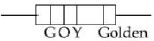
- A carbon resistance has a following colour code. What is the value of the resistance?
 JEE Mains 2019 Medium
- The effective current \(I\) in the given circuit at very high frequencies will be \(.......A\)
 JEE Mains 2022 Hard
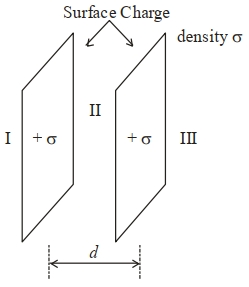
- Let \(\sigma\) be the uniform surface charge density of two infinite thin plane sheets shown in figure. Then the electric fields in three different region \(E_{ I }, E_{ II }\) and \(E_{III}\) are
 JEE Mains 2023 Medium
- A circular plate is rotating in horizontal plane, about an axis passing through its center and perpendicular to the plate, with an angular velocity \(\omega\). A person sits at the center having two dumbbells in his hands. When he stretches out his hands, the moment of inertia of the system becomes triple. If \(E\) be the initial Kinetic energy of the system, then final Kinetic energy will be \(\frac{E}{x}\).The value of \(x\) is \(....\)JEE Mains 2023 Medium
- The volume \(V\) of a given mass of monoatomic gas changes with temperature \(T\) according to the relation \(V = KT ^{2 / 3}\). The workdone when temperature changes by \(90\, K\) will be \(x\,R\). The value of \(x\) is \([ R =\) universal gas constant \(]\)JEE Mains 2021 Hard
- If the time period \(t\) of the oscillation of a drop of liquid of density \(d\), radius \(r\), vibrating under surface tension \(s\) is given by the formula \(t = \sqrt {{r^{2b}}\,{s^c}\,{d^{a/2}}} \) . It is observed that the time period is directly proportional to \(\sqrt {\frac{d}{s}} \) . The value of \(b\) should therefore beJEE Mains 2013 Hard
More PYQs from JEE Mains
- A particle of mass \(m\) is moving in a straight line with momentum \(p\). Starting at time \(t = 0\), a force \(F = kt\) acts in the same direction on the moving particle during time interval \(T\) so that its momentum changes from \(p\) to \(3p\). Here \(k\) is a constant. The value of \(T\) isJEE Mains 2019 Medium
- For changing the capacitance of a given parallel plate capacitor, a dielectric material of dielectric constant \(K\) is used, which has the same area as the plates of the capacitor. The thickness of the dielectric slab is \(\frac{3}{4} d\), where \('d'\) is the separation between the plates of parallel plate capacitor. The new capacitance \((C')\) in terms of original capacitance \(\left( C _{0}\right)\) is given by the following relationJEE Mains 2021 Medium
- A screw gauge has \(50\) divisions on its circular scale. The circular scale is \(4\) units ahead of the pitch scale marking, prior to use. Upon one complete rotation of the circular scale, a displacement of \(0.5\, mm\) is noticed on the pitch scale. The nature of zero error involved, and the least count of the screw gauge, are respectivelyJEE Mains 2020 Medium
- Space between two concentric conducting spheres of radii \(a\) and \(b (b > a)\) is filled with \(a\) medium of resistivity \(\rho \). The resistance between the two spheres will beJEE Mains 2019 Hard