


JEE Mains · Physics · STD 12 - 10. Wave optics
Given below are two statements : one is labelled as Assertion (A) and the other is labelled as Reason (R).
Assertion-(A) : If Young's double slit experiment is performed in an optically denser medium than air, then the consecutive fringes come closer.
Reason-(R) : The speed of light reduces in an optically denser medium than air while its frequency does not change.
In the light of the above statements, choose the most appropriate answer from the options given below :
- A Both \((\mathbf{A})\) and \((\mathbf{R})\) are true but \((\mathbf{R})\) is not the correct explanation of \((\mathbf{A})\)
- B Both \((\mathbf{A})\) and \((\mathbf{R})\) are true and \((\mathbf{R})\) is the correct explanation of \((\mathbf{A})\)
- C (A) is true but (R) is false
- D \((A)\) is false but (R) is true
Answer & Solution
Correct Answer
(B) Both \((\mathbf{A})\) and \((\mathbf{R})\) are true and \((\mathbf{R})\) is the correct explanation of \((\mathbf{A})\)
Step-by-step Solution
Detailed explanation
\(\beta(\text { fringe width })=\frac{\lambda D}{d}\) In denser medium, \(\lambda \downarrow \Rightarrow \beta \downarrow\) \(\Rightarrow\) fringe come closer Also, \(\mu=\frac{\mathrm{c}}{\mathrm{V}} \Rightarrow \mathrm{V}=\frac{\mathrm{c}}{\mu}\) Frequency remains same,…
See the Complete Solution
Get step-by-step explanations for this and 2.5 Lakh+ more JEE, NEET & CET questions.
- Unlock all solutions
- Practice the full chapter
- Track accuracy across PYQs
4.8 rated on Google Play · 14,000+ reviews
More questions from Physics
- A hairpin like shape as shown in figure is made by bending a long current carrying wire. What is the magnitude of a magnetic field at point \(P\) which lies on the centre of the semicircle ?
 JEE Mains 2021 Hard
 - A time varying potential difference is applied between the plates of a parallel plate capacitor of capacitance \(2.5 \mu \mathrm{~F}\). The dielectric constant of the medium between the capacitor plates is 1 . It produces an instantaneous displacement current of 0.25 mA in the intervening space between the capacitor plates, the magnitude of the rate of change of the potential difference will be _____ \(\mathrm{Vs}^{-1}\).JEE Mains 2025 Hard
- Two simple pendulums having lengths \(l_1\) and \(l_2\) with negligible string mass undergo angular displacements \(\theta_1\) and \(\theta_2\), from their mean positions, respectively. If the angular accelerations of both pendulums are same, then which expression is correct?JEE Mains 2025 Medium
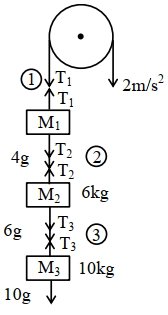
- Three blocks \(\mathrm{M}_1, \mathrm{M}_2, \mathrm{M}_3\) having masses \(4 \mathrm{~kg}, 6 \mathrm{~kg}\) and \(10 \mathrm{~kg}\) respectively are hanging from a smooth pully using rope 1,2 and 3 as shown in figure. The tension in the rope \(1, \mathrm{~T}_1\) when they are moving upward with acceleration of \(2 \mathrm{~ms}^{-2}\) is _______ \(\mathrm{N}\) (if \(\mathrm{g}=10 \mathrm{~m} / \mathrm{s}^2\) )
 JEE Mains 2024 Hard
 - A container contains a liquid with refractive index of 1.2 up to a height of 60 cm and another liquid having refractive index 1.6 is added to height H above first liquid. If viewed from above, the apparent shift in the position of bottom of container is 40 cm. The value of H is ______ cm.
(Consider liquids are immisible)JEE Mains 2025 Medium - Let \(\eta_{1}\) is the efficiency of an engine at \(T _{1}=447^{\circ}\,C\) and \(T _{2}=147^{\circ}\,C\) while \(\eta_{2}\) is the efficiency at \(T _{1}=947^{\circ}\,C\) and \(T _{2}=47^{\circ}\,C\). The ratio \(\frac{\eta_{1}}{\eta_{2}}\) will be.JEE Mains 2022 Medium
More PYQs from JEE Mains
- A data consists of \(20\) observations \(x_1, x_2, \ldots, x_{20}\). If \(\sum_{i=1}^{20}(x_i + 5)^2 = 2500\) and \(\sum_{i=1}^{20}(x_i - 5)^2 = 100\), then the ratio of mean to standard deviation of this data is:JEE Mains 2026 Medium
- Let the foot of perpendicular from a point \(P(1,2,-1)\) to the straight line \(L: \frac{x}{1}=\frac{y}{0}=\frac{z}{-1}\) be \(N\). Let a line be drawn from \(P\) parallel to the plane \(x+y+2 z=0\) which meets \(L\) at point \(Q\). If \(\alpha\) is the acute angle between the lines \(\mathrm{PN}\) and \(\mathrm{PQ}\), then \(\cos \alpha\) is equal to \(.....\)JEE Mains 2021 Hard
- A cubical block of density \(\rho_{ b }=600 kg / m ^3\) floats in a liquid of density \(\rho_{ e }=900 kg / m ^3\). If the height of block is \(H=8.0 cm\) then height of the submerged part is _________ cm .JEE Mains 2026 Hard
- The area (in sq. units) of the smaller portion enclosed between the curves, \(x^2 + y^2 = 4\) and \(y^2 =3x\), isJEE Mains 2017 Hard
- If \(f(x) = \int_0^x {t(\sin \,\,x\, - \sin \,\,t)\,dt} \) then ?JEE Mains 2018 Hard
- If \(a, b, c\) are in \(A.P.\) and \(a^2, b^2, c^2\) are in \(G.P.\) such that \( a < b\) \( < c\) and \(a+b+c\,= \frac{3}{4}\) , then the value of \(a\) isJEE Mains 2018 Hard