


JEE Mains · Physics · STD 12 - Wave optics
- JEE Mains 2025
- Medium
- MCQ
Two polarisers \(P_1\) and \(P_2\) are placed in such a way that the intensity of the transmitted light will be zero. A third polariser \(P_3\) is inserted in between \(P_1\) and \(\mathrm{P}_2\), at the particular angle between \(\mathrm{P}_2\) and \(\mathrm{P}_3\). The transmitted intensity of the light passing the through all three polarisers is maximum. The angle between the polarisers \(\mathrm{P}_2\) and \(\mathrm{P}_3\) is :
Pick an option to check your answer.
Answer & Solution
Correct Answer
(A) \(\frac{\pi}{4}\)
Step-by-step Solution
Detailed explanation
Through \(P_2 I_1=I_0 \sin ^2\left(\frac{\pi}{2}-\theta\right)\)
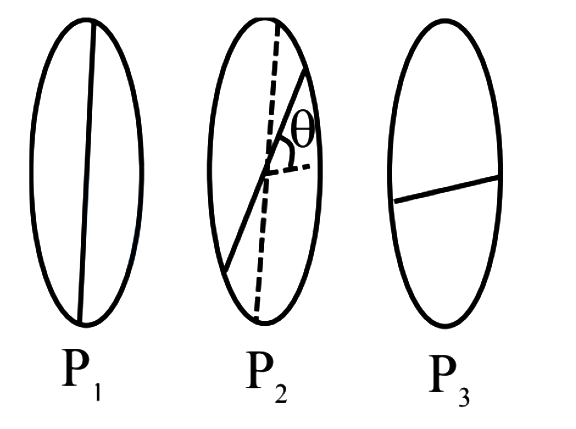
\(I_1=I_0 \cos ^2 \theta\)
Through \(P_3 I_{\text {net }}=\left(I_0 \cos ^2 \theta\right) \sin ^2 \theta\)
\(I_{n c t}=\frac{I_0}{4}[\sin (2 \theta)]^2 \text { for max } I_{\text {net }} \theta=45^{\circ}\)
So angle between \(P_2\) and \(P_3=\frac{\pi}{4}\)
Correct Ans. (1)
\(I_1=I_0 \cos ^2 \theta\)
Through \(P_3 I_{\text {net }}=\left(I_0 \cos ^2 \theta\right) \sin ^2 \theta\)
\(I_{n c t}=\frac{I_0}{4}[\sin (2 \theta)]^2 \text { for max } I_{\text {net }} \theta=45^{\circ}\)
So angle between \(P_2\) and \(P_3=\frac{\pi}{4}\)
Correct Ans. (1)
More questions from Physics
- The time taken for the magnetic energy to reach \(25\, \%\) of its maximum value, when a solenoid of resistance \(R ,\) inductance \(L\) is connected to a battery, is :JEE Mains 2021 Hard
- Choose the correct nuclear process from the below options.
[p: proton, n : neutron, \(\mathrm{e}^{-}\): electron, \(\mathrm{e}^{+}\): positron, \(v:\) neutrino, \(\bar{v}\) : antineutrino]JEE Mains 2025 Easy - Figure shows a circuit in which three identical diodes are used . Each diode has forward resistance of \(20\,\Omega \) and infinite backward resistance. Resistors \(R_1 = R_2 = R_3 = 50\,\Omega.\) Battery voltage is \(6\,V.\) The current through \(R_3\) is.....\(mA\)
 JEE Mains 2013 Medium
- A particle of mass \(m\) is moving with speed \(2\, v\) collides with a mass \(2\,m\) moving with speed \(v\) in the same direction. After collision, the first mass is stopped completely while the second one splits into two particles each of mass \(m\), which move at angle \(45^o\) with respect to the original direction. The speed of each of the moving particle will beJEE Mains 2019 Medium
- An observer looks at a distant tree of height \(10\ m\) with a telescope of magnifying power of \(20\). To the observer the tree appears :JEE Mains 2016 Easy
- A ball of mass \(10\, kg\) moving with a velocity \(10 \sqrt{3}\, ms ^{-1}\) along \(X-\)axis, hits another ball of mass \(20\, kg\) which is at rest. After collision, the first ball comes to rest and the second one disintegrates into two equal pieces. One of the pieces starts moving along \(Y-\) axis at a speed of \(10\, m / s\). The second piece starts moving at a speed of \(20\, m / s\) at an angle \(\theta\) (degree) with respect to the \(X-\)axis. The configuration of pieces after collision is shown in the figure. The value of \(\theta\) to the nearest integer is
 JEE Mains 2021 Hard
More PYQs from JEE Mains
- If \(10^{22}\) gas molecules each of mass \(10^{-26}\, kg\) collide with a surface (perpendicular to it)elastically per second over an area \(1\, m^2\) with a speed \(10^4\,m/s\), the pressure exerted by the gas molecules will be of the order ofJEE Mains 2019 Medium
- An electron with mass ' \(m\) ' with an initial velocity \((\mathrm{t}=0) \overrightarrow{\mathrm{v}}=\mathrm{v}_0 \hat{\mathrm{i}} \quad\left(\mathrm{v}_0 \gt 0\right)\) enters a magnetic field \(\vec{B}=B_0 \hat{j}\). If the initial de-Broglie wavelength at \(\mathrm{t}=0\) is \(\lambda_0\) then its value after time ' t ' would be :JEE Mains 2025 Medium
- An electron of mass \(m\) and a photon have same energy \(E.\) The ratio of de-Broglie wavelengths associated with them isJEE Mains 2021 Medium