


JEE Mains · Physics · STD 12 - Ray optics and optical instruments
- JEE Mains 2025
- Easy
- MCQ
A lens having refractive index 1.6 has focal length of 12 cm , when it is in air. Find the focal length of the lens when it is placed in water.
(Take refractive index of water as 1.28)
Pick an option to check your answer.
Answer & Solution
Correct Answer
(B) 288 mm
Step-by-step Solution
Detailed explanation
As we know,
\(\frac{1}{\mathrm{f}}=\left[\frac{\mu_{\mathrm{L}}}{\mu_{\mathrm{m}}}-1\right]\left[\frac{1}{\mathrm{R}_1}-\frac{1}{\mathrm{R}_2}\right]\)
For air \(\mu_{\mathrm{m}}=1\)
\(\begin{aligned} & \frac{1}{12}=[1.6-1]\left[\frac{1}{\mathrm{R}_1}-\frac{1}{\mathrm{R}_2}\right] \\ & \frac{1}{12}=\frac{6}{10}\left[\frac{1}{\mathrm{R}_1}-\frac{1}{\mathrm{R}_2}\right] \\ & {\left[\frac{1}{\mathrm{R}_1}-\frac{1}{\mathrm{R}_2}\right]=\frac{10}{72}}\end{aligned}\)
For water
\(\frac{1}{\mathrm{f}}=\left[\frac{1.6}{1.28}-1\right]\left[\frac{10}{72}\right]=\frac{32}{128} \times \frac{10}{72}\)
\(\begin{aligned} & \frac{1}{\mathrm{f}}=\frac{1}{4} \times \frac{10}{72} \\ & \mathrm{f}=28.8 \mathrm{~cm} \\ & \mathrm{f}=288 \mathrm{~mm}\end{aligned}\)
More questions from Physics
- A mosquito is moving with a velocity \(\overrightarrow{ v }=0.5 t ^{2} \hat{ i }+3 t \hat{ j }+9 \hat{ k }\, m / s\) and accelerating in uniform conditions. What will be the direction of mosquito after \(2 \,s\) ?JEE Mains 2021 Hard
- A paramagnetic material has \(10^{28}\,atoms/m^3.\) Its magnetic susceptibility at temperature \(350\,K\) is \(2.8 \times 10^{-4}.\) Its susceptibility at \(300\,K\) isJEE Mains 2019 Medium
- In the figure, a very large plane sheet of positive charge is shown. \(P _{1}\) and \(P _{2}\) are two points at distance \(l\) and \(2 \,l\) from the charge distribution. If \(\sigma\) is the surface charge density, then the magnitude of electric fields \(E_{1}\) and \(E_{2}\) at \(P _{1}\) and \(P _{2}\) respectively are
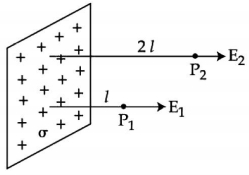 JEE Mains 2022 Medium
- A material has Poisson's ratio \(0.50.\) If a uniform rod of it suffers a longitudinal strain of \(2 \times {10^{ - 3}}\), then the percentage change in volume isJEE Mains 2024 Medium
- A cube is placed inside an electric field, \(\overrightarrow{{E}}=150\, {y}^{2}\, \hat{{j}}\). The side of the cube is \(0.5 \,{m}\) and is placed in the field as shown in the given figure. The charge inside the cube is \(.....\times 10^{-11} {C}\)
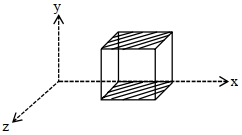 JEE Mains 2021 Hard
- The balancing length for a cell is \(560 \;\mathrm{cm}\) in a potentiometer experiment. When an external resistance of \(10 \;\Omega\) is connected in parallel to the cell, the balancing length changes by \(60\; \mathrm{cm} .\) If the internal resistance of the cell is \(\frac{\mathrm{N}}{10} \;\Omega,\) where \(\mathrm{N}\) is an integer then value of \(\mathrm{N}\) isJEE Mains 2020 Medium
More PYQs from JEE Mains
- A solenoid of \(1000\) turns per metre has a core with relative permeability \(500\). Insulated windings of the solenoid carry an electric current of \(5\, A\). The magnetic flux density produced by the solenoid is (permeability of free space \(\left.=4 \pi \times 10^{-7} H / m \right)\)JEE Mains 2021 Medium
- Taking the wavelength of first Balmer line in hydrogen spectrum (\( n = 3\) to \(n = 2\) ) as \(660\,nm ,\) the wavelength of the \(2^{nd}\) Balmer line ( \(n =4\) to \(n = 2\) ) will be....\(nm\)JEE Mains 2019 Hard
- In a radioactive decay chain, the initial nucleus is \({}_{90}^{232}Th\). At the end there are \(6\,\,\alpha -\) particles and \(4\,\,\beta -\) particles with are emitted. If the end nucleus is \({}_Z^AX\,,\,A\) and \(Z\) are given byJEE Mains 2019 Medium