


JEE Mains · Physics · STD 11 - 6. system of particles and rotational motion
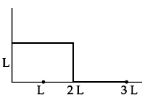
The position vector of the centre of mass \(\vec r\, cm\) of an asymmetric uniform bar of negligible area of cross-section as shown in figure is
- A \(\vec r\,cm = \frac{{13}}{8}L\hat x + \frac{5}{8}L\hat y\)
- B \(\vec r\,cm = \frac{{5}}{8}L\hat x + \frac{13}{8}L\hat y\)
- C \(\vec r\,cm = \frac{{3}}{8}L\hat x + \frac{11}{8}L\hat y\)
- D \(\vec r\,cm = \frac{{11}}{8}L\hat x + \frac{3}{8}L\hat y\)
Answer & Solution
Correct Answer
(A) \(\vec r\,cm = \frac{{13}}{8}L\hat x + \frac{5}{8}L\hat y\)
Step-by-step Solution
Detailed explanation
Three parts of rod can be considered as point masses. \({\overrightarrow r _{cm}} = \frac{{2m\,{{\overrightarrow r }_1} + m{{\overrightarrow r }_2} + m{{\overrightarrow r }_3}}}{{4\,m}}\)…
See the Complete Solution
Get step-by-step explanations for this and 2.5 Lakh+ more JEE, NEET & CET questions.
- Unlock all solutions
- Practice the full chapter
- Track accuracy across PYQs
4.8 rated on Google Play · 14,000+ reviews
More questions from Physics
- A force of \(F=(5 y+20) \hat{j} \,N\) acts on a particle. The work done by this force when the particle is moved from \(y=0 \,m\) to \(y=10 \,{m}\) is \(...\,{J}.\)JEE Mains 2021 Medium
- A body of mass \(500\,g\) moves along \(x\)-axis such that it's velocity varies with displacement \(x\) according to the relation \(v =10 \sqrt{ x } m / s\) the force acting on the body is \(...........\,N\)JEE Mains 2023 Medium
- Which of the following physical quantities have the same dimensions?JEE Mains 2022 Hard
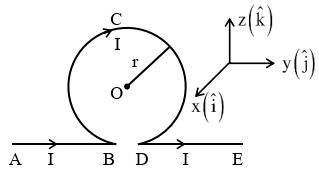
- An infinitely long straight wire carrying current \(I\) is bent in a planer shape as shown in the diagram. The radius of the circular part is r . The magnetic field at the centre O of the circular loop is :
 JEE Mains 2026 Medium
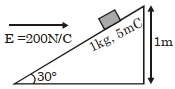
 - An inclined plane making an angle of \(30^{\circ}\) with the horizontal is placed in a uniform horizontal electric field \(200 \, \frac{ N }{ C }\) as shown in the figure. A body of mass \(1\, kg\) and charge \(5\, mC\) is allowed to slide down from rest at a height of \(1\, m\). If the coefficient of friction is \(0.2,\) find the time (in \(s\) )taken by the body to reach the bottom. \(\left[ g =9.8 \,m / s ^{2}, \sin 30^{\circ}=\frac{1}{2}\right.\); \(\left.\cos 30^{\circ}=\frac{\sqrt{3}}{2}\right]\)
 JEE Mains 2021 Hard
 - A charged particle going around in a circle can be considered to be a current loop. A particle of mass \(m\) carrying charge \(q\) is moving in a plane with speed \(v\) under the influence of magnetic field \(\overrightarrow{ B }\). The magnetic moment of this moving particleJEE Mains 2020 Hard
More PYQs from JEE Mains
- Let \(f(x)=3 \sin ^{4} x+10 \sin ^{3} x+6 \sin ^{2} x-3, x \in\left[-\frac{\pi}{6}, \frac{\pi}{2}\right] .\) Then, \(f\) is \(.....\)JEE Mains 2021 Hard
- Let \(f\) be any function continuous on \([\mathrm{a}, \mathrm{b}]\) and twice differentiable on \((a, b) .\) If for all \(x \in(a, b)\) \(f^{\prime}(\mathrm{x})>0\) and \(f^{\prime \prime}(\mathrm{x})<0,\) then for any \(\mathrm{c} \in(\mathrm{a}, \mathrm{b})\) \(\frac{f(\mathrm{c})-f(\mathrm{a})}{f(\mathrm{b})-f(\mathrm{c})}\) is greater thanJEE Mains 2020 Hard
- Let \(y = y(x)\) be the solution of the differential equation \((\tan x)^{1/2}\,dy = (\sec^3 x - (\tan x)^{3/2} y)\,dx\), \(0 < x < \dfrac{\pi}{2}\), \(y\left(\dfrac{\pi}{4}\right) = \dfrac{6\sqrt{2}}{5}\). If \(y\left(\dfrac{\pi}{3}\right) = \dfrac{4}{5}\alpha\), then \(\alpha^4\) equals _______.JEE Mains 2026 Hard
- Heat energy of \(735\,J\) is given to a diatomic gas allowing the gas to expand at constant pressure. Each gas molecule rotates around an internal axis but do not oscillate. The increase in the internal energy of the gas will be \(..........\,J\)JEE Mains 2023 Medium
- In a random experiment, a fair die is rolled until two fours are obtained in succession. The probability that the experiment will end in the fifth throw of the die is equal toJEE Mains 2019 Hard
- Match List-I with List-II.
List-I List-II A. Meter (L) I. \(\sqrt{\dfrac{hc}{G}}\) B. Second (S) II. \(\sqrt{\dfrac{Gh}{c^5}}\) C. Kilogram (M) III. \(\sqrt{\dfrac{K^2L^2c^3}{Gh}}\) D. Kelvin (K) IV. \(\sqrt{\dfrac{Gh}{c^3}}\)
where \(h\) (Planck's constant), \(G\) (gravitational constant) and \(c\) (speed of light in vacuum) as fundamental units.
Choose the correct answer from the options given below :JEE Mains 2026 Hard