


JEE Mains · Physics · STD 11 - System of particles and rotational motion
- JEE Mains 2019
- Hard
- MCQ
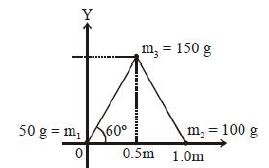
Three particles of masses \(50\, g\), \(100\, g\) and \(150\, g\) are placed at the vertices of an equilateral triangle of side \(1\, m\) (as shown in the figure). The \((x, y)\) coordinates of the centre of mass will be
Pick an option to check your answer.
Answer & Solution
Correct Answer
(D) \(\left( {\frac{7}{{12}}m,\,\frac{{\sqrt 3 }}{4}\,m} \right)\)
Step-by-step Solution
Detailed explanation
The co-ordinates of the center of mass
\({\overrightarrow r _{cm}} = \frac{{0 + 150 \times \left( {\frac{1}{2}i + \frac{{\sqrt 3 }}{2}\hat j} \right) + 100 \times \hat i}}{{300}}\)
\({\overrightarrow r _{cm}} = \frac{7}{{12}}\hat i + \frac{{\sqrt 3 }}{4}\hat j\)
\(\therefore \,\,Co - ordinate\left( {\frac{7}{{12}},\frac{{\sqrt 3 }}{4}} \right)m\)
More questions from Physics
- Light source having wavelength \(331\) nm is used to generate photo-electrons whose stopping potential is \(0.2\) V. The work function of the used metal in the experiment is \(\alpha \times 10^{-19}\) J. The value of \(\alpha\) is _____.
(\(h = 6.62 \times 10^{-34}\) J s, \(e = 1.6 \times 10^{-19}\) C and \(c = 3 \times 10^8\) m/s)JEE Mains 2026 Medium - A ceiling fan having 3 blades of length \(80 \mathrm{~cm}\) each is rotating with an angular velocity of \(1200\ \mathrm{rpm}\). The magnetic field of earth in that region is \(0.5 \ \mathrm{G}\) and angle of dip is \(30^{\circ}\). The emf induced across the blades is \(N \pi \times 10^{-5} \mathrm{~V}\). The value of \(\mathrm{N}\) is _______.JEE Mains 2024 Hard
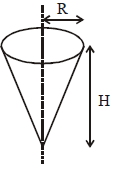
- Shown in the figure is a hollow icecream cone (it is open at the top). If its mass is \(M,\) radius of its top, \(R\) and height, \(H\), then its moment of inertia about its axis is
 JEE Mains 2020 Hard
- Given below are two statements: Statement \(I:\) Acceleration due to earth's gravity decreases as you go 'up' or 'down' from earth's surface. Statement \(II:\) Acceleration due to earth's gravity is same at a height ' \(h\) ' and depth ' \(d\) ' from earth's surface, if \(h = d\). In the light of above statements, choose the most appropriate answer form the options given belowJEE Mains 2023 Medium
- The diameter of the objective lens of microscope makes an angle \(\beta \) at the focus of the microscope. Further, the medium between the object and the lens is an oil of refractive index \(n\). Then the resolving power of the microscopeJEE Mains 2014 Medium
- A potential \(V_0\) is applied across a uniform wire of resistance \(R\). The power dissipation is \(P_1\). The wire is then cut into two equal halves and a potential of \(V _0\) is applied across the length of each half. The total power dissipation across two wires is \(P_2\). The ratio \(P_2: P_1\) is \(\sqrt{x}: 1\). The value of \(x\) is \(.............\).JEE Mains 2023 Medium
More PYQs from JEE Mains
- As an electron makes a transition from an excited state to the ground state of a hydrogen - like atom/ion:JEE Mains 2015 Medium
- Mass per unit area of a circular disc of radius \(\mathrm{a}\) depends on the distance \(\mathrm{r}\) from its centre as \(\sigma(\mathrm{r})=\mathrm{A}+\mathrm{Br} .\) The moment of inertia of the disc about the the axis, perpendicular to the plane and passing through its centre isJEE Mains 2020 Hard
- The election field in a region is given by \(\vec E = (Ax + B)\hat i\) where \(E\) is in \(N\,C^{-1}\) and \(x\) in meters. The values of constants are \(A = 20\, SI\, unit\) and \(B = 10\, SI\, unit\). If the potential at \(x =1\) is \(V_1\) and that at \(x = -5\) is \(V_2\) then \(V_1 -V_2\) is.....\(V\)JEE Mains 2019 Medium