


enEnglishguગુજરાતી
JEE Mains · Physics · STD 12 - Moving charges and magnetism
- JEE Mains 2019
- Medium
- MCQ
A thin ring of \(10\, cm\) radius carries a uniformly distributed charge. The ring rotates at a constant angular speed of \(40\,\pi \,rad\,{s^{ - 1}}\) about its axis, perpendicular to its plane. If the magnetic field at its centre is \(3.8 \times {10^{ - 9}}\,T\), then the charge carried by the ring is close to \(\left( {{\mu _0} = 4\pi \times {{10}^{ - 7}}\,N/{A^2}} \right)\)
Pick an option to check your answer.
Answer & Solution
Correct Answer
(D) \(3 \times {10^{ - 5}}\,C\)
Step-by-step Solution
Detailed explanation
\(B=\frac{\mu_{0} i}{2 R}=\frac{\mu_{0} q \omega}{2 R 2 \pi}\)
\(\Rightarrow q=3 \times 10^{-5}\, \mathrm{C}\)
More questions from Physics
- When a coil is placed in a time dependent magnetic field the power dissipated in it is \(P\). The number of turns, area of the coil and radius of the coil wire are \(N\), \(A\) and \(r\) respectively. For a second coils number of turns, area of the coil and radius of the coil wire are \(2N\), \(2A\) and \(3r\) respectively. When the first coil is replaced with second coil the power dissipated in it is \(\sqrt{2}\,\alpha P\). The value of \(\alpha\) is _______.JEE Mains 2026 Hard
- A particle \(A\) of mass \(‘m’\) and charge \(‘q’\) is accelerated by a potential difference of \(50\, V\). Another particle \(B\) of mass \(‘4\, m’\) and charge \(‘q’\) is accelerated by a potential difference of \(2500\, V\). The ratio of de-Broglie wavelength \(\frac{{{\lambda _A}}}{{{\lambda _B}}}\) is close toJEE Mains 2019 Medium
- Three particles of masses \(50\, g\), \(100\, g\) and \(150\, g\) are placed at the vertices of an equilateral triangle of side \(1\, m\) (as shown in the figure). The \((x, y)\) coordinates of the centre of mass will be
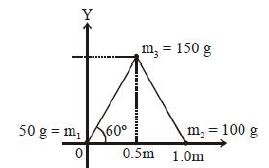 JEE Mains 2019 Hard
- Match List-I with List-II.
List-I List-II (A) Isothermal (I) \(\Delta W(\text{work done}) = 0\) (B) Adiabatic (II) \(\Delta Q(\text{supplied heat}) = 0\) (C) Isobaric (III) \(\Delta U(\text{change in internal energy}) \neq 0\) (D) Isochoric (IV) \(\Delta U = 0\)
Choose the correct answer from the options given below :JEE Mains 2025 Easy - When light of frequency twice the threshold frequency is incident on the metal plate, the maximum velocity of emitted election is \(v _{1}\). When the frequency of incident radiation is increased to five times the threshold value, the maximum velocity of emitted electron becomes \(v _{2}\). If \(v _{2}= x\) \(v _{1}\), the value of \(x\) will be...........JEE Mains 2022 Medium
- Refer to the figure given below, current between terminals \(A\) and \(B\) is _____ A.
 JEE Mains 2026 Hard
More PYQs from JEE Mains
- Two stars are \(10\) light years away from the earth. They are seen through a telescope of objective diameter \(30\, cm\). The wavelength of light is \(600\, nm\). To see the stars just resolved by the telescope, the minimum distance between them should be ( \(1\) light year \(= 9.46 \times 10^{15}\, m\)) of the order ofJEE Mains 2016 Medium
- Statement \(I:\) If three forces \(\vec{F}_{1}, \vec{F}_{2}\) and \(\vec{F}_{3}\) are represented by three sides of a triangle and \(\overrightarrow{{F}}_{1}+\overrightarrow{{F}}_{2}=-\overrightarrow{{F}}_{3}\), then these three forces are concurrent forces and satisfy the condition for equilibrium. Statement \(II:\) A triangle made up of three forces \(\overrightarrow{{F}}_{1}, \overrightarrow{{F}}_{2}\) and \(\overrightarrow{{F}}_{3}\) as its sides taken in the same order, satisfy the condition for translatory equilibrium. In the light of the above statements, choose the most appropriate answer from the options given below:JEE Mains 2021 Medium
- When a hydrogen atom going from \(\mathrm{n}=2\) to \(\mathrm{n}=1\) emits a photon, its recoil speed is \(\frac{\mathrm{x}}{5} \mathrm{~m} / \mathrm{s}\). Where \(\mathrm{x}=\) _______. (Use : mass of hydrogen atom\(\left.=1.6 \times 10^{-27 /} \ \mathrm{kg}\right)\)JEE Mains 2024 Hard
- particle moves with simple harmonic motion in a straight line. In first \(\tau\ s\), after starting from rest it travels a distance \(a\), and in next \(\tau\ s\) it travels \(2a\), in same direction, thenJEE Mains 2014 Hard