


Questions
29 questionsShowing 1–29 of 29 questions
-
- (A) \(88\, {A}\) and \(\tan ^{-1}\left(\frac{11}{6}\right)\)
- (B) \(0.88\, {A}\) and \(\tan ^{-1}\left(\frac{11}{6}\right)\)
- (C) \(8.8 \,{A}\) and \(\tan ^{-1}\left(\frac{11}{6}\right)\)
- (D) \(8.8 \,{A}\) and \(\tan ^{-1}\left(\frac{6}{11}\right)\)
Show answer and solution
Correct Answer: (C)
Inductive reactance, \(X_{L}=\omega L\)\(=100 \pi \times 0.07\)
\(=100 \times \frac{22}{7} \times \frac{7}{100}\)
\(=22 \Omega\)
\(\therefore \quad \text { Impedance, } Z =\sqrt{R^{2}+X_{L}^{2}}\)
\(=\sqrt{12^{2}+22^{2}}\)
\(=\sqrt{144+484}\)
\(=\sqrt{628}\)
\( \approx 25 \Omega\)
\(\therefore \text { Current, } I=\frac{V}{Z}=\frac{220}{25} =8.8 A\)
\(\Rightarrow \quad I=8.8 \Lambda\)
Also, phase angle between current and source voltage can be given as
\(\tan \phi =\left(\frac{X_{L}}{R}\right) \Rightarrow \tan \phi=\frac{22}{12}\)
\(\Rightarrow \quad \phi =\tan ^{-1}\left(\frac{11}{6}\right)\)
-
- (A) \(703\)
- (B) \(700\)
- (C) \(730\)
- (D) \(70.3\)
Show answer and solution
Correct Answer: (D)
\(C=0.1\, \mu {F}=10^{-7}\, {F}\)Resonant frequency \(=60\, {Hz}\)
at resonance
\(\omega_{0}=\frac{1}{\sqrt{L C}}\)
\(2 \pi f_{0}=\frac{1}{\sqrt{L C}} \Rightarrow \frac{1}{4 \pi^{2} f_{0}^{2} C}\)
By putting values \({L}=70.3\, {Hz}\)
-
- (A) \(2000\)
- (B) \(2500\)
- (C) \(1600\)
- (D) \(1800\)
Show answer and solution
Correct Answer: (A)
Given : \(\quad L =2 \times 10^{-4} H\)\(R =6.28 \Omega\)
\(f =10 MHz =10^{7} Hz\)
Since quality factor,
\(Q =\omega_{0} \frac{ L }{ R }=2 \pi f \frac{ L }{ R }\)
\(\therefore Q =2 \pi \times 10^{7} \times \frac{2 \times 10^{-4}}{6.28}\)
\(Q =2 \times 10^{3}=2000\)
\(\therefore\) Ans. is 2000
-
- (A) \(4\)
- (B) \(25\)
- (C) \(400\)
- (D) \(40\)
Show answer and solution
Correct Answer: (A)
For maximum average power\(X_{\mathrm{L}}=\mathrm{X}_{\mathrm{C}}\)
\(250 \pi=\frac{1}{2 \pi(50) \mathrm{C}}\)
\(\mathrm{C}=4 \times 10^{-6}\)
-
- (A) \(1200\)
- (B) \(600\)
- (C) \(800\)
- (D) \(900\)
Show answer and solution
Correct Answer: (D)
At resonance\(P =\frac{ V ^{2}}{ R }\)
\(R =\frac{ V ^{2}}{ P } =\frac{(120)^{2}}{16}\)
\(=900 \,\Omega\)
-
- (A) \(150\)
- (B) \(125\)
- (C) \(160\)
- (D) \(200\)
Show answer and solution
Correct Answer: (B)
\(X_{L}=X_{c}\) (due to resonance)\(Z=R \text { So } i_{m s}=\frac{V}{Z}=\frac{V}{R}\)
\(\frac{V^{2}}{R}=\frac{250 \times 250}{5}=125 \times 10^{2} \,W\)
-
- (A) \(3\)
- (B) \(4\)
- (C) \(5\)
- (D) \(6\)
Show answer and solution
Correct Answer: (B)
At resonance power \((P)\)\(P=\frac{\left(V_{ rms }\right)^{2}}{ R }\)
\(P=\frac{(250 / \sqrt{2})^{2}}{8}=3906.25 W\)
\(\approx 4 kW\)
-
- (A) \(5\)
- (B) \(15\)
- (C) \(20\)
- (D) \(10\)
Show answer and solution
Correct Answer: (D)
\(\lambda=960 m\)\(C =2.56 \mu F =2.56 \times 10^{-6} F\)
\(c=3 \times 10^{8} m / s\)
\(L =?\)
Now at resonance, \(\omega_{0}=\frac{1}{\sqrt{L C}}\)
[Resoant frequency]
\(2 \pi f _{0}=\frac{1}{\sqrt{ LC }}\)
On substituting \(f _{0}=\frac{ c }{\lambda},\) we have \(2 \pi \frac{ c }{\lambda}=\frac{1}{\sqrt{ LC }}\)
Squaring both sides : \(4 \pi^{2} \frac{ c ^{2}}{\lambda^{2}}=\frac{1}{ LC }\)
\(=\frac{4 \times 10 \times\left(3 \times 10^{8}\right)^{2}}{(960)^{2}}=\frac{1}{ L \times 2.56 \times 10^{-6}}\)
\(\Rightarrow \frac{1}{L}=\frac{4 \times 10 \times 9 \times 10^{16} \times 2.56 \times 10^{-6}}{960 \times 960}\)
\(\Rightarrow L =10 \times 10^{-8} H\)
-
- (A) \(2\)
- (B) \(1\)
- (C) \(3\)
- (D) \(4\)
Show answer and solution
Correct Answer: (B)
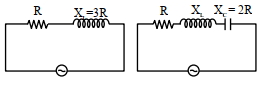
\(\cos \phi=\frac{{R}}{\sqrt{{R}^{2}+3 {R}^{2}}}\)\(=\frac{1}{\sqrt{10}}\)
\(\cos \phi^{\prime}=\frac{{R}}{\sqrt{{R}^{2}+{R}^{2}}}\)
\(=\frac{1}{\sqrt{2}}\)
\(\frac{\cos \phi^{\prime}}{\cos \phi}=\frac{\sqrt{10}}{\sqrt{2}}=\frac{\sqrt{5}}{1}\)
\(\therefore {x}=1\)
- 10. An \(AC\) current is given by \(I = I _{1} \sin \omega t + I _{2} \cos \omega t\). A hot wire ammeter will give a reading 2021 Hard
- (A) \(\sqrt{\frac{I_{1}^{2}-I_{2}^{2}}{2}}\)
- (B) \(\sqrt{\frac{ I _{1}^{2}+ I _{2}^{2}}{2}}\)
- (C) \(\frac{ I _{1}+ I _{2}}{\sqrt{2}}\)
- (D) \(\frac{ I _{1}+ I _{2}}{2 \sqrt{2}}\)
Show answer and solution
Correct Answer: (B)
\(I=I_{1} \sin \omega t+I_{2} \cos \omega t\)\(\therefore I_{0}=\sqrt{I_{1}^{2}+I_{2}^{2}}\)
\(\therefore I_{ rms }=\frac{I_{0}}{\sqrt{2}}=\sqrt{\frac{I_{1}^{2}+I_{2}^{2}}{2}}\)
-
- (A) \(2.5\, ms\)
- (B) \(25\, ms\)
- (C) \(2.5\, s\)
- (D) \(0.25\, ms\)
Show answer and solution
Correct Answer: (A)
\(i = i _{0} \cos (\omega t )\)\(i = i _{0}\) at \(t =0\)
\(i =\frac{ i _{0}}{\sqrt{2}}\) at \(\omega t =\frac{\pi}{4}\)
\(t =\frac{\pi}{4 \omega}=\frac{\pi}{4(2 \pi f )}=\frac{1}{8 f }\)
\(t =\frac{1}{400}=2.5 ms\)
- 12. An alternating current is given by the equation \(i=i_{1} \sin \omega t+i_{2} \cos \omega t\). The rms current will be 2021 Hard
- (A) \(\frac{1}{\sqrt{2}}\left(i_{1}^{2}+i_{2}^{2}\right)^{\frac{1}{2}}\)
- (B) \(\frac{1}{\sqrt{2}}\left( i _{1}+ i _{2}\right)^{2}\)
- (C) \(\frac{1}{2}\left( i _{1}^{2}+ i _{2}^{2}\right)^{\frac{1}{2}}\)
- (D) \(\frac{1}{\sqrt{2}}\left( i _{1}+ i _{2}\right)\)
Show answer and solution
Correct Answer: (A)
\(i = i _{1} \sin \omega t + i _{2} \sin (\omega t +90)\)\(i_0 =\sqrt{ i _{1}^{2}+ i _{2}^{2}}\)
\(i _{ rms }=\frac{ i _{0}}{\sqrt{2}}=\frac{\sqrt{ i _{1}^{2}+ i _{2}^{2}}}{\sqrt{2}}\)
-
- (A) \(1\)
- (B) \(2.5\)
- (C) \(1.5\)
- (D) \(2\)
Show answer and solution
Correct Answer: (D)
\(\tan 45^{\circ}=\frac{1}{\omega C R}=\frac{\omega L}{R} \Rightarrow X_{L}=X_{C}\)\(\Rightarrow\) resonance
\(i =\frac{ V }{ R }\)
\(=\frac{220}{110}=2 \,A\)
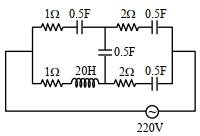
- 14. At very high frequencies, the effective impendance of the given circuit will be \(....\Omega\)
 2021 Hard
- (A) \(0.2\)
- (B) \(20\)
- (C) \(2.2\)
- (D) \(2\)
Show answer and solution
Correct Answer: (D)
\({X}_{{L}}=2 \pi {fL}\)\({f}\) is very large
\(\therefore {X}_{{L}}\) is very large hence open circuit.
\({X}_{{C}}=\frac{1}{2 \pi {fC}}\)
\({f}\) is very large.
\(\therefore {X}_{{c}}\) is very small, hence short circuit.
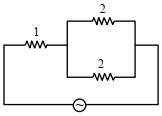
Final circuit
\(Z_{e q}=1+\frac{2 \times 2}{2+2}=2\)
-
- (A) \(2.25\)
- (B) \(3.0\)
- (C) \(3.37\)
- (D) \(9.0\)
Show answer and solution
Correct Answer: (A)
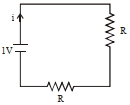
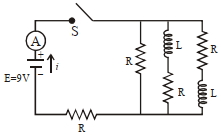
Just after the switch is closed, inductor will behave like infinite resistance (open circuit) so the circuit will look like\(i=\frac{9}{R+R}=\frac{9}{4}=2.25\)
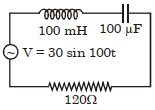
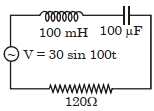
- 16. Find the peak current and resonant frequency of the following circuit (as shown in figure).
 2021 Hard
- (A) \(0.2\, A\) and \(50 \,Hz\)
- (B) \(0.2\, A\) and \(100\, Hz\)
- (C) \(2\, A\) and \(100\, Hz\)
- (D) \(2\, A\) and \(50\, Hz\)
Show answer and solution
Correct Answer: (A)
as given \(z=\sqrt{\left(x_{L}-x_{C}\right)^{2}+R^{2}}\)\(x _{ L }=\omega_{ L }=100 \times 100 \times 10^{-3}=10 \, \Omega\)
\(x _{ C }=\frac{1}{\omega_{ C }}=\frac{1}{100 \times 100 \times 10^{-6}}=10\, \Omega\)
\(z=\sqrt{(10-100)^{2}+R^{2}}=\sqrt{90^{2}+120^{2}}\)
\(=30 \times 5=150\, \Omega\)
\(i _{ peal }=\frac{\Delta v }{ z }=\frac{30}{150}=\frac{1}{5} amp =0.2\,amp\)
And For resonant frequency
\(\Rightarrow \omega L =\frac{1}{\omega C } \Rightarrow \omega^{2}=\frac{1}{ LC } \Rightarrow \omega=\frac{1}{\sqrt{ LC }}\)
And \(f=\frac{1}{2 \pi \sqrt{L C}} \Rightarrow \frac{1}{2 \pi \sqrt{100 \times 10^{-3} \times 100 \times 10^{-6}}}\)
\(=\frac{100 \sqrt{10}}{2 \pi}=\frac{100 \pi}{2 \pi}=50\, Hz\)
as \(\sqrt{10} \approx \pi\)
-
- (A) \(\approx 90^{\circ}\), predominantly inductive circuit
- (B) \(0^{\circ}\), resistive circuit
- (C) \(0^{\circ}\), resonance circuit
- (D) \(\approx 90^{\circ}\), predominantly capacitive circuit
Show answer and solution
Correct Answer: (D)
\(R=100\, \Omega\)\(X_{L}=\omega L=50 \pi \times 10^{-3}\)
\(X_{c}=\frac{1}{\omega C}=\frac{10^{11}}{100 \pi}\)
\(X_{c} \gg X_{L}\)
\(\&\,\left|X_{c}-X_{L}\right| \gg R\)
- 18. In a scries \(LCR\) resonance circuit, if we change the resistance only, from a lower to higher value 2021 Medium
- (A) The bandwidth of resonance circuit will increase.
- (B) The resonance frequency will increase.
- (C) The quality factor will increase.
- (D) The quality factor and the resonance frequency will remain constant.
Show answer and solution
Correct Answer: (A)
Bandwidth \(= R / L\)Bandwidth \(\propto R\)
So bandwidth will increase
-
- (A) \(\frac{1}{2}\)
- (B) \(\frac{1}{2 \sqrt{2}}\)
- (C) \(\frac{1}{\sqrt{2}}\)
- (D) \(\frac{\sqrt{3}}{2}\)
Show answer and solution
Correct Answer: (C)
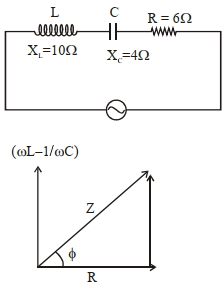
We know that power factor is \(\cos \phi\)\(\cos \phi=\frac{ R }{ Z }\)
\(Z=\sqrt{R^{2}+\left(X_{L}-X_{C}\right)^{2}} \quad \ldots\)
\(\Rightarrow Z =\sqrt{6^{2}+(10-4)^{2}}\)
\(\Rightarrow Z =6 \sqrt{2} \mid \cos \phi=\frac{6}{6 \sqrt{2}}\)
\(\cos \phi=\frac{1}{\sqrt{2}}\)
-
- (A) \(200\)
- (B) \(100\)
- (C) \(300\)
- (D) \(400\)
Show answer and solution
Correct Answer: (D)
\(Q =\frac{ X _{ L }}{ R }=\frac{\omega L }{ R }=\frac{1}{\sqrt{ LC }} \frac{ L }{ R }=\frac{\sqrt{ L }}{ R \sqrt{ C }}\)\(Q ^{\prime}=\frac{\sqrt{2 L }}{\left(\frac{ R }{2}\right) \sqrt{ C }}=2 \sqrt{2} Q =2 \sqrt{2}(100)\)
\(=282.84\)
-
- (A) \(2 {R}^{2}\)
- (B) Zero
- (C) \({R}\)
- (D) \({R} \sqrt{2}\)
Show answer and solution
Correct Answer: (C)
\(Z=\sqrt{\left(X_{L}-X_{C}\right)^{2}+R^{2}}=R: \because X_{L}=X_{C}\) -
- (A) \(3\)
- (B) \(5\)
- (C) \(7\)
- (D) \(9\)
Show answer and solution
Correct Answer: (A)
\(\tan \phi=\frac{x_{C}-x_{L}}{R}\)\(\tan 45=\frac{x_{C}-x_{L}}{R}\)
\(X_{C}-X_{L}=R\)
\(\frac{1}{\omega C}-\omega L=R\)
\(\frac{1}{\omega C}-300 \times 0.03=1\)
\(\frac{1}{\omega C}=10\)
\(C=\frac{1}{10 \omega}=\frac{1}{10 \times 300}\)
\(C=\frac{1}{3} \times 10^{-3}\)
\(X=3\)
-
- (A) \(5.9\)
- (B) \(3.16\)
- (C) \(0.94\)
- (D) \(6\)
Show answer and solution
Correct Answer: (B)
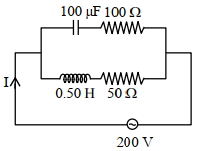
\(Z_{{c}}=\sqrt{\left(\frac{1}{\omega {C}}\right)^{2}+{R}^{2}}\)\(=\sqrt{\left(\frac{1}{100 \times 100 \times 10^{-6}}\right)^{2}+100^{2}}\)
\({Z}_{{C}}=\sqrt{(100)^{2}+(100)^{2}}\)
\(=100 \sqrt{2}\)
\({Z}_{{L}}=\sqrt{(\omega {L})^{2}+{R}^{2}}\)
\(\sqrt{(100 \times 0.5)^{2}+50^{2}}\)
\(=50 \sqrt{2}\)
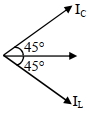
\({i}_{{C}}=\frac{200}{{z}_{{c}}}=\frac{200}{100 \sqrt{2}}=\sqrt{2}\)
\({i}_{{L}}=\frac{200}{{z}_{{L}}}=\frac{200}{50 \sqrt{2}}=2 \sqrt{2}\)
\(\cos \phi_{1}=\frac{100}{10 \sqrt{2}}=\frac{1}{\sqrt{2}} \Rightarrow \phi_{1}=45^{\circ}\)
\(\cos \phi_{2}=\frac{50}{50 \sqrt{2}}=\frac{1}{\sqrt{2}} \Rightarrow \phi_{2}=45^{\circ}\)
\({I}=\sqrt{{I}_{{C}}^{2}+{I}_{{L}}^{2}}\)
\(=\sqrt{2+8}\)
\(=\sqrt{10}\)
\({I}=3.16 \,{A}\)
-
- (A) \((a) - (iv) ; (b) - (iii) ; (c) - (ii) ; (d) - (i)\)
- (B) \((a) - (iii) ; (b) - (i) ; (c) - (iv) ; (d) - (ii)\)
- (C) \((a) - (ii) ; (b) - (i) ; (c) - (iv) ; (d) - (iii)\)
- (D) \((a) - (ii) ; (b) - (i) ; (c) - (iii) ; (d) - (iv)\)
Show answer and solution
Correct Answer: (C)
\((a)\) For \({x}_{{L}}\,>\,{x}_{{C}}\), voltage leads the current\((ii)\)
\((b)\) For \(x_{L}=x_{C}\), voltage \(\&\) current are in same phase
\((i)\)
\((c)\) For \({x}_{{L}}\, < \,{x}_{{C}}\), current leads the voltage
\((iv)\)
\((d)\) For resonant frequency \({x}_{{L}}={x}_{{C}}\), current is maximum
\((iii)\)
-
- (A) \((a) -( i ),( b )-( iii ),( c )-( iv ),( d )-( ii )\)
- (B) \((a) -( ii ),( b )-( iv ),( c )-( iii ),( d )-( i )\)
- (C) \((a)-(ii),(b)-(iii),(c)-(iv),(d)-(i)\)
- (D) \((a)-(ii),(b)-(iii), (c)-(i), ( d )-( iv )\)
Show answer and solution
Correct Answer: (D)
\(\tan \phi=\frac{ V _{ L }- V _{ C }}{ V _{ R }}=\frac{ X _{ L }- X _{ C }}{ R }\)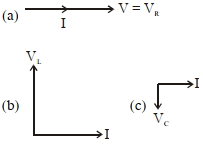
-
- (A) \(11\)
- (B) \(13\)
- (C) \(9\)
- (D) \(15\)
Show answer and solution
Correct Answer: (A)
\({f}_{{rms}}^{2}={f}_{1 {m} {m}}^{2}+{f}_{2 {rms}}^{2}\)\(=\left(\frac{\sqrt{42}}{\sqrt{2}}\right)^{2}+10^{2}\)
\(=121 \Rightarrow {f}_{{rms}}=11\, {A}\)
-
- (A) \(0.8\, H\) and \(150\, \mu F\)
- (B) \(0.8\, H\) and \(250\, \mu F\)
- (C) \(1.33\, H\) and \(250\, \mu F\)
- (D) \(1.33\, H\) and \(150\, \mu F\)
Show answer and solution
Correct Answer: (B)
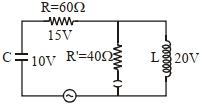
Current through \(60 \Omega\) resistance \(=\frac{15}{60}=\frac{1}{4} A\)thus capacitor current \(=\frac{1}{4} A\)
\(\because V _{ C }= I X _{ C }\)
\(10=\frac{1}{4} \times \frac{1}{\omega C}\)
\(\therefore C =\frac{1}{40 \omega}=\frac{1}{4000}=250 \mu F\)
Now,
current through \(40 \Omega\) resistance \(=\frac{20}{40}=\frac{1}{2} A\)
thus current through inductor \(=\frac{1}{2}-\frac{1}{4}=\frac{1}{4} A\)
\(V _{ L }= IX _{ L }=\frac{1}{4} \times \omega L\)
\(20=\frac{1}{4} \times 100 \times L\)
\(\Rightarrow L =0.8 H\)
-
- (A) \(1000\)
- (B) \(200\)
- (C) \(500\)
- (D) \(5\)
Show answer and solution
Correct Answer: (C)
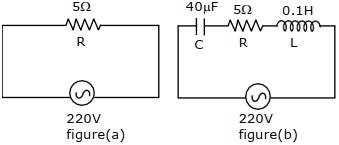
\(P_{\text {avg }}=\frac{v_{\text {rms }}^{2}}{R}\)\(\frac{v_{ rms }^{2}}{Z^{2}} \times R=\frac{v_{r m s}^{2}}{R} \times 1\)
\(R^{2}=Z^{2}\)
\(25=\left(\sqrt{\left(x_{C}-x_{L}\right)^{2}+5^{2}}\right)^{2}\)
\(25=\left(x_{c}-x_{L}\right)^{2}+25\)
\(x_{c}=x_{L} \Rightarrow \frac{1}{\omega C}=\omega L\)
\(\omega^{2}=\frac{1}{L C}=\frac{10^{6}}{0.1 \times 40}\)
\(\omega=500\)
- 29. What happens to the inductive reactance and the current in a purely inductive circuit if the frequency is halved ? 2021 Medium
- (A) Both, inductive reactance and current will be halved.
- (B) Inductive reactance will be halved and current will be doubled.
- (C) Inductive reactance will be doubled and current will be halved.
- (D) Both, inducting reactance and current will be doubled.
Show answer and solution
Correct Answer: (B)
\(X _{ L }=\omega L\)\(i =\frac{ v _{0}}{\omega L }\)
No questions on this page match these filters.