


JEE Mains · Chemistry · STD 11 - Chemical bonding and molecular structure
- JEE Mains 2026
- Medium
- MCQ
The pairs among \(A = [\text{SO}_3^{2-}, \text{CO}_3^{2-}]\), \(B = [\text{O}_2^{2-}, \text{F}_2]\), \(C = [\text{CN}^-, \text{CO}]\), \(D = [\text{NH}_3, \text{H}_3\text{O}^+]\) and \(E = [\text{MnO}_4^{2-}, \text{CrO}_4^{2-}]\) that do not have similar Lewis dot structure are
Pick an option to check your answer.
Answer & Solution
Correct Answer
(B) A and E
Step-by-step Solution
Detailed explanation
Species with the same number of valence electrons and the same skeletal structure generally have similar Lewis dot structures (isoelectronic species).
For pair A: \(\text{SO}_3^{2-}\) has \(6 + 3(6) + 2 = 26\) valence electrons. \(\text{CO}_3^{2-}\) has \(4 + 3(6) + 2 = 24\) valence electrons. Since they have different numbers of valence electrons, they do not have similar Lewis dot structures (\(\text{SO}_3^{2-}\) has a lone pair on the central atom and is pyramidal, while \(\text{CO}_3^{2-}\) has no lone pair on the central atom and is trigonal planar).
For pair B: \(\text{O}_2^{2-}\) has \(2(6) + 2 = 14\) valence electrons. \(\text{F}_2\) has \(2(7) = 14\) valence electrons. Both have a single bond and three lone pairs on each atom, so they have similar Lewis dot structures.
For pair C: \(\text{CN}^-\) has \(4 + 5 + 1 = 10\) valence electrons. \(\text{CO}\) has \(4 + 6 = 10\) valence electrons. Both have a triple bond and one lone pair on each atom, so they have similar Lewis dot structures.
For pair D: \(\text{NH}_3\) has \(5 + 3(1) = 8\) valence electrons. \(\text{H}_3\text{O}^+\) has \(6 + 3(1) - 1 = 8\) valence electrons. Both have three single bonds and one lone pair on the central atom, so they have similar Lewis dot structures.
For pair E: \(\text{MnO}_4^{2-}\) has \(7 + 4(6) + 2 = 33\) valence electrons. \(\text{CrO}_4^{2-}\) has \(6 + 4(6) + 2 = 32\) valence electrons. Since they have different numbers of valence electrons (\(\text{MnO}_4^{2-}\) has an unpaired electron), they do not have similar Lewis dot structures.
Thus, pairs A and E do not have similar Lewis dot structures.
Answer: A and E
More questions from Chemistry
- The species which does not undergo disproportionation reaction is _______.JEE Mains 2025 Easy
- The order of reactivity of the given haloalkanes towards nucleophile isJEE Mains 2013 Medium
- The reaction \(\frac{1}{2} H _2( g )+ AgCl ( s ) \rightleftharpoons H ^{+}( aq )+ Cl ^{-}( aq )+ Ag ( s )\) occurs in which of the given galvanic cell.JEE Mains 2023 Medium
- The wavelength of light absorbed for the following complexes are in the order:
\(\underset{\text { (I) }}{\left[ Co \left( NH _3\right)_6\right]^{3+}} ; \underset{\text { (II) }}{\left[ Co \left( H _2 O \right)_6\right]^{3+}} ; \underset{\text { (III) }}{\left[ Co ( CN )_6\right]^{3-}}\) ;
\(\underset{( IV )}{\left[ Co \left( NH _3\right)_5\left( H _2 O \right)\right]^{3+}} ; \underset{( V )}{\left[ CoF _6\right]^{3-}}\)JEE Mains 2026 Easy - A tetrapeptide " \(x\) " on complete hydrolysis produced glycine (Gly), alanine (Ala), valine (Val), leucine (Leu) in equimolar proportion each. The number of tetrapeptides (sequences) possible involving each of these amino acids is _______.JEE Mains 2025 Medium
- \(PCl _{5}\) dissociates as \(PCl _{5}( g ) \rightleftharpoons PCl _{3}( g )+ Cl _{2}( g )\) \(5\) moles of \(PCl _{5}\) are placed in a \(200\) \(litre\) vessel which contains \(2\, moles\) of \(N _{2}\) and is maintained at \(600 \,K\). The equilibrium pressure is \(2.46 \,atm\). The equilibrium constant \(K _{ p }\) for the dissociation of \(PCl _{5}\) is \(......\,\times 10^{-3}\). (nearest integer) (Given: \(R =0.082\, L \,atm \,K ^{-1} \,mol ^{-1}\) : Assume ideal gas behaviour)JEE Mains 2022 Medium
More PYQs from JEE Mains
- Enthalpy of sublimation of iodine is \(24\, cal\, g^{-1}\) at \(200\,^oC\). If specific heat of \(I_2(s)\) and \(I_2(vap)\) are \(0.055\) and \(0.031\, cal\, g^{-1}K^{-1}\) respectively, then enthalpy of sublimation of iodine at \(250\,^oC\) in \(cal\, g^{-1}\) isJEE Mains 2019 Hard
- pendulum made of a uniform wire of cross sectional area \(A\) has time period \(T\). When an additional mass \(M\) is added to its bob, the time period changes to \(T_M\). If the Young's modulus of the material of the wire is \(Y\) then \(\frac{1}{Y}\) is equal to : (\(g\) = gravitational acceleration)JEE Mains 2015 Hard
- The time period of a satellite, revolving above earth's surface at a height equal to \(R\) will be (Given \(g =\pi^2 m / s ^2, R =\) radius of earth)JEE Mains 2023 Medium
- When Uranium is bombarded with neutrons, it undergoes fission. The fission reaction can be written as \({}_{92}{U^{235}} + {}_0{n^1} \to {}_{56}B{a^{141}} + {}_{36}K{r^{92}} + 3x + Q{\rm{( energy)}}\) where three particles named \(x\) are produced and energy \(Q\) is released. What is the name of the particle \(x\) ?JEE Mains 2013 Medium
- If \(m\) and \(e\) are the mass and charge of the revolving electron in the orbit of radius \(r\) for hydrogen atom, the total energy of the revolving electron will beJEE Mains 2014 Hard
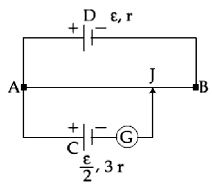
- A potentiometer wire \(AB\) having length \(L\) and resistance \(12\, r\) is joined to a cell \(D\) of \(emf\) \(\varepsilon \) and internal resistance \(r\). A cell \(C\) having \(emf\) \(\varepsilon /2\) and internal resistance \(3r\) is connected. The length \(AJ\) at which the galvanometer as shown in figure shows no deflection is
 JEE Mains 2019 Medium