


JEE Mains · Chemistry · STD 11 - Chemical bonding and molecular structure
- JEE Mains 2026
- Medium
- MCQ
Given below are two statements:
Statement I: Aluminium is more electropositive than thallium as the standard electrode potential value of \(E^{\circ}_{\text{Al}^{3+}/\text{Al}}\) is negative and \(E^{\circ}_{\text{Tl}^{3+}/\text{Tl}}\) is positive.
Statement II: The sum of first three ionization enthalpies of boron is very high when compared to that of aluminium. Due to this reason boron forms covalent compounds only and aluminium forms \(\text{Al}^{3+}\) ion.
In the light of the above statements, choose the correct answer from the options given below
Pick an option to check your answer.
Answer & Solution
Correct Answer
(A) Both Statement I and Statement II are true
Step-by-step Solution
Detailed explanation
Statement I: The standard reduction potential \(E^{\circ}_{\text{Al}^{3+}/\text{Al}}\) is \(-1.66\) V, which is highly negative, indicating that aluminium has a strong tendency to lose electrons and is highly electropositive. The standard reduction potential \(E^{\circ}_{\text{Tl}^{3+}/\text{Tl}}\) is \(+1.26\) V, which is positive, indicating that thallium is less electropositive than aluminium. Thus, Statement I is true.
Statement II: Boron has a very small atomic size, resulting in a very high sum of its first three ionization enthalpies. This high energy requirement prevents boron from losing three electrons to form \(\text{B}^{3+}\) ions, so it forms only covalent compounds. In contrast, aluminium has a larger size and a significantly lower sum of its first three ionization enthalpies, allowing it to easily form \(\text{Al}^{3+}\) ions in its compounds. Thus, Statement II is true.
Both Statement I and Statement II are true.
Answer: Both Statement I and Statement II are true
More questions from Chemistry
- The correct statements about metal carbonyls are
A. The metal-carbon bonds in metal carbonyls possess both \(\sigma\) and \(\pi\)-character.
B. Due to synergic bonding interactions between metal and CO ligand, the metal-carbon bond becomes weak.
C. The metal-carbon \(\sigma\) bond is formed by the donation of lone pair of electrons on the carbonyl carbon into a vacant orbital of metal.
D. The metal-carbon \(\pi\) bond is formed by the donation of electrons from filled d-orbital of metal into vacant \(\pi^*\) orbital of CO.
Choose the correct answer from the options given below:JEE Mains 2026 Medium - Consider the reaction
\(2\text{H}_2\text{S}(g) + 3\text{O}_2(g) \rightarrow 2\text{H}_2\text{O}(l) + 2\text{SO}_2(g)\)
The magnitude of enthalpy change for the reaction in kJ mol\(^{-1}\) is ________. (Nearest integer)
Given: \(\Delta_fH^{\ominus}(\text{H}_2\text{S}) = -20.1\) kJ mol\(^{-1}\)
\(\Delta_fH^{\ominus}(\text{H}_2\text{O}) = -286.0\) kJ mol\(^{-1}\)
\(\Delta_fH^{\ominus}(\text{SO}_2) = -297.0\) kJ mol\(^{-1}\)JEE Mains 2026 Medium - For a first order reaction \(A \rightarrow B\), the rate constant, \(k =5.5 \times 10^{-14} \,s ^{-1}\). The time required for \(67\, \%\) completion of reaction is \(x \,\times 10^{-1}\) times the half life of reaction. The value of \(x\) is \(....\) (Nearest integer)JEE Mains 2022 Medium
- Two compounds \(A\) and \(B\) with same molecular formula \(\left( C _{3} H _{6} O \right)\) undergo Grignard's reaction with methylmagnesium bromide to give products \(C\) and \(D\). products \(C\) and \(D\) show following chemical tests.
\(C\) and \(D\) respectively areTest \(C\) \(D\) Ceric ammonium nitrate Test Positive positive Lucas Test Turbidity obtained after five minutes Turbidity obtained immediately Iodoform Test Positive Negative JEE Mains 2020 Medium - In the following sequence of reactions the maximum number of atoms present in molecule '\(C\)' in one plane is \(A \xrightarrow[ { Cu\; tube }]{\text { Redhot }}\mathrm{B} \xrightarrow[ Anhydrous AlCl_3]{\mathrm{CH}_{3} \mathrm{Cl}(1 \mathrm{eq}} \mathrm{C}\) (\(A\) is a lowest molecular weight alkyne)JEE Mains 2020 Hard
- The d-orbital electronic configuration of the complex among \(\quad\left[\mathrm{Co}(\mathrm{en})_3\right]^{3+}, \quad\left[\mathrm{CoF}_6\right]^{3-}\), \(\left[\mathrm{Mn}\left(\mathrm{H}_2 \mathrm{O}\right)_6\right]^{2+}\) and \(\left[\mathrm{Zn}\left(\mathrm{H}_2 \mathrm{O}\right)_6\right]^{2+}\) that has the highest CFSE is which?JEE Mains 2025 Easy
More PYQs from JEE Mains
- The magnetic field of a plane electromagnetic Wave is \(\overrightarrow{ B }=3 \times 10^{-8} \sin [200 \pi( y + ct )] \hat{ i }\, T\) Where \(c=3 \times 10^{8} \,ms ^{-1}\) is the speed of light. The corresponding electric field isJEE Mains 2020 Hard
- Which of the following relations is true for two unit vectors \(\hat{ A }\) and \(\hat{ B }\) making an angle \(\theta\) to each other\(?\)JEE Mains 2022 Hard
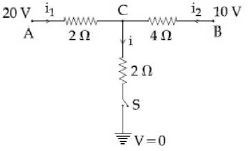
- When the switch \(S\), in the circuit shown, is closed, then the value of current \(i\) will be ................. \(A\)
 JEE Mains 2019 Medium
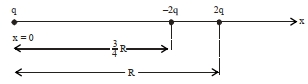
- Three point charges \(q,-2 q\) and \(2 q\) are placed on \(x\)-axis at a distance \(x=0, x=\frac{3}{4} R\) and \(x=R\) respectively from origin as shown. If \(q =2 \times 10^{-6}\,C\) and \(R =2\,cm\), the magnitude of net force experienced by the charge \(-2 q\) is .......... \(N\)
 JEE Mains 2023 Medium
- \(2.0\) g of a bromo hydrocarbon \((X)\) was subjected to Carius analysis, gave \(3.36\) g of \(AgBr\). The percentage of carbon in the compound \((X)\) is \(26.7\%\). Total number of carbon atoms in the empirical formula for compound \((X)\) is _____. (Given molar mass in g mol\(^{-1}\) H:\(1\), C:\(12\), Br:\(80\), Ag:\(108\))JEE Mains 2026 Hard