


JEE Mains · Chemistry · STD 11 - Organic chemistry Nomenclature of organic compounds
- JEE Mains 2026
- Easy
- MCQ
The correct increasing order of C-H(A), C-O(B), C=O(C) and \(C \equiv N(D)\) bonds in terms of covalent bond length is:
Pick an option to check your answer.
Answer & Solution
Correct Answer
(B) A < D < C < B
Step-by-step Solution
Detailed explanation
Explanation:
Let us determine the correct order of bond lengths step-by-step by analyzing the two primary factors involved: bond order and atomic size.
1. Effect of Bond Order:
For a given pair of atoms, bond length decreases as the bond order increases because more shared electrons pull the nuclei closer together. Therefore, a triple bond is shorter than a double bond, which is shorter than a single bond: \(\text{Triple} < \text{Double} < \text{Single}\). This explains why the carbonyl double bond \(C=O(C)\) is shorter than the ether single bond \(C-O(B)\).
2. Effect of Atomic Size (The C-H Exception):
When comparing bonds with different atoms, the size of the atoms is crucial. Hydrogen belongs to the first period and has the smallest atomic radius because it possesses only a single \(1s\) orbital shell. Because the hydrogen atom is exceptionally small, the \(C-H(A)\) single bond is uniquely compressed, measuring only around \(107\text{ pm}\). This is shorter than the \(C \equiv N(D)\) triple bond (\(116\text{ pm}\)), where both carbon and nitrogen are larger second-period atoms.
3. Summary of Bond Length Values:
- \(C-H(A)\): \(107\text{ pm}\)
- \(C \equiv N(D)\): \(116\text{ pm}\)
- \(C=O(C)\): \(121\text{ pm}\)
- \(C-O(B)\): \(143\text{ pm}\)
Arranging these values from shortest to longest gives: A < D < C < B.
Hence, Option B is the correct choice.
More questions from Chemistry
- The chloride that can not get hydrolysed isJEE Mains 2019 Hard
- For a reaction \(\mathrm{A} \xrightarrow{\mathrm{K}_4} \mathrm{~B} \xrightarrow{\mathrm{K}_2} \mathrm{C}\) If the rate of formation of \(B\) is set to be zero then the concentration of \(B\) is given by _______.JEE Mains 2024 Medium
- Which of the following is \('a'\) \(FALSE\) statement ?JEE Mains 2021 Easy
- Which of the following pair of molecules contain odd electron molecule and an expanded octet molecule?JEE Mains 2022 Medium
- The standard electrode potential of \(M ^{+} / M\) in aqueous solution does not depend onJEE Mains 2023 Medium
- During the detection of acidic radical present in a salt, a student gets a pale yellow precipitate soluble with difficulty in \(NH _4 OH\) solution when sodium carbonate extract was first acidified with dil. \(HNO _3\) and then \(AgNO _3\) solution was added. This indicates presence of _______.JEE Mains 2024 Medium
More PYQs from JEE Mains
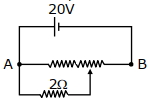
- the given potentiometer has its wire of resistance \(10\, \Omega\). When the sliding contact is in the middle of the potentiometer wire, the potential drop across \(2\, \Omega\) resistor is -
 JEE Mains 2021 Hard
- A solid sphere of mass \(M\) and radius \(R\) is divided into two unequal parts. The first part has a mass of \(\frac {7M}{8}\) and is converted into a uniform disc of radius \(2R.\) The second part is converted into a uniform solid sphere. Let \(I_1\) be the moment of inertia of the disc about its axis and \(I_2\) be the moment of inertia of the new sphere about its axis. The ratio of \(I_1/I_2\) is given byJEE Mains 2019 Hard
- For an electromagnetic wave propagating through vacuum, \(\vec{k}\), \(\vec{E}\) and \(\omega\) represent propagation vector, electric field and angular frequency, respectively. The magnetic field associated with this wave is represented by :JEE Mains 2026 Medium
- The osmotic pressure of a dilute solution of an ionic compound \(XY\) in water is four times that of a solution of \(0.01\,M\,BaCl_2\) in water. Assuming complete dissociation of the given ionic compounds in water, the concentration of \(XY\) (in \(mol\,L^{-1}\)) in solution isJEE Mains 2019 Hard
- \(t _{87.5}\) is the time required for the reaction to undergo \(87.5 \%\) completion and \(t_{50}\) is the time required for the reaction to undergo \(50 \%\) completion. The relation between \(t_{87.5}\) and \(t_{50}\) for a first order reaction is \(t _{87.5}= x \times t _{50}\) The value of \(x\) is \(......\). (Nearest integer)JEE Mains 2023 Medium
- For compound having the formula \(GaAlCl _4\), the correct option from the following isJEE Mains 2023 Medium