


JEE Mains · Chemistry · STD 11 - 2. structure of atom
Maximum number of electrons that can be accommodated in shell with \(n=4\) are:
- A \(16\)
- B \(32\)
- C \(50\)
- D \(72\)
Answer & Solution
Correct Answer
(B) \(32\)
Step-by-step Solution
Detailed explanation
The number of electrons in the orbitals of sub-shell of \(n=4\) are
See the Complete Solution
Get step-by-step explanations for this and 2.5 Lakh+ more JEE, NEET & CET questions.
- Unlock all solutions
- Practice the full chapter
- Track accuracy across PYQs
4.8 rated on Google Play · 14,000+ reviews
More questions from Chemistry
- Number of complexes with even number of electrons in \(\mathrm{t}_{2 \mathrm{g}}\) orbitals is _______. \({\left[\mathrm{Fe}\left(\mathrm{H}_2 \mathrm{O}\right)_6\right]^{2+},\left[\mathrm{Co}\left(\mathrm{H}_2 \mathrm{O}\right)_6\right]^{2+},\left[\mathrm{Co}\left(\mathrm{H}_2 \mathrm{O}\right)_6\right]^{3+},}\) \({\left[\mathrm{Cu}\left(\mathrm{H}_2 \mathrm{O}\right)_6\right]^{2+},\left[\mathrm{Cr}\left(\mathrm{H}_2 \mathrm{O}\right)_6\right]^{2+}}\)JEE Mains 2024 Medium
- Complete reduction of benzene-diazonium chloride with \(Zn/HCl\) givesJEE Mains 2014 Medium
- Consider the reaction \({H_2}S{O_3}\left( {aq} \right) + S{n^{4 + }}\left( {aq} \right) + {H_2}O\left( l \right) \to S{n^{2 + }}\left( {aq} \right) + HSO_4^ - \left( {aq} \right) + 3{H^ + }\left( {aq} \right)\) Which of the following statements is correct?JEE Mains 2014 Medium
- Pair of transition metal ions having the same number of unpaired electrons is _______.JEE Mains 2025 Medium
- The correct set of ions (aqueous solution) with same colour from the following is which?JEE Mains 2025 Easy
- For there action of \(H_2\) with \(I_2,\) the rate constant is \(2.5\times 10^{-4}\,dm^3\,mol^{-1}\,s^{-1}\) at \(327\,^oC\) and \(1.0\,dm^3\,mol^{-1}\,s^{-1}\) at \(527\,^oC\). The activation energy for the reaction, in \(kJ\,mol^{-1}\) is: \((R = 8.314\,J\,K^{-1}\,mol^{-1} )\)JEE Mains 2019 Hard
More PYQs from JEE Mains
- The electronegativity of a group 13 element 'E' is same as that of Ge (on Pauling scale and upto one decimal point). The CORRECT statements about \(E^{3+}\) are
A. It can act as a reducing agent.
B. It can act as an oxidizing agent.
C. \(E^{3+}\) is more stable than \(E^+\).
D. The standard electrode potential value for \(E^{3+}/E\) is positive.
Choose the correct answer from the options given below:JEE Mains 2026 Hard - In the sixth period, the orbitals that are filled areJEE Mains 2020 Medium
- If the magnetic moment of a dioxygen species is \(1.73 \;B.M\), it may beJEE Mains 2020 Hard
- If for the solution curve \(y=f(x)\) of the differential equation \(\frac{\mathrm{d} y}{\mathrm{~d} x}+(\tan x) y=\frac{2+\sec x}{(1+2 \sec x)^2}\), \(x \in\left(\frac{-\pi}{2}, \frac{\pi}{2}\right), f\left(\frac{\pi}{3}\right)=\frac{\sqrt{3}}{10}\), then \(f\left(\frac{\pi}{4}\right)\) is equal to :JEE Mains 2025 Medium
- Both the diodes used in the circuit shown are assumed to be ideal and have negligible resistance when these are forward biased. Built in potential in each diode is \(0.7\; \mathrm{V} .\) For the input voltages shown in the figure, the voltage (in \(Volts\)) at point \(A\) is
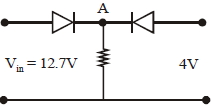 JEE Mains 2020 Medium
 - When vector \(\overrightarrow{ A }=2 \hat{ i }+3 \hat{ j }+2 \hat{ k }\) is subtracted from vector \(\vec{B}\), it gives a vector equal to \(2 \hat{j}\). Then the magnitude of vector \(\vec{B}\) will be:JEE Mains 2023 Easy