


JEE Mains 2023 Chemistry के सभी प्रश्न
25 अध्याय342 में से 201–250 प्रश्न
-
- (A) \(\mathrm{A}\) एवं \(\mathrm{R}\) दोनों सही हैं तथा \(\mathrm{A}\) की सही व्याख्या \(\mathrm{R}\) नहीं है।
- (B) \(\mathrm{A}\) गलत है परन्तु \(\mathrm{R}\) सही है।
- (C) \(\mathrm{A}\) सही है परन्तु \(\mathrm{R}\) गलत है।
- (D) \(A\) एवं \(R\) दोनों सही हैं तथा \(A\) की सही व्याख्या \(\mathrm{R}\) है।
उत्तर और हल देखें
सही उत्तर: (D)
Assertion is correct.\(H _2 C _2 O _4 \cdot 2 H _2 O\)
\(M =\frac{3.15 \times 1000}{126 \times 250}\)
\(\frac{12.6}{126}=0.1\)
Reason is correct. It is used as a fact in explanation of assertion.
-
- (A) \(2.00\)
- (B) \(6.00\)
- (C) \(8.00\)
- (D) \(4\)
उत्तर और हल देखें
सही उत्तर: (D)
\(\pi= iCRT\)\(\pi \propto iC\)
\(A, B, D\) and \(E\) have same value of osmatic pressure.
-
- (A) \(B\), \(D\), तथा \(E\) केवल
- (B) \(\mathrm{A}, \mathrm{B}\), तथा \(\mathrm{D}\) केवल
- (C) \(\mathrm{A}\) तथा \(\mathrm{C}\) केवल
- (D) \(B\) तथा \(D\) केवल
उत्तर और हल देखें
सही उत्तर: (D)
\((A)\) \(\Delta T _{ b } \propto i \times c\)\((B)\) Azeotropic mixtures have same composition in both liquid and vapour phase.
\((C)\) Osmosis always takes place from hypotonic to hypertonic solution.
\((D)\) \(M =\frac{30 \times 10 \times 1.26}{98} \approx 4.09\,M\)
\((E)\) When \(KI\) solutions is added to \(AgNO _3\) solution, positively charged solution results due to adsorption of \(Ag ^{ F }\) ions from dispersion medium
\(AgI / Ag ^{+}\)
Positively charged
-
- (A) \(8\)
- (B) \(6\)
- (C) \(4\)
- (D) \(2\)
उत्तर और हल देखें
सही उत्तर: (A)
\(\frac{\left( T _{ B }\right)_{ x }}{\left( T _{ B }\right)_{ y }}=\frac{2}{1} \quad \frac{(\Delta H )_{ x }}{(\Delta H )_{ y }}=\frac{1}{2}\)\(\frac{\left(\Delta T _{ B }\right)_{ x }}{\left(\Delta T _{ B }\right)_{ y }}= m =\frac{\left( K _{ B }\right)_{ x } \times \text { molality }}{\left( K _{ B }\right)_{ y } \times \text { molality }}\)
\(=\frac{( T \cdot B )_{ x }^2}{( T \cdot B )_{ y }^2} \times \frac{\Delta H _{ y }}{\left(\Delta H _{ x }\right.}=(2)^2 \times 2=8\)
-
- (A) \(A-III, B-I, C-II, D-IV\)
- (B) \(A-III, B-II, C-I, D-IV\)
- (C) \(A-III, B-I, C-IV, D-II\)
- (D) \(A-I, B-III, C-II, D-IV\)
उत्तर और हल देखें
सही उत्तर: (A)
\((A)\) van't Hoff factor, \(i\)\(i =\frac{\text { Normal molar mass }}{\text { Abnormal molar mass }}\)
\((B)\) \(k _{ f }=\) Cryoscopic constant
\((C)\) Solutions with same osmotic pressure are known as isotonic solutions.
\((D)\) Solutions with same composition of vapour over them are called Azeotrope.
-
- (A) \(1112\)
- (B) \(1113\)
- (C) \(1114\)
- (D) \(1111\)
उत्तर और हल देखें
सही उत्तर: (D)
\(\frac{ P ^0- P _{ s }}{ P _{ s }}=\frac{ n _{\text {solute }}}{ n _{\text {solvent }}}=\frac{\frac{ x }{60}}{\frac{1000}{18}}=\frac{ P ^0-0.75 P ^0}{0.75 P ^0}\)\(\Rightarrow x =\frac{10000}{9}=1111\,gm\)
- 207. " \(\mathrm{X}\) " के \(2 \mathrm{~g}\) को \(1\) मोल जल में घोलकर विलयन बनाया जाता है। विलयन में " \(\mathrm{X}\) " का द्रव्यमान प्रतिशत है। 2023 मध्यम
- (A) \(20\)
- (B) \(5\)
- (C) \(2\)
- (D) \(10\)
उत्तर और हल देखें
सही उत्तर: (D)
Solute \(( X )=2\,g\)Solvent \(\left( H _2 O \right)=1\) mole \(=18\,g\)
Total mass \(=2+18=20\,g\)
\(\%\) mass of \(X =\frac{2}{20} \times 100=10 \%\)
-
- (A) \(200\)
- (B) \(300\)
- (C) \(50\)
- (D) \(100\)
उत्तर और हल देखें
सही उत्तर: (D)
\(\underset{1\,gm }{ M _2 CO _3}+\underset{\text { Excess }}{2 HCl } \rightarrow \underset{0.02 \text { mole }}{2 MCl }+ H _2 O +\underset{0.01 \text { mole }}{ CO _2}\)From principle of atomic conservation of carbon atom,
Mole of \(M _2 CO _3 \times 1=\) Mole of \(CO _2 \times 1\)
\(\frac{1 gm }{\text { molar mass of } M _2 CO _3}=0.01 \times 1\)
\(\text { Molar mass of } M _2 CO _3=100\,gm / mole\)
-
- (A) \(1361\)
- (B) \(1362\)
- (C) \(1360\)
- (D) \(1368\)
उत्तर और हल देखें
सही उत्तर: (B)
Mole of \(CO _2=0.2\,M \times\left(300 \times 10^{-3}\right)\,L\)\(=0.06 Mole\)
Volume of \(0.06\) mole \(CO _2\) at S.T.P
\(=0.06 \times 22.7\)
\(=1.362\,L\)
-
- (A) \(4\)
- (B) \(3\)
- (C) \(2\)
- (D) \(1\)
उत्तर और हल देखें
सही उत्तर: (A)
\(\left[ Cr \left( H _2 O \right)_5 Cl \right] Cl _2+2 AgNO _3 \rightarrow\)\(\begin{array}{ll}0.01\,M , 20\, mL & 0.1\, M \\ \text { For } 0.2 \text { milimole } & AgNO _3 \text { required }\end{array}\)
\(0.4=0.1 \times V ( ml )\)
\(V =4\,mL\)
-
- (A) \(138\)
- (B) \(139\)
- (C) \(137\)
- (D) \(136\)
उत्तर और हल देखें
सही उत्तर: (B)
\((10\,ml\) solute in \(90\,ml\) solvent\(\text { mass of solute }=10 \times 3.2=32\,g\)
\(\text { mass of solvent }=90 \times 1.6\,g\)
\(m =\frac{32 \times 1000}{160 \times 90 \times 1.6}=1.388\)
\(m =138.8 \times 10^{-2}=139\)
-
- (A) \(MCl _2\)
- (B) \(MCl _4\)
- (C) \(MCl _3\)
- (D) \(MCl\)
उत्तर और हल देखें
सही उत्तर: (A)
Molecular. weight of metal chloride\(=\frac{0.57}{100} \times 22700\)
\(=129.39\)
weight of \(Cl =129.39 \times 0.55\)
\(=71.1645\)
\(\therefore\) Mole of \(Cl =\frac{71.1645}{35.5} \cong 2\)
Hence \(MCl _2\)
-
- (A) \(51\)
- (B) \(52\)
- (C) \(56\)
- (D) \(53\)
उत्तर और हल देखें
सही उत्तर: (C)
Moles of \(CO _2=\frac{0.22}{44}=\frac{1}{200}\)\(\therefore\) Moles of carbon
\(=\left(\text { Moles of } CO _2\right) \times 1\)
\(=\frac{1}{200}\)
\(\therefore\) wt. of \(C =\frac{1}{200} \times 12=0.06\)
\(\text { \% of } C =\frac{0.06}{ W } \times 100=24\)
\(( W = Wt \text {. of Organic Compound })\)
\(W =0.25\)
Moles of \(H _2 O =\frac{0.126}{18}=0.007\)
\(\therefore \text { Moles of } H \text { atom }=2 \times 0.007=0.014\)
\(\%\) of Hydrogen \(=\frac{0.014 \times 1}{ W } \times 100\)
\(=\frac{0.014 \times 1}{0.25} \times 100\)
\(=5.6\)
\(=56 \times 10^{-1}\)
-
- (A) \(6\)
- (B) \(12\)
- (C) \(3\)
- (D) \(24\)
उत्तर और हल देखें
सही उत्तर: (B)
millimole of \(NaOH =0.24 \times 25\)\(\therefore \quad \text { millimole of acid }=0.24 \times 25\)
\(\Rightarrow \quad \text { mass of acid }=0.24 \times 25 \times 24.2\,mg\)
\(\text { for pure acid, }\)
\(\qquad V =\frac{ w }{ d } ;( d =1.21\,kg / L =1.21\,g / ml )\)
\(\therefore V =\frac{0.24 \times 25 \times 24.2}{1.12} \times 10^{-3}\)
\(=120 \times 10^{-3}\,ml\)
\(=12 \times 10^{-2}\,ml\)
-
- (A) \(1: 1\)
- (B) \(3: 1\)
- (C) \(2: 1\)
- (D) \(1: 2\)
उत्तर और हल देखें
सही उत्तर: (C)
Assume : Mass of solvent \(\approx\) Mass of solutionCase \(I:-\)
\(0.25=\frac{ W _1}{62} \times \frac{1000}{500}\)
Case \(II:-\)
\(0.25=\frac{ W _2}{62} \times \frac{1000}{250}\)
\(\frac{ W _1}{ W _2}=\frac{2}{1}\)
-
- (A) \(2\)
- (B) \(3\)
- (C) \(1\)
- (D) \(4\)
उत्तर और हल देखें
सही उत्तर: (C)
Reaction with \(HCl\)\(Ca ( OH )_2+2 HCl \rightarrow CaCl _2+2 H _2 O\)
Volume of \(Ca ( OH )_2=10 ml\)
Volume of \(HCl =20 ml\)
Concentration of \(HCl =0.5 M\).
No. of milli moles of \(HCl =10\)
No. of milli moles of \(Ca ( OH )_2=5\).
\(\text { i.e. }M _{ Ca ( OH )_2}=\frac{\text { no. of milli moles }}{ V ( ml )}=\frac{5}{10}\)
\(=0.5\,M.\)
Reaction with \(H _2 SO _4\)
\(Ca ( OH )_2+ H _2 SO _4 \rightarrow CaSO _4+2 H _2 O\)
No. of milli moles of \(Ca ( OH )_2=20 \times 0.5\)
\(=10\)
i.e. no. of milli moles of \(H _2 SO _4=10\)
\(\Rightarrow M _{ H _2 so }=\frac{\text { no. of mil lim oles }}{ V ( ml )}\)
\(=\frac{10}{10}\)
\(=1\,M\)
-
- (A) \(C _9 H _8\)
- (B) \(C _{11} H _4\)
- (C) \(C _5 H _8\)
- (D) \(C _{11} H _8\)
उत्तर और हल देखें
सही उत्तर: (A)
\(C _{ x } H _{ y }+\left( x +\frac{ y }{4}\right) O _2 \rightarrow xCO _2+\frac{ y }{2} H _2 O\)\(\frac{ y }{2}=4 \therefore y =8\)
\(x +\frac{8}{4}=11\)
\(\therefore x =9\)
\(\therefore \text { Hydrocarbon will be }= C _9 H _8\)
-
- (A) \(2\)
- (B) \(6\)
- (C) \(8\)
- (D) \(4\)
उत्तर और हल देखें
सही उत्तर: (D)
\(Zn +2 HCl \rightarrow ZnCl _2+ H _2 \uparrow\)Moles of \(Zn\) used \(=\frac{11.5}{65.4}=\) Moles of \(H _2\) evolved
Volume of \(H _2=\frac{11.5}{65.4} \times 22.7\,L =3.99\, L\)
-
- (A) \(226\)
- (B) \(223\)
- (C) \(227\)
- (D) \(229\)
उत्तर और हल देखें
सही उत्तर: (C)
\(2 C ( s )+ O _2( g ) \rightarrow 2 CO ( g )\)\(1\,mol \qquad 1.5\,mol\)
Limiting reagent is carbon. One mole carbon produces one mole CO. Hence, volume at STP is \(227 \times 10^{-1}\) litre
-
- (A) \(4\)
- (B) \(5\)
- (C) \(3\)
- (D) \(2\)
उत्तर और हल देखें
सही उत्तर: (B)
\(Na _2 O + H _2 O \rightarrow 2 NaOH\)\(Cl _2 O _7+ H _2 O \rightarrow 2 HClO _4\)
\(1+4=5\)
-
- (A) केवल \(A, B\) तथा \(C\)
- (B) केवल \(C\) तथा \(D\)
- (C) केवल \(A, C\) तथा \(D\)
- (D) केवल \(B\) तथा \(C\)
उत्तर और हल देखें
सही उत्तर: (C)
All non zero digits are significant.\(0.00253\)
\(\text { Significant figures }=3(2,5,3)\)
\(1.0003\)
Zeros between non-zero digit are significant.
Thus,\(1.0003\) has \(5\) significant figures.
\(15.0\)
Significant number \(=3\)
\(163\)
Significant number \(=3\)
Options (3) - \(A,C\) and \(D\)
-
- (A) \(24\)
- (B) \(23\)
- (C) \(25\)
- (D) \(22\)
उत्तर और हल देखें
सही उत्तर: (C)
Mol. Wt of \(C _4 N _2 H _4 O _2=112\)\(\% N =\frac{28}{112} \times 100=25 \%\)
- 223. \(STP\) पर \(\mathrm{O}_2\) के \(2.8375\) लीटर में अणुओं एवं मोलों की संख्या है, क्रमशः : 2023 कठिन
- (A) \(7.527 \times 10^{22}\) and \(0.250\,mol\)
- (B) \(1.505 \times 10^{23}\) and \(0.250\,mol\)
- (C) \(7.527 \times 10^{23}\) and \(0.125\,mol\)
- (D) \(7.527 \times 10^{22}\) and \(0.125\,mol\)
उत्तर और हल देखें
सही उत्तर: (D)
Number of moles of \(O _2=\frac{2.8375}{22.7}=0.125\)Number of molecules \(=0.125\,N _{ A }\)
\(=7.525 \times 10^{22}\)
-
- (A) \(A-I, B-III, C-II, D-IV\)
- (B) \(A-II, B-III, C-IV, D-I\)
- (C) \(A-II, B-IV, C-III, D-I\)
- (D) \(A-II, B-IV, C-I, D-III\)
उत्तर और हल देखें
सही उत्तर: (D)
\(16\,g\,CH _4=1\) mole \(CH _4\) contains \(10 \times 6.02 \times 10^{23}\) electrons\(=60.2 \times 10^{23}\)
\(1\,g\,H _2=0.5\) mole \(H _2\) gas occupy \(11.35\) litre volume at STP
\(1 \text { mole of } N _2=28\,g\)
\(0.5 \text { mole of } SO _2=32\,g\)
-
- (A) \(14\)
- (B) \(12\)
- (C) \(15\)
- (D) \(13\)
उत्तर और हल देखें
सही उत्तर: (C)
Mole of \(Na =\frac{0.69}{23}=3 \times 10^{-2}\)\(Na + H _2 O \longrightarrow NaOH +\frac{1}{2} H _2\)
By using \(POAC\)
Moles of \(NaOH =3 \times 10^{-2}\)
\(NaOH\) reacts with \(HCl\)
No. of equivalent of \(NaOH = No\). of equivalent of \(HCl\)
\(3 \times 10^{-2} \times 1=\frac{73}{36.5} \times V (\text { in L }) \times 1\)
\(V =1.5 \times 10^{-2}\,L\)
Volume of \(HCl =15\,ml\).
-
- (A) \(2\)
- (B) \(3\)
- (C) \(4\)
- (D) \(1\)
उत्तर और हल देखें
सही उत्तर: (D)
\(3 BaCl _2+2 Na _3 PO _4 \rightarrow Ba _3\left( PO _4\right)_2+6 NaCl\)\(Na _3 PO _4\) is limiting reagent.
\(2\) mole \(Na _3 PO _4\) gives \(1\) mole of \(Ba _3\left( PO _4\right)_2\)
-
- (A) \(3\)
- (B) \(6\)
- (C) \(9\)
- (D) \(12\)
उत्तर और हल देखें
सही उत्तर: (A)
Moles of hydrocarbon \(=\frac{17 \times 10^{-3}}{136}=1.25 \times 10^{-4}\)Mole of \(H _2\) gas
\(\Rightarrow 1 \times \frac{8.40}{1000}= n \times 0.0821 \times 273\)
\(\Rightarrow n =3.75 \times 10^{-4}\)
Hydrogen molecule used for 1 molecule of hydrocarbon is 3
\(=\frac{3.75 \times 10^{-4}}{1.25 \times 10^{-4}}=3\)
-
- (A) \(13\)
- (B) \(14\)
- (C) \(15\)
- (D) \(12\)
उत्तर और हल देखें
सही उत्तर: (D)
Element Percentage Mole Mole ratio \(C\) \(85.8\) \(\frac{85.8}{12}=7.15\) \(1\) \(H\) \(14.2\) \(\frac{14.2}{1}=14.2\) \(2\) Empirical formula \(\left( CH _2\right)\)
\(14 \times n=84\)
\(n =6\)
\(\therefore\) Molecular formula \(C _6 H _{12}\)
-
- (A) कथन \(I\) और कथन \(II\) सत्य हैं
- (B) कथन \(I\) सत्य है परन्तु कथन \(II\) असत्य है
- (C) कथन \(I\) असत्य है परन्तु कथन \(II\) सत्य है
- (D) कथन \(I\) और \(II\) असत्य है
उत्तर और हल देखें
सही उत्तर: (B)
Tropolone is an aromatic compound and has \(8 \pi\) electrons \(\left(6 \pi e ^{-}\right.\)are endocyclic and \(2 \pi e^{-}\) are exocyclic) and \(\pi\) electrons of \( > C = O\) group in tropolone is not involved in aromaticity.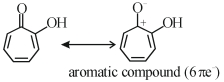
-
- (A) \(\mathrm{A}\) सही है परन्तु \(\mathrm{R}\) गलत है
- (B) \(A\) गलत है परन्तु \(R\) सही है
- (C) \(A\) तथा \(R\) दोनों सही हैं तथा \(R, A\) का सही स्पष्टीकरण है
- (D) \(A\) तथा \(R\) दोनों सही हैं तथा \(R, A\) का सही स्पस्टीकरण नहीं है
उत्तर और हल देखें
सही उत्तर: (C)
Assertion \(- A\) : Benzene is more stable than cyclohexatriene (True)Reason \(- R :\) Delocalised \(\pi-\) e cloud lies \(B.M.O\) so more attracted by nuclei of carbon atom.
(True and Correct Explanation)
-
- (A) \(CH _3\left( CH _2\right)_4 CH _2 Cl\)
- (B) \(Cl - CH _2-\left( CH _2\right)_4- CH _2- Cl\)
उत्तर और हल देखें
सही उत्तर: (C)
\(n\)-alkanes on heating in this presence of anhydrous \(AlCl _3\) and hydrogen chloride gas isomerise to branched chain alkanes. The major product has one methyl side chain.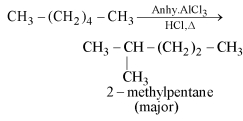
-
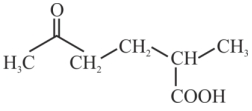
- (A) \(5\)-फॉर्मिल-\(2\)-मेथलहेक्सेन एसिड
- (B) \(2\)-मेथिल-\(5\)-ऑक्सोहेक्सेन एसिड
- (C) \(2\)-फॉर्मिल-\(5\)-मेथिलहेक्सेन-\(6\)-ओइक एसिड
- (D) \(5\)-मेथिल-\(2\)-ऑक्सोहेक्सेन-\(6\)-ओइक एसिड
उत्तर और हल देखें
सही उत्तर: (B)
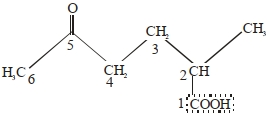
IUPAC NAME\(2-\)Methyl\(-5-\)oxohexanoic acid
-
- (A) \(41\)
- (B) \(42\)
- (C) \(40\)
- (D) \(38\)
उत्तर और हल देखें
सही उत्तर: (B)
\(\%\) sulphur \(=\frac{32}{233} \times \frac{\text { weight of } BaSO _4 \text { formed }}{\text { weight of organic compound }} \times 100\)\(=\frac{32}{233} \times \frac{1.4439}{0.471} \times 100\)
\(=42.10\)
Nearest integer \(42\)
-
- (A) \(42\)
- (B) \(43\)
- (C) \(48\)
- (D) \(44\)
उत्तर और हल देखें
सही उत्तर: (D)
weight of \(C\) in \(0.792\,gm CO _2\)\(=\frac{12}{44} \times 0.792=0.216\)
\(\% \text { of } C \text { in compound }=\frac{0.216}{0.492} \times 100\)
\(=43.90 \%\)
Ans:\(44\)
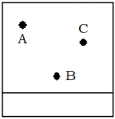
- 235. एक मिश्रण की पतली परत क्रोमेटोग्राफी निम्नलिखित प्रेक्षण दर्शाती है: सिलिका जेल कॉलम क्रोमेटोग्राफी में निक्षालन का सही क्रम है
 2023 मध्यम
- (A) \(A,C,B\)
- (B) \(B,C,A\)
- (C) \(C,A,B\)
- (D) \(B,A,C\)
उत्तर और हल देखें
सही उत्तर: (A)
According to the observation,\(A\) is more mobile and interacts with the mobile phase more than \(C\), and \(C\) is more drawn to the mobile phase than \(B\).Hence, the correct order of elution in the silico gel column chromatography is \(- B < C < A\)

-
- (A) \(20\)
- (B) \(30\)
- (C) \(50\)
- (D) \(40\)
उत्तर और हल देखें
सही उत्तर: (D)
mole of \(AgBr =\frac{0.376}{188}\)mole of \(Br ^{-}=\)mole of \(AgBr =\frac{0.376}{188}\)
mass of \(Br ^{-}=\frac{0.376}{188} \times 80\)
\(\%\) of \(Br ^{-}=\frac{0.376 \times 80}{188 \times 0.4} \times 100=40 \%\)
-
- (A) \(10\)
- (B) \(11\)
- (C) \(12\)
- (D) \(13\)
उत्तर और हल देखें
सही उत्तर: (B)
Percentage of Carbon\(=\frac{12}{44} \times \frac{\text { mass of } CO _2 \text { formed }}{\text { mass of compound taken }} \times 100\)
\(60=\frac{12}{44} \times \frac{\text { mass of } CO _2 \text { formed }}{0.5} \times 100\)
Mass of \(CO _2\) formed \(=\frac{60 \times 44 \times 0.5}{12 \times 100}\,g\)
\(=1.1 \text { gram }\)
\(=11 \times 10^{-1} \text { gram }\)
-
- (A) \(A-(iii), B-(iv), C-(ii), D-(i)\)
- (B) \(A-(i), B-(iii), C-(ii), D-(iv)\)
- (C) \(A-(ii), B-(iii), C-(iv), D-(i)\)
- (D) \(A-(ii), B-(iv), C-(i), D-(iii)\)
उत्तर और हल देखें
सही उत्तर: (C)
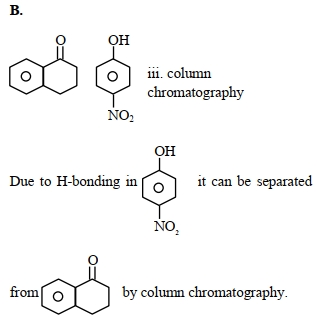
\(A\). \(H _2 O / CH _2 Cl _2 \rightarrow\) \(ii\), \(CH _2 Cl _2> H _2 O\) (density) so they can be separated by differential solvent extraction.\(B\).\(C.\) Kerosene / Naphthalene \(\rightarrow\) iv. Fractional distillation.
Due to different B.P. of kerosene and Naphthalene it can be separated by fractional distillation.
\(D.\) \(C _6 H _{12} O _6 / NaCl \rightarrow\) i. Crystallization.
\(NaCl\) (ionic compound) can be crystallized.
-
- (A) निम्न \(\mathrm{R}_{\mathrm{f}}\), दुर्बल अधिशोषण
- (B) उच्च \(R _{ f }\), stronger adsorption
- (C) उच्च \(R_f\), दुर्बल अधिशोषण
- (D) निम्न \(\mathrm{R}_{\mathrm{f}}\), प्रबल अधिशोषण
उत्तर और हल देखें
सही उत्तर: (D)
If any component eluted second then it means that its \(R_f\) value is low and its adsorption is stronger\(R _{ f }=\frac{\text { distance covered by substance from base line }}{\text { total distance covered by solvent from base line }}\)
-
- (A) गतिशील प्रावस्था में उपस्थित जल को पेपर द्वारा अवशोषित किया जाता है, जो अब स्थिर प्रावस्था का कार्य करता है।
- (B) पेपर के छिद्रों में उपस्थित जल स्थिर प्रावस्था का कार्य करता है।
- (C) पेपर शीट स्थिर प्रावस्था का कार्य करता है।
- (D) पेपर एवं उसके छिद्रों में उपस्थित जल स्थिर प्रावस्था का कार्य करता है।
उत्तर और हल देखें
सही उत्तर: (B)
In paper chromatography, a special quality paper known as chromatography paper is used. Paper contains water trapped in it, which acts as the stationary phase. - 241. फेरस अमोनियम सल्फेट के निर्माण के दौरान लम्बे समय तक गर्म करने से बचा जाता है जिंससे : 2023 कठिन
- (A) ऑक्सीकरण से बचा जा सके
- (B) अपचयन से बचा जा सके
- (C) जल अपघटन से बचा जा सके
- (D) टूटने से बचा जा सके
उत्तर और हल देखें
सही उत्तर: (A)
Prolonged heating will cause oxidation of \(Fe ^{+2}\) to \(Fe ^{+3}\). -
- (A) \(A-IV, B-I, C-III, D-II\)
- (B) \(A-III, B-IV, C-I, D-II\)
- (C) \(A-II, B-I, C-III, D-IV\)
- (D) \(A-III, B-I, C-IV, D-II\)
उत्तर और हल देखें
सही उत्तर: (B)
List \(I\) (Mixture) List \(II\) (Separation Technique) \(A\) \(CHCl _3+ C _6 H _5 NH _2\) \(I\) Distillation \(B\) \(C _6 H _{14}+ C _5 H _{12}\) \(II\) Fractional distillation \(C\) \(C _6 H _5 NH _2+ H _2 O\) \(III\) Steam distillation \(D\) Organic compound in \(H _2 O\) \(IV\) Differential extraction NCERT \((XI)\) Vol. \(2\) Page No. \(359, 360. \)
-
- (A) \(A-II, B-IV, C-I, D-III\)
- (B) \(A-IV, B-II, C-I, D-III\)
- (C) \(A-II, B-I, C-IV, D-III\)
- (D) \(A-III, B-I, C-IV, D-II\)
उत्तर और हल देखें
सही उत्तर: (D)
Nitrogen detection by lassaigne's method\(Na + C + N \rightarrow NaCN\)
\(6 NaCN + FeSO _4 \rightarrow Na _4\left[ Fe ( CN )_6\right]+ Na _2 SO _4\)
\(Na _4\left[ Fe ( CN )_6\right]+ Fe ^{3+} \rightarrow Fe _4\left[ Fe ( CN )_6\right]_3\)
(Prussian blue)
Sulphur detection by Sodium nitroprusside
\(Na _2\left[ Fe ( CN )_5 NO \right]+ Na _2 S \rightarrow Na 4\left[ Fe ( CN )_5 NOS \right]\)
\(\text { [Purple }]\)
Phosphorus detection by ammonium molybdate
\(Na _3 PO _4+3 HNO _3 \rightarrow H _3 PO _4+3 NaNO _3\)
\(H _3 PO _4+12\left( NH _4\right)_2 MoO _4+21 HNO _3 \rightarrow\)
\(\left( NH _4\right)_3 PO _4 .12 MoO _3+21 NH _4 NO _3+12 H _2 O\)
\(\text { (canary yellow) }\)
\(\text { Halogen give specific coloured ppt with }\)
\(AgNO _3( aq )\)
\(NaCl + AgNO _3( aq ) \rightarrow AgCl + NaNO _3\)
\(\text { (White) }\)
\(NaBr + AgNO _3( aq ) \rightarrow AgBr + NaNO _3\)
\(\text { (Pale yellow) }\)
\(NaI + AgNO _3( aq ) \rightarrow AgI + NaNO _3\)
\(\text { (Yellow) }\)
-
- (A) \(24\)
- (B) \(25\)
- (C) \(23\)
- (D) \(22\)
उत्तर और हल देखें
सही उत्तर: (B)
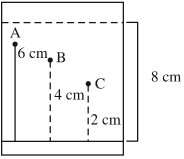
More \(R _{ f }\), less its polarity\(R _{ f }=\frac{\text { Distance travelled by compound ' } X \text { ' }}{\text { Distance travelled by solvent ' } Y '}\)
\(=\frac{2}{8}=0.25=25 \times 10^{-2}\)
-
- (A) \(61\)
- (B) \(60\)
- (C) \(62\)
- (D) \(63\)
उत्तर और हल देखें
सही उत्तर: (B)
\(W _{ NH _3}=\frac{131.8 \times 1000}{112} \times 3 \times 17\)\(=60\,Kg\)

-
- (A) \(A-III, B-II, C-I, D-IV\)
- (B) \(A-III, B-I, C-IV, D-II\)
- (C) \(A-I, B-II, C-III, D-IV\)
- (D) \(A-III, B-I, C-II, D-IV\)
उत्तर और हल देखें
सही उत्तर: (D)
\(HVZ\) reactions \(= Br _2 / \operatorname{red} P\)Iodoform reaction \(= NaOH + I _2\)
Etard reaction \(=\) (i) \(CrO _2 Cl _2, CS _2\) (ii) \(H _2 O\)
Gatterman-Koch Reaction \(= CO , HCl\), Anhydrous, \(AlCl _3\)
-
- (A) \(\mathrm{A}\) और \(\mathrm{R}\) दोनों सही हैं परन्तु \(\mathrm{R}, \mathrm{A}\) की सही व्याख्या नहीं है।
- (B) \(A\) सत्य है परन्तु \(R\) असत्य है
- (C) \(\mathrm{A}\) असत्य है परन्तु \(\mathrm{R}\) सत्य है
- (D) \(\mathrm{A}\) और \(\mathrm{R}\) दोनों सही है और \(\mathrm{R}, \mathrm{A}\) की सही व्याख्या है।
उत्तर और हल देखें
सही उत्तर: (C)
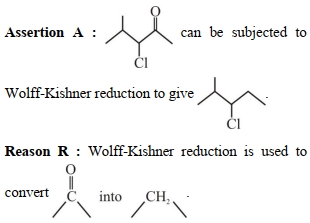
Wolff-Kishner reduction is not suitable for base sensitive group.
-
- (A) प्रकाशिक सक्रिय है और ब्रोमीन का एक मोल संकलित कर लेता है।
- (B) रेसिमिक मिश्रण है और उदासीन है।
- (C) रेसिमिक मिश्रण है और \(\mathrm{NaHCO}_3\) के संतृप्त विलयन से एक गैस देता है।
- (D) प्रकाशिक सक्रिय ऐल्कोहॉल है तथा उदासीन है।
उत्तर और हल देखें
सही उत्तर: (C)
Carboxylic acid will give \(CO _2\) gas, with \(NaHCO _3\) solution
-
- (A) केवल \(a\)
- (B) केवल \(c\)
- (C) \(a\) तथा \(c\) दोनों
- (D) केवल \(b\)
उत्तर और हल देखें
सही उत्तर: (A)
Most easily deprotonation
-
- (A) \(4\)
- (B) \(5\)
- (C) \(6\)
- (D) \(3\)
उत्तर और हल देखें
सही उत्तर: (D)
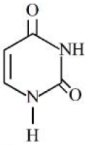
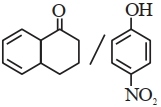
Compound \(2,3,7\)



इस पेज पर इन फ़िल्टर से कोई प्रश्न नहीं मिला।