


Questions
4 questionsShowing 1–4 of 4 questions
- 1. In the presence of peroxide, \(HCl\) and \(HI\) do not give anti-Markownikoff's addition of alkenes because 2014 Hard
- (A) One of the steps is endothermic in \(HCl\) and \(HI\)
- (B) Both \(HCl\) and \(HI\) are strong acids
- (C) \(HCl\) is oxidizing and the \(HI\) is reducing
- (D) All the steps are exothermic is \(HCl\) and \(HI\)
Show answer and solution
Correct Answer: (A)
Anti-Markownikoff addition is possible only in case of \(HBr\) and not in \(HCl\) and \(HI\). In \(HBr\) both the chain initiation and propagation steps are exothermic, while in \(HCl,\) first step is Exothermic, and second step is endothermic and in \(HI,\) no step is exothermic. Hence \(HCl\) and \(HI\) do not undergo anti-Markownikoff's addition. - 2. The major product obtained in the photo catalysed bromination of \(2-\) methylbutane is 2014 Hard
- (A) \(1-\) bromo \(-2-\) methylbutane
- (B) \(1-\) bromo \(-3-\) methylbutane
- (C) \(2-\) bromo \(-3-\) methylbutane
- (D) \(2-\) bromo \(-2-\) methylbutane
Show answer and solution
Correct Answer: (D)
The order of substituion in different alkanes is\(3^o > 2^o > 1^o\)
Thus the bromination of \(2-\) methyl butane mainly gives \(2-\) Bromo \(-2-\) methyl butane
\(\mathop {\begin{array}{*{20}{c}}
{\,\,\,\,\,\,\,\,\,\,\,\,\,\,\,C{H_3}} \\
{\,\,\,\,\,\,\,\,\,\,\,\,\,\,|\,\,\,\,} \\
{C{H_3} - C{H_2} - CH - C{H_3}}
\end{array}}\limits_{2 - methyl\,bu\tan e} \xrightarrow{{B{r_2}}}\)\(\mathop {\mathop {\begin{array}{*{20}{c}}
{\,\,\,\,\,\,\,\,\,\,C{H_3}} \\
{\,\,\,\,\,|} \\
{C{H_3} - C{H_2} - CH - C{H_2}Br}
\end{array}}\limits_{1 - Bromo - 2\,methyl\,bu\tan e} }\limits_{(\min or)} \) \(+\) \(\underset{\begin{smallmatrix}
2-Bromo-2-methyl\,bu\tan e \\
\,\,\,\,\,\,\,\,\,\,\,\,\,\,\,\,\,\,\,\,\,\,\,\,\,\,\,(major)
\end{smallmatrix}}{\mathop{\begin{matrix}
\,\,\,\,\,\,\,\,\,\,\,\,\,\,\,\,\,\,\,C{{H}_{3}} \\
\,\,\,\,\,\,\,\,\,\,\,\,\,\,\,| \\
C{{H}_{3}}-C{{H}_{2}}-C-C{{H}_{3}} \\
\,\,\,\,\,\,\,\,\,\,\,\,\,\,\,| \\
\,\,\,\,\,\,\,\,\,\,\,\,\,\,\,\,Br \\
\end{matrix}}}\,\) -
- (A) Cat. Hydrogenation
- (B) \(H_2/\) Lindlar Cat.
- (C) \(Li/NH_3\)
- (D) \(LiAlH_4\)
Show answer and solution
Correct Answer: (C)
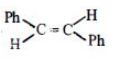
With Lithium in liquid ammonia, trans-alkene is almost an exclusive product.\(Ph-C\equiv C-Ph\xrightarrow[Brich\,reduction]{Li\,in\,liq.N{{H}_{3}}}\begin{matrix}
^{Ph} \\
_{H} \\
\end{matrix}\begin{matrix}
\text{ }\!\!\backslash\!\!\text{ } \\
/ \\
\end{matrix}C=C\begin{matrix}
/ \\
\text{ }\!\!\backslash\!\!\text{ } \\
\end{matrix}_{Ph}^{H}\) - 4. Which one of the following class of compounds is obtained by polymerization of acetylene? 2014 Hard
- (A) Poly-yne
- (B) Poly-ene
- (C) Poly-ester
- (D) Poly-amine
Show answer and solution
Correct Answer: (B)
Poly-ene. e.g\(\mathop {3CH \equiv CH}\limits_{acetylene} \to \mathop {{C_6}{H_6}}\limits_{Benzene} \)
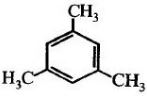
\(\mathop {3C{H_3} - C \equiv CH}\limits_{\Pr opyne} \to \) (figure)
No questions on this page match these filters.