


JEE Mains · Chemistry · STD 12 - Co-ordination chemistry
- JEE Mains 2026
- Hard
- MCQ
Consider the metal complexes \([Ni(en)_3]^{2+}\) (A), \([NiCl_4]^{2-}\) (B) and \([Ni(NH_3)_6]^{2+}\) (C). Choose the CORRECT option by considering the number of unpaired electrons present in (A), (B) and (C) respectively and the order of frequency of absorption.
Pick an option to check your answer.
Answer & Solution
Correct Answer
(A) \(2, 2, 2\) and \((A)>(C)>(B)\)
Step-by-step Solution
Detailed explanation
The oxidation state of \(Ni\) in all three complexes is \(+2\). The electronic configuration of \(Ni^{2+}\) is \([Ar] 3d^{8}\).
In \([Ni(en)_3]^{2+}\) (A), the coordination number is \(6\) (octahedral geometry). The \(d^{8}\) configuration in an octahedral field is \(t_{2g}^{6} e_{g}^{2}\), which has \(2\) unpaired electrons.
In \([NiCl_4]^{2-}\) (B), the coordination number is \(4\) with weak field \(Cl^{-}\) ligands (tetrahedral geometry). The \(d^{8}\) configuration in a tetrahedral field is \(e^{4} t_{2}^{4}\), which has \(2\) unpaired electrons.
In \([Ni(NH_3)_6]^{2+}\) (C), the coordination number is \(6\) (octahedral geometry). The \(d^{8}\) configuration in an octahedral field is \(t_{2g}^{6} e_{g}^{2}\), which has \(2\) unpaired electrons.
Thus, the number of unpaired electrons in (A), (B), and (C) are \(2, 2,\) and \(2\) respectively.
The frequency of absorption of light is directly proportional to the crystal field splitting energy (\(\Delta\)).
According to the spectrochemical series, the field strength of the ligands follows the order: \(en > NH_3 > Cl^{-}\).
Furthermore, the crystal field splitting energy for octahedral complexes is significantly greater than that for tetrahedral complexes (\(\Delta_o = \dfrac{9}{4}\Delta_t\)).
Therefore, the order of crystal field splitting energy, and hence the frequency of absorption, is \([Ni(en)_3]^{2+} > [Ni(NH_3)_6]^{2+} > [NiCl_4]^{2-}\), which corresponds to \((A) > (C) > (B)\).
Answer: \(2, 2, 2\) and \((A)>(C)>(B)\)
More questions from Chemistry
- The compounds which give positive Fehling's test are :
(A)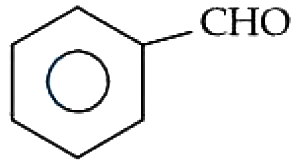
(B)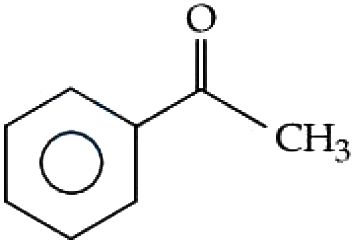
(C) \(\mathrm{HOCH}_2-\mathrm{CO}-(\mathrm{CHOH})_3-\mathrm{CH}_2-\mathrm{OH}\)
(D)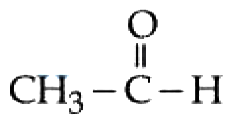
(E)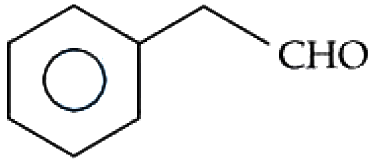
Choose the correct answer from the options given below :JEE Mains 2025 Medium - Half life of zero order reaction \(\mathrm{A} \rightarrow\) product is 1 hour, when initial concentration of reaction is \(2.0 \mathrm{~mol} \mathrm{~L} \mathrm{~L}^{-1}\). The time required to decrease concentration of A from 0.50 to \(0.25 \mathrm{~mol} \mathrm{~L}^{-1}\) is _______.JEE Mains 2025 Easy
- At \(300\, K\), the vapour pressure of a solution containing \(1\) mole of \(n-\)hexane and \(3\) moles of \(n-\)heptane is \(550\, mm\) of \(Hg\). At the same temperature, if one more mole of n-heptane is added to this solution, the vapour pressure of the solution increases by \(10\, mm\) of \(Hg\). What is the vapour pressure in \(mm Hg\) of \(n-\)heptane in its pure state..........\(?\)JEE Mains 2020 Medium
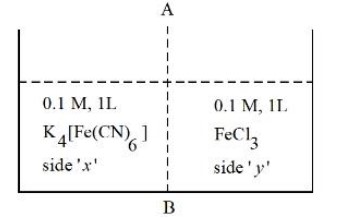
- At \(27°\)C, \(0.1\) M, \(1\) L \(K_4[Fe(CN)_6]\) aqueous solution and \(0.1\) M, \(1\) L \(FeCl_3\) aqueous solution are placed in a container separated by a semi permeable membrane AB. Assume complete dissociation of both the solutes. Which of the following statement is correct?
 JEE Mains 2026 Hard
- A \(6.50\) molal solution of \(KOH\) \((aq.)\) has a density of \(1.89\, g\, cm ^{-3}\). The molarity of the solution is .......... \(mol\, dm ^{-3} .\) (Round off to the Nearest Integer). [Atomic masses: \(K : 39.0\, u ; O : 16.0 \,u ; H : 1.0\, u ]\)JEE Mains 2021 Medium
- By usual analysis, 1.00g of compound (X) gave 1.79g of magnesium pyrophosphate. The percentage of phosphorus in compound (X) is: (nearest integer)
(Given, molar mass in \(g~mol^{-1}\); O=16, Mg=24, P=31)JEE Mains 2026 Easy
More PYQs from JEE Mains
- A convex lens of focal length \(40 \mathrm{~cm}\) forms an image of an extended source of light on a photoelectric cell. A current I is produced. The lens is replaced by another convex lens having the same diameter but focal length \(20 \mathrm{~cm}\). The photoelectric current now is:JEE Mains 2024 Hard
- Given below are two statements: one is labelled as Assertion \(A\) and the other is labelled as Reason \(R\) Assertion \(A:\) The binding energy per nucleon is practically independent of the atomic number for nuclei of mass number in the range \(30\) to \(170\). Reason \(R\) : Nuclear force is short ranged. In the light of the above statements, choose the correct answer from the options given below onJEE Mains 2023 Medium
- Match the LIST-I with LIST-II.
LIST-I (Molecule/ion) LIST-II Bond pair : lone pair (on the central atom) (A) ICl2- (I) 4 : 2 (B) H2O (II) 4 : 1 (C) SO2 (III) 2 : 3 (D) XeF4 (IV) 2 : 2
Choose the correct answer from the options given below :JEE Mains 2025 Easy - The reaction \(X \to Y\) is an exothermic reaction . Activation energy of the reaction for \(X\) into \(Y\) is \(150\,kJ\,mol^{-1}\) . Enthalpy of reaction is \(135\,kJ\,mol^{-1}\) . The activation energy for the reverse reaction, \(Y \to X\) will be.......\(kJ\,mol^{-1}\)JEE Mains 2013 Hard
- A galvanometer having a coil resistance \(100 \;\Omega\) gives a full scale deflection when a current of \(1 \;\mathrm{mA}\) is passed through it. What is the value of the resistance which can convert this galvanometer into a voltmeter giving full scale deflection for a potential difference of \(10\; \mathrm{V} ?\)......\(k\Omega\)JEE Mains 2020 Medium
- \(n-\) \(moles\) of an ideal gas with constant volume heat capacity \(C_v\) undergo an isobaric expansion by certain volume. The ratio of the work done in the process, to the heat supplied isJEE Mains 2019 Medium