


JEE Mains · Chemistry · STD 12 - Co-ordination chemistry
- JEE Mains 2025
- Medium
- MCQ
An octahedral complex having molecular composition Co. \(5 \mathrm{NH}_3. \mathrm{Cl}. \mathrm{SO}_4\) has two isomers A and B. The solution of A gives a white precipitate with \(\mathrm{AgNO}_3\) solution and the solution of B gives white precipitate with \(\mathrm{BaCl}_2\) solution. The type of isomerism exhibited by the complex is which?
Pick an option to check your answer.
Answer & Solution
Correct Answer
(C) Ionisation isomerism
Step-by-step Solution
Detailed explanation
(A) complex is \(\left[\mathrm{Co}\left(\mathrm{NH}_3\right)_5\left(\mathrm{SO}_4\right)\right] \mathrm{Cl}\)
(B) complex is \(\left[\mathrm{Co}\left(\mathrm{NH}_3\right)_5 \mathrm{Cl}\right] \mathrm{SO}_4\)
Both \((\mathrm{A})\) and \((\mathrm{B})\) are Ionisation isomers.
More questions from Chemistry
- Consider the reaction \(aX \rightarrow bY\), for which the rate constant at \(30°C\) is \(1 \times 10^{-3}\) mol\(^{-1}\) L s\(^{-1}\). Which of the following statements are true?
A. When concentration of 'X' is increased to four times, the rate of reaction becomes \(16\) times.
B. The reaction is a second order reaction.
C. The half-life period is independent of the concentration of X.
D. Decomposition of \(N_2 O_5\) is an example of the above reaction.
E. \(\ln\dfrac{[R_o]}{[R]}\) vs time is valid for the above reaction.
Choose the correct answer from the options given below:JEE Mains 2026 Medium - In the structure of the dichromate ion, there is a :JEE Mains 2021 Easy
- \(2 IO _3^{-}+ xI ^{-}+12 H ^{+} \rightarrow 6 I _2+6 H _2 O\) What is the value of \(x\) ?JEE Mains 2023 Easy
- The unsaturated ether acidic hydrolysis produces carbonyl compounds as shown below :-
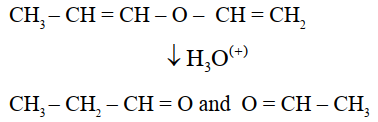
Based on this, predict the solution / reagent that will help to distinguish "P" and "Q" obtained in the following reaction. JEE Mains 2026 Medium
- The correct order for acidity of the following hydroxyl compound is: Choose the correct answer from the options given below:
 JEE Mains 2023 Medium
- For the equilibrium \(2{H_2}O \rightleftharpoons {H_3}{O^ + } + O{H^ - }\) , the value of \(\Delta {G^o}\) at \(298\,K\) is approximately .......\(kJ\,mol^{-1}\)JEE Mains 2019 Medium
More PYQs from JEE Mains
- Two liquids A and B form an ideal solution at temperature T K. At T K, the vapour pressures of pure A and B are 55 and 15 \(kNm^{-2}\) respectively. What is the mole fraction of A in solution of A and B in equilibrium with a vapour in which the mole fraction of A is 0.8 ?JEE Mains 2026 Easy
- Two beams of light having intensities \(I\) and \(4\,I\) interfere to produce a fringe pattern on a screen. The phase difference between the two beams are \(\pi / 2\) and \(\pi / 3\) at points \(A\) and \(B\) respectively. The difference between the resultant intensities at the two points is \(x I\). The value of \(x\) will be.JEE Mains 2022 Medium
- In the Claisen-Schmidt reaction to prepare, dibenzalacetone from 5.3 g of benzaldehyde, a total of 3.51 g of product was obtained. The percentage yield in this reaction was ______ %.JEE Mains 2025 Medium
- A collimated beam of light of diameter 2 mm is propagating along x -axis. The beam is required to be expanded in a collimated beam of diameter 14 mm using a system of two convex lenses. If first lens has focal length 40 mm , then the focal length of second lens is _________ mm.JEE Mains 2026 Medium
- Which one of the following lanthanoids does not form \(MO _{2} ?\) [\(M\) is lanthanoid metal]JEE Mains 2021 Easy
- A bead \(P\) sliding on a frictionless semi-circular string \((A C B)\) and it is at point \(S\) at \(t =0\) and at this instant the horizontal component of its velocity is \(v\). Another bead \(Q\) of the same mass as \(P\) is ejected from point \(A\) at \(t =0\) along the horizontal string \(A B\), with the speed \(v\), friction between the beads and the respective strings may be neglected in both cases. Let \(t_p\) and \(t_Q\) be the respective times taken by beads \(P\) and \(Q\) to reach the point \(B\), then the relation between \(t_p\) and \(t_Q\) is
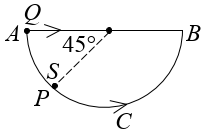 JEE Mains 2026 Hard